From System Parameters to Flares: Radiation Hydrodynamics of Star-Disk Collisions ✛
Context
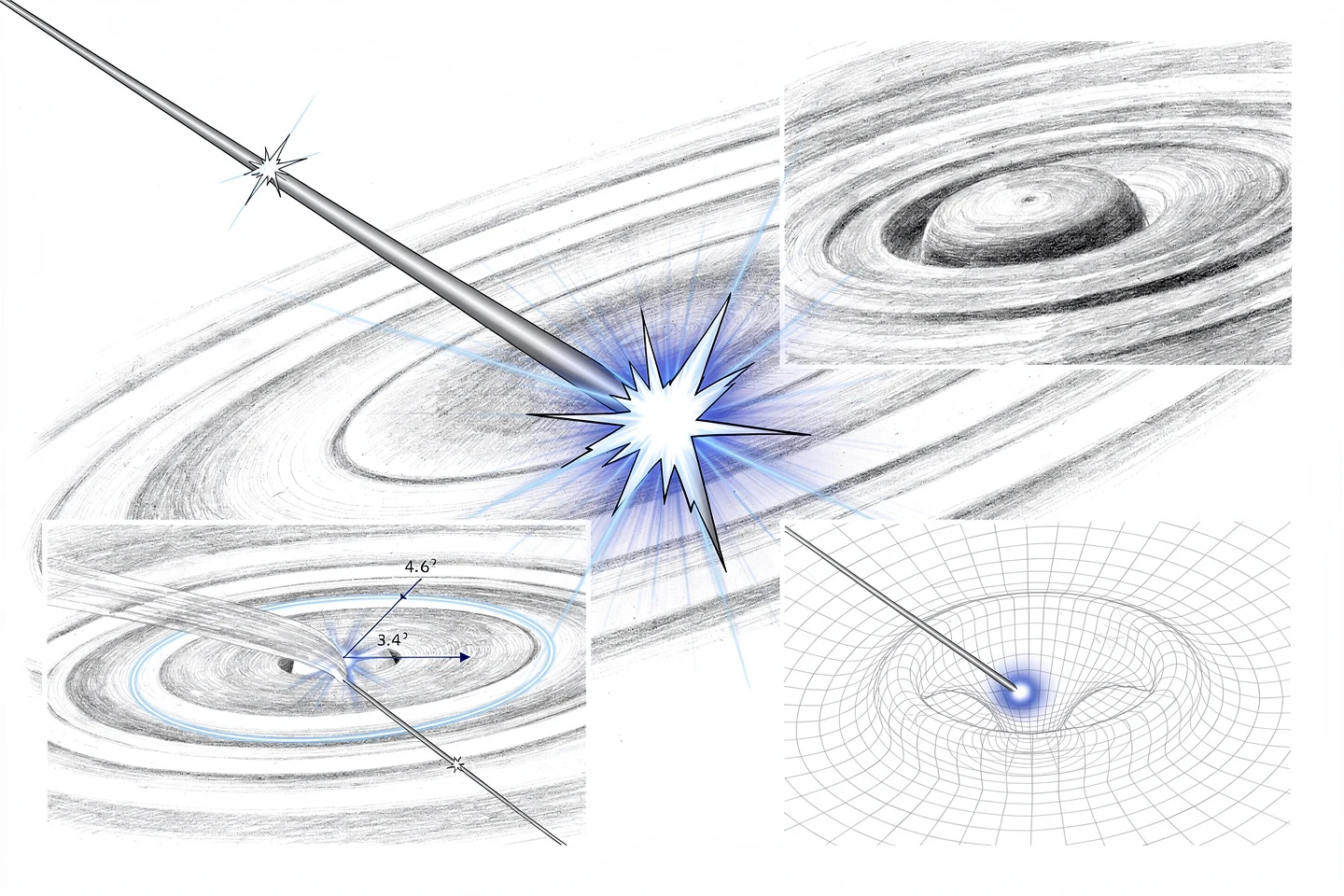
Quasi-periodic eruptions (QPEs)—a recently discovered class of nuclear transients linked to supermassive black holes—appear as bright recurrent X-ray flares with a still-mysterious mechanism. A model in which a star periodically crosses the accretion disk offers a natural explanation for the recurrence, duration, and alternation of bright and dim flares. Connecting local collision parameters—disk density, speed, and impact angle—to observed emission properties is crucial for testing this hypothesis and for future detection of such systems via gravitational waves with space-based interferometers. It has long been clear that matter’s behavior near the Schwarzschild radius requires accounting for both hydrodynamics and radiative transfer.
Methods
The researchers performed a series of 3D local simulations based on smoothed particle hydrodynamics (SPH) with radiation diffusion in the flux-limited diffusion approximation. The star was modeled as a rigid sphere crossing a local patch of the accretion disk at speeds up to 0.1 the speed of light. Five key parameters were varied: star speed, disk surface density, stellar radius, vertical density profile (from uniform to Gaussian with various dispersions), and local impact angle. For each configuration, the dynamics of the shock and ejecta were computed, along with the bolometric emission emerging through the photosphere.
Results
The analysis revealed the following patterns. Increasing the star speed (up to 0.15 the speed of light) boosts peak luminosity ($L_{peak}$ ∝ $v^2$) and flare duration but does not alter shock morphology. Denser disks (with surface density $Σ_d$ up to 100 times the fiducial value) prolong flares (Δt ∝ $Σ_d^0$.5) while only weakly affecting peak luminosity. A larger stellar radius enhances ejecta asymmetry: the forward flow becomes dominant, and its luminosity scales as R_⋆^1.5. Disks with a vertically concentrated profile (Gaussian distribution with dispersion σ) produce brighter and shorter flares due to efficient radiation escape through tenuous outer layers. Decreasing the local impact angle i (from 90° to 30°) reduces the momentum asymmetry of the two ejecta and lengthens the flares; for the reverse flow, $L_{peak}$ ∝ (sin i)^-0.8. Applying these empirical scalings to the source GSN 069 showed the best match is achieved for a star with radius ~R_⊙ on a retrograde orbit (sin i ~ 0.4) and a dense post-tidal-disruption disk concentrated toward the midplane.
Implications
These results for the first time systematically connect local physical collision conditions with global observational properties of QPEs, paving the way to use these flares to probe accretion disk structure near supermassive black holes. The discovered dependence of brightness asymmetry on impact angle positions QPEs as a potential tool for determining orbital geometry and density distributions in disks, which could be refined by future high-resolution spectroscopy in the X-ray band.
Future development
Future model development will incorporate a realistic stellar structure, disk rotation and shear, and directional luminosities for different viewing angles. This will refine predictions for specific sources and lay the groundwork for interpreting data from upcoming missions like Athena. Moreover, concurrent detection of gravitational waves from such systems by next-generation laser interferometers will allow independent measurement of orbital parameters.
Impact
The results will impact high-energy astrophysics, accretion theory, and the dynamics of relativistic objects, as well as the planning of observing campaigns in the X-ray and gravitational-wave bands.
Next steps
Next steps include running simulations with more realistic equations of state, incorporating general relativistic effects, and developing semi-analytic models for rapid estimation of QPE parameters from observational data.
Key open problems
The study is directly linked to the unsolved problem of fueling active galactic nuclei and variability mechanisms in accretion disks. It also provides insight into the evolution of stellar populations in the vicinity of supermassive black holes and opens a new way to probe strong gravitational fields.
The knowledge machine's view
This section is addressed to the author of the paper and their colleagues. Neighbouring works were found by meaning-based search across our archive, not by word overlap. We do not review: we show the field around the work.
What the work does
You ran a series of three-dimensional local SPH simulations with radiative diffusion, modeling the star as a rigid sphere crossing a patch of the accretion disk. By varying the speed, disk density, stellar radius, vertical profile, and impact angle, you derived empirical scalings for the peak luminosity and duration of the flares. Applying these to GSN 069, you found that the best match is a star of about one solar radius on a retrograde orbit in a dense disk.
Where its strength is
The systematic link between local collision parameters and observed QPE characteristics is a ready-made tool for interpreting future observations. The empirical formulas allow quick estimates of stellar and disk properties from flares, without resorting to expensive simulations.
Where it could go next
- It might be interesting to see how your scalings align with models where the star is not point-like but undergoes tidal disruption at each passage—there is an analysis nearby in the archive of the work on the slow tidal disruption of a star.based on: How a Black Hole Slowly Rips a Star Apart arXiv:2603.27132
- Nearby there is a treatment that includes stellar rotation: one study shows that rapid rotation alters flare decay, which could be important for explaining the diversity of QPE light curves.based on: Fading Black Hole Flares: The Key Is the Star's Rapid Spin arXiv:2606.02692v1
- You could try to connect your results with black hole spin estimates: there is a paper in the archive where the flare rhythm is used to measure spin, and your formulas could provide an additional constraint.based on: The Black Hole's Record: Flare Rhythm Reveals Its Spin arXiv:2605.24905
Worth trying
- Test how the scalings change when accounting for disk self-gravity, using the approach from the work on quasi-stars.
- Compare your model's predictions with the observed mode switches in flares described in the work on the cosmic lighthouse.
- Assess how sensitive your formulas are to the presence of double flares, as in the work on the black hole with double flares.
Why this may matter
If the proposed scalings are confirmed on a larger sample of sources, they will become a standard tool for rapid QPE diagnostics and will allow these flares to be used as probes of accretion disk structure in galactic nuclei.
Nearby works in our archive
- The Black Hole's Record: Flare Rhythm Reveals Its Spinsimilarity 0.72
- X-ray Beacons in Galactic Centerssimilarity 0.69
- Black Hole with Double Flashessimilarity 0.68
- Neutron Star's Sleeping Volcano: How Mass, Not Spin, Gives Birth to Magnetic Monsterssimilarity 0.67
- The Cosmic Lighthouse Has Switchedsimilarity 0.66
- How a Black Hole Slowly Rips a Star Apartsimilarity 0.66
- Fading Black Hole Flares: The Key Is the Star's Rapid Spinsimilarity 0.65
The archive is crowded around this work: 7 reviews nearby, closest at 0.72. This ground is well walked — and there is plenty to compare against.
Original abstract
as written by the authors arXiv:2607.05508v1
Quasi-periodic eruptions (QPEs) are nuclear transients producing bright, repeating soft X-ray flares superimposed on quiescent emission. A promising interpretation is that they are powered by star-disc collisions, in which a star crosses an accretion disc around a supermassive black hole, drives shocks, and launches dense outflows from which radiation emerges. We present a systematic study of star-disc collisions, linking the physical parameters of the collision to the resulting outflows and emerging bolometric luminosities. We perform three-dimensional local radiation-hydrodynamics simulations, varying the disc surface density and vertical density profile, stellar velocity and radius, and local collision angle. We focus on the regime where the star remains unperturbed by the collision. We find that the variations of stellar velocity and disc surface density leave the bow shock and outflow morphology largely unchanged. However, faster stars produce brighter flares, while denser discs mainly increase the flare duration. Increasing the stellar radius increases the momentum of the forward outflow and produces brighter and longer flares. More centrally concentrated discs yield brighter and shorter flares because radiation escapes more efficiently through outer low-density layers. More oblique crossings reduce the momentum and luminosity asymmetry of two outflows and lengthen the flares. We provide empirical scalings of the peak luminosity and flare duration with the individual system parameters and apply them to GSN 069. The best candidate solutions favour a star with a radius $$\sim R_\odot$$ on a retrograde orbit, colliding with a dense post-TDE disc with a vertically concentrated density profile. Our findings suggest that specific combinations of system parameters can reproduce characteristic flare amplitudes, durations, duty cycles, and strong-weak flare patterns observed in QPE sources.
If such a star really collided with a disk at 0.1c, the released energy would be enough to momentarily outshine an entire galaxy, and the shock wave would generate temperatures of hundreds of millions of degrees.
The idea of an object periodically plunging into a scorching disk around a black hole recalls scenes from Interstellar, where the protagonists explore Gargantua’s accretion disk, but in reality such collisions produce recurring X-ray flares.
Key numbers
- star speed: 0.05–0.15 c (up to 45,000 km/s)
- peak QPE bolometric luminosity: ~1041–1043 erg/s
- flare duration: tens of minutes to several hours
- QPE period: hours to days
- radiation temperature: 100–200 eV (~1–2 million K)