Mini

Ghostly Duet: Neutrino Decay of a Superluminal Photon

Original: "Lorentz-Violating Photon Decay into Neutrinos and Constraints from PeV Photon Stability"
· Zurab Kepuladze
arXiv:2607.10404 · 2026-07-11 · CC BY · 1 min · HEP Phenomenology High Energy
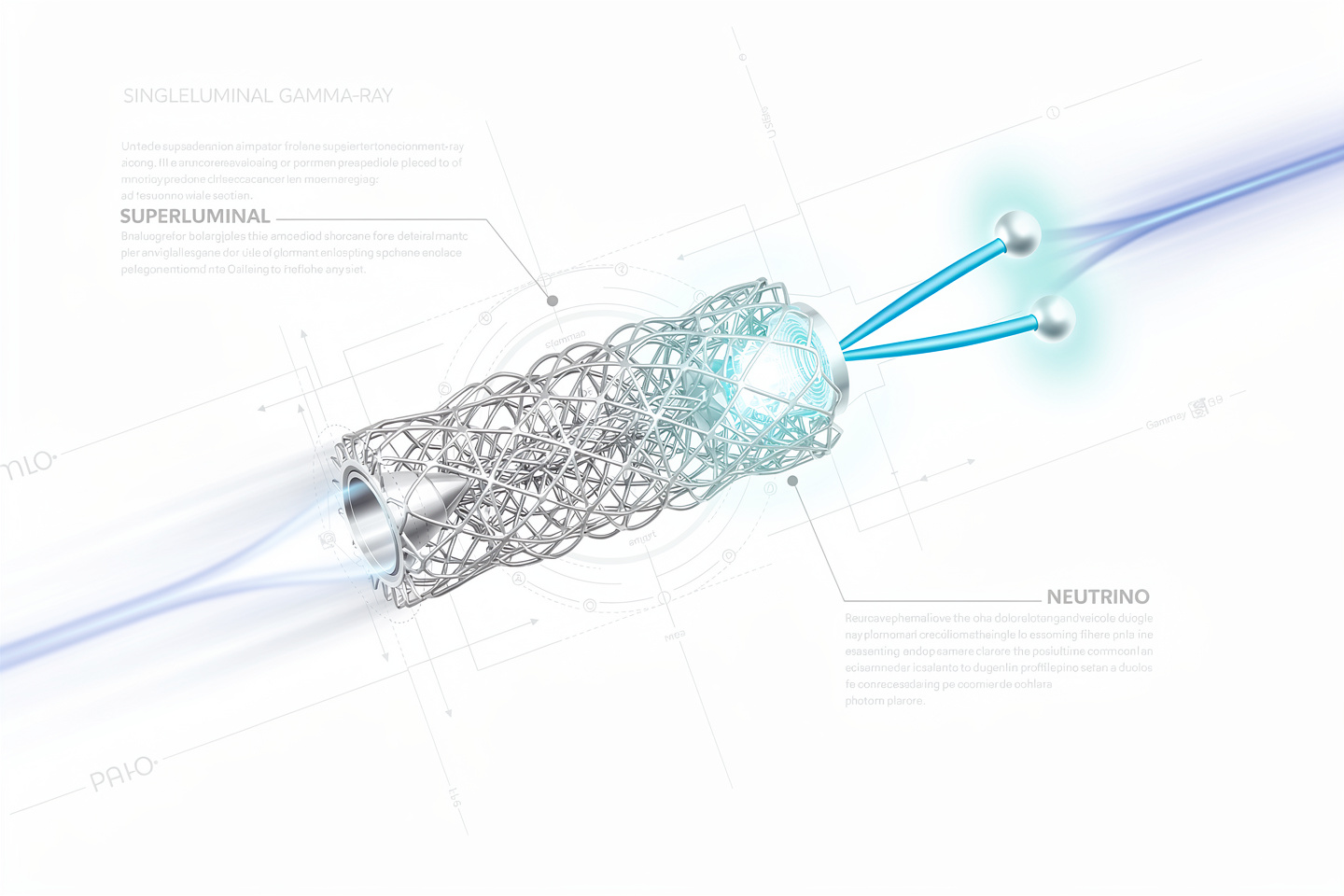
Superluminal gamma quanta from the Crab Nebula may secretly decay into a pair of neutrinos — this ghostly duet pries open a new loophole in Lorentz invariance, a pillar of relativity.
Links in the knowledge graph 1

Photons with energies a billion times higher than visible light may secretly outrun themselves and decay into neutrino pairs. It's like light casting a shadow that steals its own energy. The LHAASO telescope already catches such quanta from the Crab Nebula. Soon, we might notice photons 'going missing' — and then Lorentz invariance, the bedrock of Einstein's theory, will show its first crack.

🎯 The effective mass of a PeV photon at a typical speed shift is only about 10 keV — a hundred times lighter than an electron, yet millions of times heavier than the lightest neutrino. Due to the feebleness of the neutrino interaction, its lifetime stretches billions of years, comparable to the age of Earth. Such a long-lived photon could have existed since the planet formed, never once decaying.

🎬 Imagine a neutrino telescope capturing the shadows of photons: it predicts gamma-ray bursts before the light arrives, working as a cosmic detector of hidden symmetries.

m_{\text{eff}}^2 = \delta E_\gamma^2
The effective mass grows proportionally to the photon energy and the parameter δ, which characterizes the deviation of the speed of light from a constant.
\Gamma_\gamma = \frac{2\alpha}{3} \frac{m_{\text{eff}}^6}{k_0} \sum_{\ell} a_{\nu_\ell}^2
The decay probability depends on the sixth power of the effective mass, making the process extremely sensitive to the magnitude of the violation: even a slight shift δ sharply slows the decay.
Scientists
Christian DopplerD. B. McLaughlinDidier QuelozMichel MayorR. A. RossiterPaul Dirac
Tags
speed of light neutrino Standard Model electromagnetism cosmic rays supernova pulsar Quantum Field photometry
Laws
Doppler effectDirac equationprinciple of constancy of the speed of lightNoether's theoremmass–energy equivalenceMaxwell's equations
Original: arXiv:2607.10404 · CC BY · bridge42worlds