How magnetic particles get entangled on schedule express
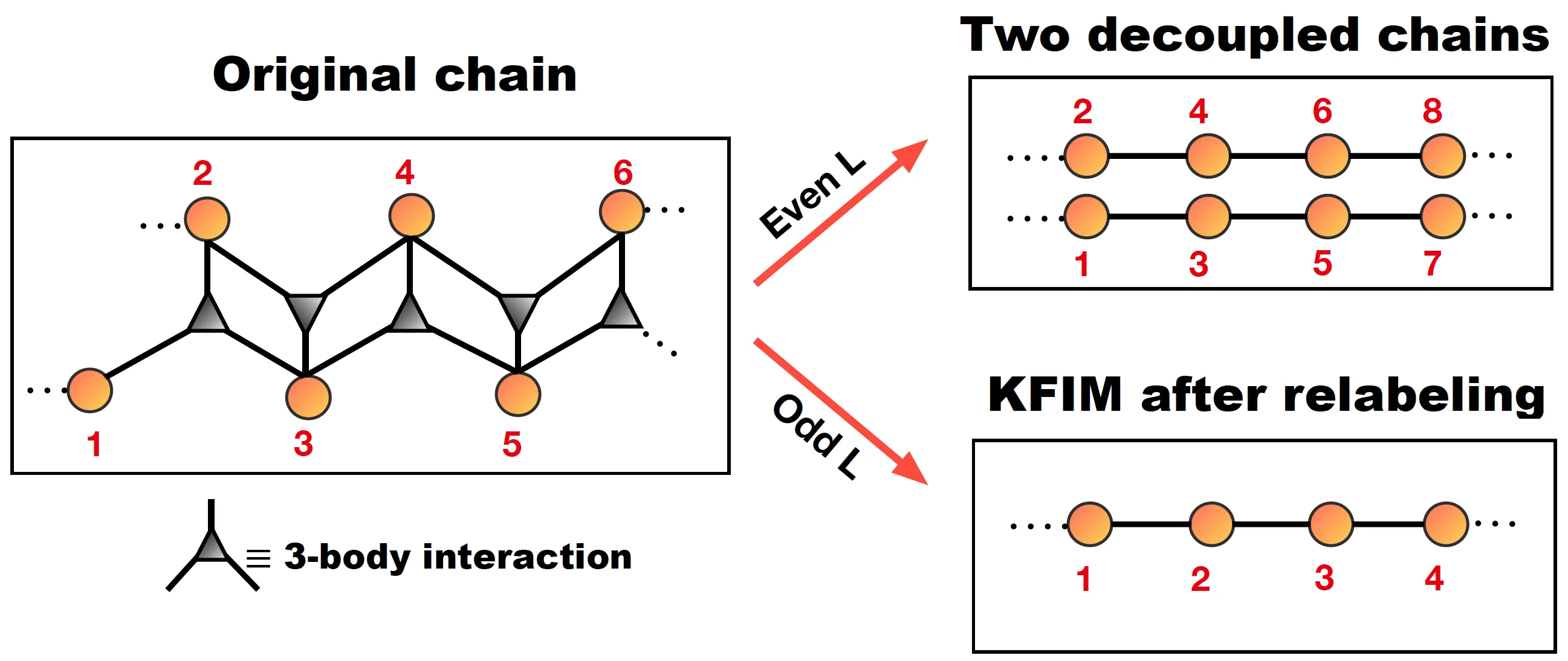
A chain of a hundred tiny magnets lies on a table. Each one can point up or down, like a coin landing heads or tails. But these are not ordinary magnets: they sense each other not just individually but in threes. Three neighboring particles seem to negotiate which way to turn. Once a second, the experimenter shakes the table, and the whole system gets a short kick.
This picture, a spin chain (quantum magnetic moments) with group interactions and periodic kicks, is what the authors of the new study explored. The big surprise: the complex three-body interaction could be recast as a simple pairwise one, but with one key difference. Particles now "see" not only their nearest neighbor but also the one next to that. The interaction range grows by exactly one. Mathematically, this looks like an exact transformation from one set of rules to another — physicists call it a order-to-range mapping.
The practical payoff is predictability. For a whole class of initial states, the authors derived formulas showing how quickly information spreads across the chain. In the three-body interaction example, entanglement grows not smoothly but in jumps, as if the echo from each kick reaches distant particles with a delay. Such exactly solvable models are needed as a testing ground for future quantum computers: you can try out ideas on them without waiting for the hardware to become perfect.
The table with magnets no longer seems chaotic. Each shake is not random noise but a precisely calculated step that moves the system to a new, fully predictable state. And the stronger the kick, the farther the invisible thread between particles reaches.
In spin-chain physics, group interactions (where three or more particles "negotiate" at once) were long considered too complex for exact calculations. This work shows that periodic kicks can turn such a system into a mathematically tame one.
The idea of a precisely controlled quantum system with kicks evokes the "deterministic chaos" from Liu Cixin's "The Three-Body Problem," where periodic influences create a predictable yet highly intricate pattern.