Predictability is a measure of how well a system's future behavior can be known in advance. In physics, it is not an all-or-nothing property but a matter of degree: some systems, like a swinging pendulum, can be forecast far into the future with high accuracy, while others, like the weather, lose reliability after a few days. The concept is central to distinguishing between systems that are deterministic—where the same starting conditions always lead to the same outcome—and those that are chaotic, where tiny differences in initial conditions grow exponentially, making long-term forecasts impossible in practice.
History
The modern understanding of predictability emerged in the late 19th century with Henri Poincaré's work on the three-body problem, where he showed that even simple gravitational systems can be unpredictable. In the 1960s, Edward Lorenz rediscovered this in meteorology, coining the term 'butterfly effect'.
How it works
Predictability depends on two factors: the precision of initial measurements and the system's sensitivity to those measurements. In a stable system, small errors in measurement remain small over time, so forecasts stay accurate. In a chaotic system, errors amplify rapidly, so even minuscule uncertainties—like the flap of a butterfly's wings—soon dominate the outcome. This is quantified by the Lyapunov exponent, which measures how quickly nearby trajectories diverge. When the exponent is positive, the horizon of predictability is finite and often short.
In practice
Predictability limits are used in weather forecasting to set confidence intervals, in climate modeling to distinguish signal from noise, and in engineering to design control systems that remain stable despite uncertainties.
Fun fact
The atmosphere's predictability horizon is roughly two weeks, not because of any fundamental law, but because of the chaotic amplification of measurement errors.
Imagine a huge puzzle where each piece is a quantum particle. To complete the picture, you don't just fit the pieces together: you need to entangle them in a special way. Usually, this is done by carefully applying operations one after another, like assembling the puzzle strictly by the instructions, row by row.
Two pendulums suspended from a single invisible spring swing in a shared air current. One always lags the other by exactly half a period: when the first swings left, the second is already returning from the right. By watching the first, you can tell where the second will be half a period later.
The quantum world plays a strange game with causality. If in everyday life salt is always added to soup before serving, here the ingredients end up in the bowl at the same time, and the chef doesn't remember the order. Physicists asked: can we measure this 'recipe'? The answer is no.
Magnetic fields on the surface of the Sun appear as dark spots and bright faculae. But they are born deep inside, where flows of hot gas act like a giant dynamo. The question is whether sunspots on the surface can predict what will happen inside the star years from now.
The authors applied a mathematical theorem similar to the rule linking the area of a shape to its boundary.
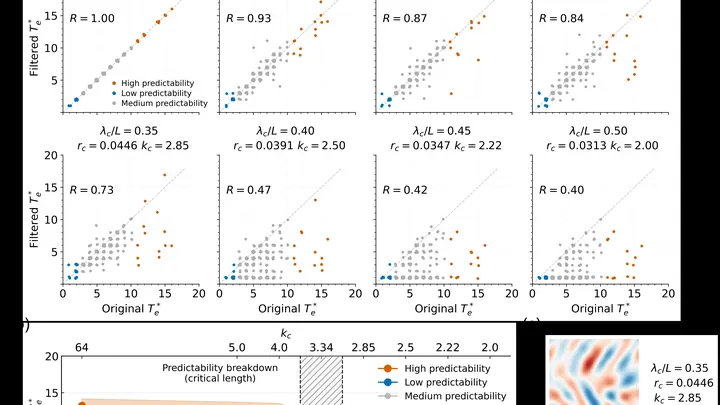
In a turbulent flow, like a raging river, energy constantly cascades from large whirlpools to small ones. Occasionally, particularly powerful bursts occur, resembling sudden waves crashing against the shore. Scientists asked: can we know in advance when such a "wave" will strike? It turns out the answer depends on which vortices are present in the flow at that moment.
A solar panel on a roof produces little current in the morning, a lot at noon, and stays silent at night. Wind doesn't blow randomly either: it's often stronger in the morning and evening than during the day. Energy providers need to know in advance how much energy will be available in an hour or three, so they can switch on backup plants or store electricity in batteries in time.
In 1935, Einstein, Podolsky, and Rosen proposed a thought experiment that, in their view, exposed the incompleteness of quantum mechanics. Two particles fly apart after interacting, and measuring the momentum of one instantly gives exact knowledge of the other's momentum.
Imagine an orchestra playing without a conductor. Each section takes its turn: first the winds introduce the theme, then the strings join in, and sometimes an unexpected percussionist solos.
In the Pacific Ocean, every few years the water off the coast of Peru warms up, and fishermen call it El Niño. Sometimes the warming is mild, sometimes so strong that it changes weather across the entire planet. Forecasting a strong El Niño six months to a year ahead is a task at the edge of possibility: weather is forgotten within two weeks, while climate remembers for decades.
Imagine a map where each patch of ocean is colored with its own shade: in some places the color is saturated, meaning the future of the system is predetermined; in others it is pale, meaning the outcome depends on a random gust of wind.
The Indian summer monsoon feeds a fifth of humanity, but its seasonal forecast has been considered nearly hopeless for decades: the potential predictability limit was estimated at only 45% of explained variability.