A spin chain is a theoretical model consisting of a one-dimensional array of quantum spins — tiny magnetic moments associated with particles like electrons. These models are fundamental in condensed matter physics because they capture the essential physics of magnetism in real materials, while being simple enough to solve or simulate. Spin chains exhibit rich phenomena such as quantum phase transitions, fractional excitations, and exotic states like spin liquids, making them a playground for exploring quantum many-body physics.
History
The concept of spin chains dates back to the 1930s, with the exact solution of the one-dimensional Heisenberg model by Hans Bethe in 1931, which introduced the famous Bethe ansatz. This work laid the foundation for the study of integrable quantum systems.
How it works
In a spin chain, each site hosts a spin that can point up or down (or in a superposition). The spins interact with their neighbors through exchange couplings, which can be ferromagnetic (aligning spins) or antiferromagnetic (anti-aligning them). The quantum nature of the spins allows for entanglement and superposition, leading to collective behaviors that cannot be understood from individual spins alone. For example, in an antiferromagnetic chain, the ground state is not a simple alternating pattern but a quantum superposition of many configurations, giving rise to excitations called spinons that behave as fractional particles.
In practice
Spin chains are used to model real quasi-one-dimensional magnetic materials, such as certain cuprate compounds, and to design quantum simulators and quantum computing architectures where qubits are arranged in arrays.
Fun fact
In a spin chain, the elementary excitations are not single flipped spins but pairs of domain walls that can move independently, effectively behaving as particles with fractional quantum numbers.
A thin silver thread nearly as long as a hair's width, and inside it, pristine quantum laws hold sway. Physicists built a conductor where electrons can only move forward or backward, like on a perfectly straight single-lane road with no shoulders. On such a road, any pothole or pebble would normally destroy the fragile quantum state.
A quantum chain is like a string of lights, where the bulbs are the spins of particles. Ideally, all bulbs glow in sync, following a common rhythm: that's symmetry. But if you cut off a piece of the string, the rhythm can get out of step: within that segment, symmetry is broken.
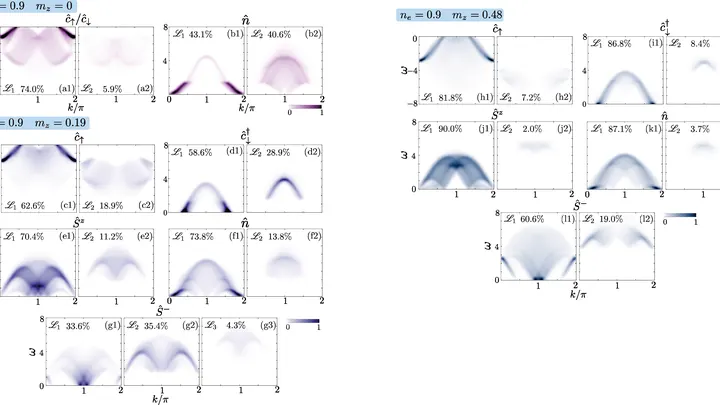
Physicists study a chain of strongly interacting particles (the XYZ model).
A pale green crystal was placed in a magnetic field and cooled below one kelvin — almost to absolute zero. Inside it hide chains of copper atoms that behave like tiny magnetic needles. Usually their orientation is chaotic, but the strong field and cold make the needles align in a unified impulse, like soldiers on a parade ground.
For a long time, identifying quantum phases was like interrogating a witness: you had to reach every corner of the system to uncover its secret. In the era of Landau, order was tied to symmetry breaking and a local parameter — everything plain as day.
The quantum world is often compared to a musical instrument. Each system, whether an atom or a chain of particles, sounds at its own frequencies, which physicists call energy levels. In chaotic systems, like an orchestra without a conductor, these frequencies usually fill the entire available range without gaps.
Quantum spin chains resemble a line of people passing along a secret handshake: each turns to a neighbor, and how firmly they clasp palms determines how the wave runs through the entire chain. In the ideal Heisenberg chain, quantum magnetism’s bedrock, all handshakes are equal.
Imagine an orchestra where every musician plays their own part without listening to the others. Suddenly, without any visible command, neighboring musicians begin to sync perfectly, yet there is still no overall melody.
Two entangled photons fly apart in opposite directions but continue to behave as a single whole: measuring one instantly determines the state of the other. That's quantum entanglement. But sometimes it resembles a seasoned spy — leaving no traces detectable by ordinary checks.
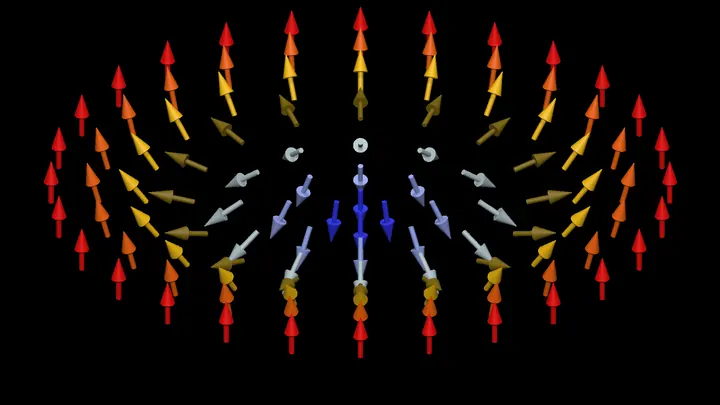
In a field trap, scientists assembled a crystal — 150 ions at ultra-low temperature. Each ion behaves like a tiny magnet, capable of rotating in any direction. By controlling forces that depend on this rotation, physicists made all the magnets swirl into a common vortex called a skyrmion.
An electron in an ordinary wire is like a courier carrying both a package and the recipient's signature at once: its charge and spin are always together. But if the wire is made just one atom thick, the courier gets cramped. In such a one-dimensional tube, electrons cannot overtake each other, and their collective behavior changes beyond recognition.
In some materials, atomic magnetic moments: their tiny 'arrows'—refuse to freeze even at ultra-low temperatures. Instead of conventional order, they form a spin liquid: a state where spins constantly flicker but do so coherently, like dancers in an intricate routine.
Physicists have discovered exact laws by which quantum entanglement mixes in chaotic systems. In a model with rhythmic jolts — like a baker kneading dough — they studied the growth of entropy of entanglement, a measure of quantum disorder.
Quantum entanglement works like a leash: it ties particles together, but the length of this tether is strictly limited. In a chain of particles, heat plays the role of an impatient dog tugging at the leash — the hotter it gets, the shorter the distance over which the connection holds.
A black hole is a place from which even light cannot escape. But quantum theory says it still glows faintly. This glow is called Hawking radiation. In space, it's impossible to spot: it's too faint. So physicists build models of black holes from ordinary materials.
Fourteen rubidium atoms lined up like beads on a string. Each atom is a tiny magnet that can point up or down. Together they follow strict rules, similar to a train schedule: everything is predictable, everything repeats. But introduce a barely noticeable change, and the schedule goes off the rails.
In a chain of cold spins stretched along a single line, order and disorder can intertwine into a pattern that defies the usual rules. Two states of matter, two kinds of "order," are separated by a crossroads where the roads do not converge but diverge.