Popular

Statistical Mech cond-mat.stat-mech

24 articles

Phase transitions, thermodynamics, field theory, non-equilibrium phenomena, renormalization group and scaling, integrable models, turbulence.

articles

One-Way Door: How Quantum Magnets Reconcile Order with Chaos

The study reveals an unusual transition in one-dimensional magnetic chains, where ordered and disordered states coexist. The key was nonreciprocal symmetries—rules with no reverse path, like a door that only opens one way. This allowed them to not only describe a single critical point but also gener
arXiv:2506.01131v1 · 2025-06-01

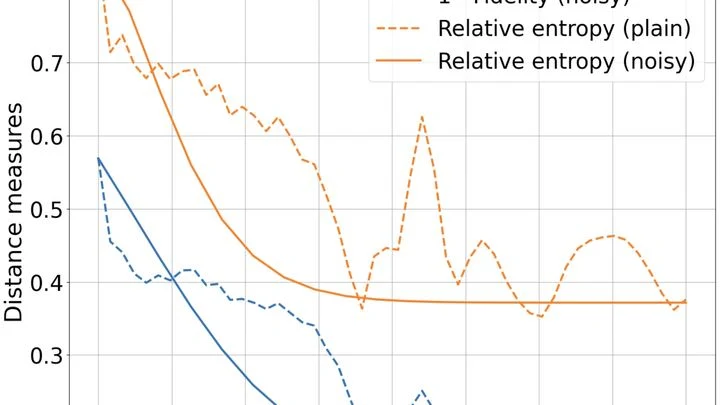
How Noise Turns Order into Chaos on a Quantum Chip

Physicists ran two programs on a superconducting chip: an orderly one and a chaotic one. By measuring the distances between energy levels, they found that in chaos, these levels keep a respectful distance, like people in a crowded room forming a circle. On a graph, this looks like a 'donut'—an empty
arXiv:2506.04325v1 · 2025-06-04

Taming Quantum Chaos through Learning

To control many quantum particles, scientists used trial and error: a computer agent, seeing only part of what's happening, learned to limit the growth of connections between particles. Normally, these connections (entanglement) quickly fill all space, like chaos. But the agent places 'bottlenecks'
arXiv:2508.06612 · 2025-08-08

Speed Outsmarts the Laws of Heat Engines

A heat engine made of quantum particles, flying almost as fast as light, perceives temperature in a whole new way. Einstein’s effects make the hot even hotter and the cold even colder, boosting useful work and bypassing the classical barrier. Speed becomes a thermodynamic trump card.
arXiv:2508.11554 · 2025-08-15

How Symmetry Saves Quantum Entanglement from Heat

Physicists have discovered: if a quantum system obeys a strict symmetry rule—like charge conservation—its particles remain entangled even at infinitely high temperature. This finding explains how order survived the Big Bang and promises quantum devices that don’t fear overheating.
arXiv:2508.20166 · 2025-08-27

Quark Captivity: The Secret of the Invisible String's Snap

Using a simulation, scientists studied how the force strings connecting quarks break. The rupture turned out to be more complex: entire families of particles are born, and in a dense environment the process slows down. This discovery will help understand the microworld and can be tested on special d
arXiv:2509.08868 · 2025-09-10

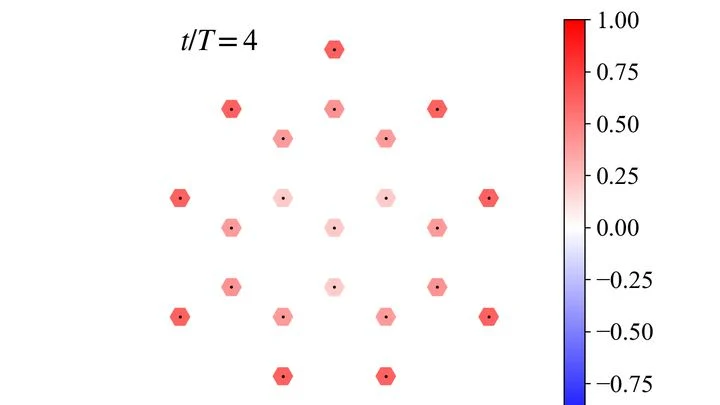
Noise That Helps: A Quantum 'Pendulum' on a Chip

Scientists simulated a magnetic material with a kagome pattern on a quantum computer. They found that noise from extra qubits doesn't disrupt but actually prolongs periodic oscillations (a time crystal), and sometimes even creates them. This is a way to control quantum states using unavoidable error
arXiv:2510.13577 · 2025-10-15

Quantum Mpemba Effect: Controlled Cooling

Hot water sometimes freezes faster than cold—the Mpemba effect. Now scientists have figured out how to control this effect in the atomic world: temporarily increasing 'friction' in the right places so the system settles down faster or slower. The method works for any quantum device and promises to s
arXiv:2511.04354 · 2025-11-06

False vacuum in a ring of atoms

An experiment with giant atoms sensitive to electric fields showed how an unstable emptiness transforms into a stable one, forming bubbles. The rate of the process depends on external influences exactly as theory predicts, as long as everything is perfectly calibrated. The slightest imprecision brea
arXiv:2512.04637 · 2025-12-04

Noise Helps Quantum Computers

Noise in quantum computers unexpectedly accelerates the preparation of thermal states. Like shaking a glass of sugar, it forces the system to reach complete chaos faster. The discovery allows imperfect quantum machines to be used for practical tasks today.
arXiv:2512.14842 · 2025-12-16

The Secret of Warped Webs: A New Way to Compare Networks

Graphs are diagrams made of dots and lines. Determining whether two graphs have the same structure, even if drawn differently, is often difficult. Scientists have found a way by envisioning a graph as a landscape of hills and valleys. Each node gets its own curvature measure. By comparing these curv
arXiv:2601.03787 · 2026-01-07

Why some bubbles grow and others collapse

Physicists modeled the behavior of true vacuum bubbles inside a false vacuum using a simplified particle system. It turned out that a bubble either expands indefinitely or collapses, depending on its initial size and the strength of internal bonds. A similar mechanism could have triggered the Big Ba
arXiv:2601.04305 · 2026-01-07

Your Coffee’s Warmth Is a Silent Light Trade

Stable warmth is not stillness but a dynamic balance. Objects constantly emit and absorb light energy. A new calculation shows the average photon in this exchange carries 2.7 times the energy of molecular motion, linking your coffee to the sun’s fiery glow through a universal trade network.
arXiv:2601.22247 · 2026-01-29

Quantum Entanglement on a Short Leash

Scientists have proven that in a chain of quantum particles at any non-zero temperature, there is a maximum entanglement length. Remove a piece longer than this limit and the halves are no longer connected. Like a leash that snaps under tension, quantum connections are broken by thermal noise, which
arXiv:2602.20694 · 2026-02-24

Cosmic Rhythm: From Snowdrifts to Quantum Gas

The bumps of a 'quantum snowdrift' made of cold atoms grow according to exactly the same scenario as a snowdrift in your yard. This universal law works for sand, water, and even cities. The experiment proved: nature is unified from atoms to skyscrapers.
arXiv:2603.09060 · 2026-03-10

The Quantum Mpemba Paradox: Why Hotter Cools Faster

In the quantum world, a system initially farther from equilibrium can settle down faster. Physicists found that suppressing the dominant rhythm of chaos sharply accelerates the growth of disorder and the approach to equilibrium. Moreover, by breaking time symmetry, they achieved an almost instantane
arXiv:2603.11788 · 2026-03-12

The Synchronous Dance of Quantum Tops

On an IBM quantum processor, scientists cyclically rotated 28 quantum tops. Without any external force, their spinning synchronized. A symmetry, like a hidden rule, protected this rhythm. With 156 tops, some synchronized while the rest spun chaotically—a quantum chimera paving the way to ultra-stabl
arXiv:2603.11910 · 2026-03-12

Quantum Particles Remember Their Past

Quantum systems usually quickly forget their initial state, but physicists found a way to slow this process. On an IBM processor, 144 qubits evolved for 5000 cycles, and entropy — a measure of disorder — grew so slowly it resembled a black hole evaporating in slow motion. This proves the ability to
arXiv:2603.12675 · 2026-03-13

The Silent String of Gravity: Hunting for κ

The weak equivalence principle has been tested with fantastic precision, but always with grounded samples — as if one string of the gravitational violin is deliberately muted. The κ parameter quantifies whether acceleration depends on electric charge: it is the ratio of the difference in acceleratio
arXiv:2605.12246v2 · 2026-05-12

How Internal Noise Destroys Quantum Magic

For a long time, it remained a mystery why large objects don't exhibit quantum weirdness like the Schrödinger's cat superposition. It's all about internal noise: countless microscopic details, acting like interference, cause the superposition to collapse rapidly. Thus, Born's rule is derived from qu
arXiv:2605.16148 · 2026-05-15

A Trap for 11,000 Atoms: A Step Towards a Quantum Computer

Using a flat metasurface the size of a coin, replacing bulky lenses, scientists trapped 11,000 atoms for the first time. This breakthrough paves the way to quantum computers with tens of thousands of qubits, capable of solving problems beyond the reach of ordinary machines.
arXiv:2606.02715 · 2026-06-01

The Quantum Mpemba Paradox: Asymmetry Accelerates Order

Scientists have discovered that in quantum systems where conservation laws split states into isolated 'pockets,' a strong disturbance of equilibrium recovers faster than a weak one—just like hot water sometimes freezes sooner than cold. Meanwhile, some imbalances vanish in a flash, while others get
arXiv:2606.06653 · 2026-06-04

Permanent Chaos: How Disorder Emerges in Static Quantum Systems

In frozen quantum objects like crystals, chaotic disorder has been discovered. Previously, it was only seen in systems continuously shaken by external forces. Scientists used a clever trick — a quantum clock mechanism — to 'awaken' chaos in stillness. This discovery links the microworld with black h
arXiv:2606.30635 · 2026-06-29

Quantum Engine Combines Power with Ideal Efficiency

Ordinary heat engines can't be both powerful and maximally efficient: upping power increases losses. New research describes a quantum engine on a superconducting chip, where many quantum systems synchronize like fireflies in a forest, bypassing the classic trade-off. This paves the way to energy-sav
arXiv:2607.08713 · 2026-07-09