The Ising model is a simple yet powerful mathematical model used to describe how magnetic materials behave. It consists of a lattice of 'spins'—tiny magnetic moments that can point up or down—that interact with their neighbors. Despite its simplicity, it captures the essence of phase transitions, such as when a magnet loses its magnetism upon heating, and it has become a cornerstone of statistical mechanics.
History
The model was proposed by Wilhelm Lenz in 1920 and solved exactly in one dimension by his student Ernst Ising in 1925. The two-dimensional solution, which showed a phase transition, was found by Lars Onsager in 1944.
How it works
Each spin in the lattice interacts with its nearest neighbors, favoring alignment (ferromagnetic) or anti-alignment (antiferromagnetic). The model is typically studied using statistical mechanics, where the probability of a configuration depends on its energy and temperature. At low temperatures, spins tend to align, creating a magnetized state; at high temperatures, thermal fluctuations destroy this order, leading to a paramagnetic state. The transition between these states is a phase transition, and the model can be solved exactly in one and two dimensions.
In practice
The Ising model is used in diverse fields, from understanding magnetism and alloy behavior to modeling neural networks, social opinion dynamics, and even protein folding.
Fun fact
The two-dimensional Ising model was solved exactly by Lars Onsager in 1944, a feat that remains one of the most celebrated achievements in theoreticalphysics.
In the layered crystal CrSBr, the magnetic moments of atoms are arranged like notes in a score: within each layer they point in the same direction, but between layers they point in opposite directions. This antiferromagnetic melody plays up to 132 kelvin, beyond which thermal motion destroys the order.
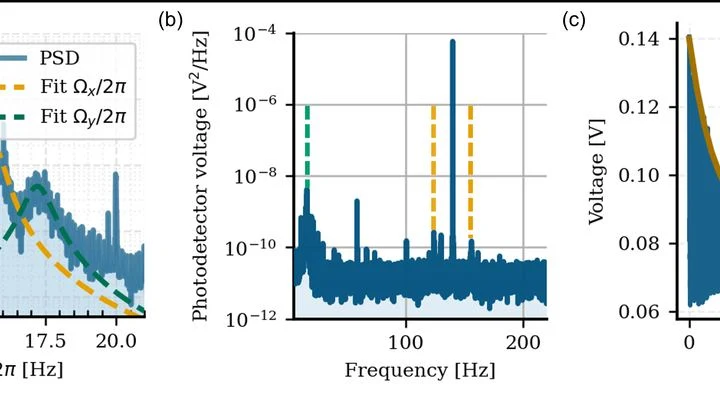
A magnetic top that doesn't fall. A tiny sphere of yttrium iron garnet hovers in midair, held by invisible forces. This isn't a magic trick but a Paul trap — an alternating magnetic field that rapidly changes direction and keeps the sphere from falling, like a juggler tossing balls.
The sphere trembles but doesn't fall.
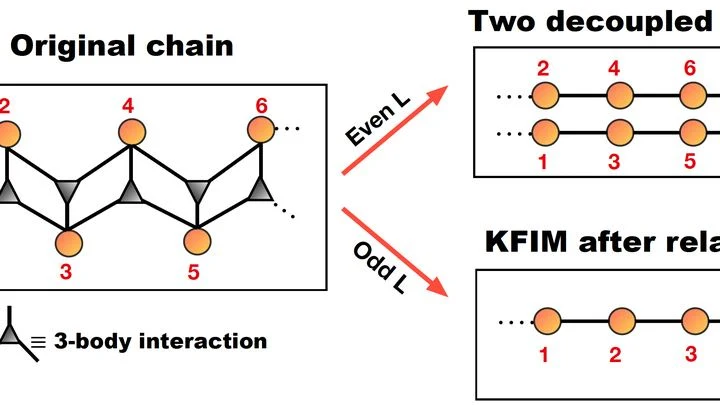
A chain of a hundred tiny magnets lies on a table. Each one can point up or down, like a coin landing heads or tails. But these are not ordinary magnets: they sense each other not just individually but in threes. Three neighboring particles seem to negotiate which way to turn. Once a second, the experimenter shakes the table, and the whole system gets a short kick.
Water boils at one hundred degrees — everyone knows that. But why exactly one hundred? Why not smoothly, but abruptly: a second ago it was liquid, and suddenly — bubbles, steam, bubbling. Such sharp changes are called phase transitions, and they have a rigorous mathematical foundation.
Machine learning has long ceased to be just a tool — it is becoming an investigator, independently fishing out the laws of nature from data. But how does a silicon mind come to understand?
Some materials are internally like a Möbius strip: their electronic states are twisted in a special way. Such topological properties are usually manipulated with a powerful magnetic field, as if trying to flatten the strip with a sledgehammer. A group of researchers has found a more delicate tool.
In a world striving for chaos, rhythm sometimes arises. The Belousov–Zhabotinsky reaction has amazed for decades: in a test tube, color waves run on their own, as if a living organism breathing matter. Something similar lurks in crystals where iron atoms balance between two magnetic states — high-spin and low-spin.
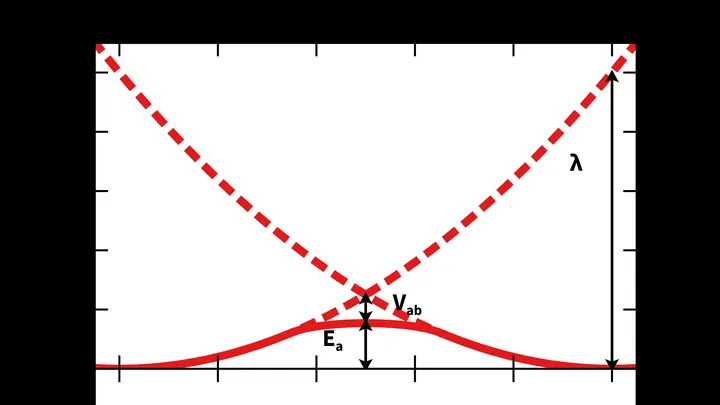
Imagine a slide with three dips: the deepest one is a stable position for a ball, the middle one is precarious. A slight push and the ball rolls down. Yet, constant vibration of the right strength can hold it in the middle hollow for a long time.
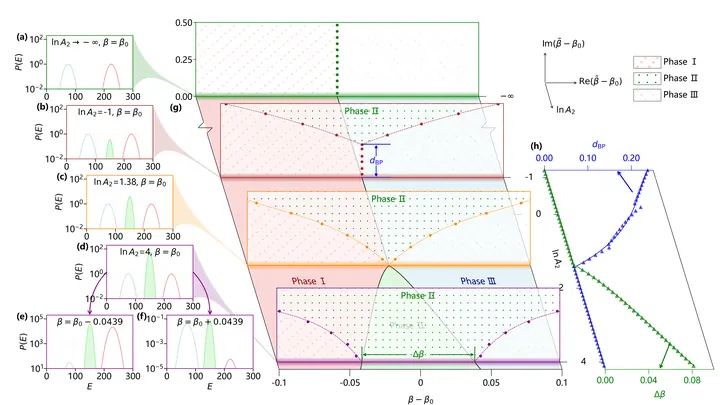
In the 1950s, physicists Lee and Yang discovered that all states of matter are separated by invisible points in the world of imaginary numbers.
If you squeeze an ordinary piece of metal, it heats up — even those who have pumped a bicycle tire know that. But what happens if you squeeze a magnet in which atomic arrows refuse to freeze even at absolute zero?
Imagine a line of people holding hands but facing in opposite directions: some look north, others south. That's how a p-wave magnet is arranged. Electrons in it align their magnetic moments (spins) not randomly but in a strict wave-like pattern.
Tiny magnets on a lattice, the classic Ising model, are usually described by how neighbors influence each other. But what happens when the system is closely watched? Each measurement of a coupling energy is like a gaze that forces the magnets to 'decide' their state.
A piece of magnetite, an ordinary iron stone, behaves strangely. At room temperature, it conducts electricity, but cool it below minus 150 degrees, and its resistance jumps sharply. This jump, discovered back in 1939, physicists could not explain for nearly a century.
A new study offers a solution.
An orchestra where each musician plays their own part but hears only the neighbor. One wrong note, and a wave of errors rolls through the hall. That's how Ising machines work — special devices for solving problems where you need to find the best option among many.
A magnet, like a compass needle, likes to point in a certain direction. But what if the material is layered, like a stack of pancakes? Scientists took just such a magnet made from a compound of chromium, germanium, and tellurium and set out to find out how stubbornly it resists having its magnetization turned.
Physicists have discovered exact laws by which quantum entanglement mixes in chaotic systems. In a model with rhythmic jolts — like a baker kneading dough — they studied the growth of entropy of entanglement, a measure of quantum disorder.
A flexible thread, coiled into a loop, was locked in a tiny box with liquid. It can either absorb water and swell like a sponge, or expel the moisture and shrink into a tight ball. The choice between these states depends on whether the thread has a knot – and which one.
The reason lies in entropy, a measure of disorder.
Muscle contraction is driven by two types of protein filaments: thin carbon actin filaments and thick myosin filaments that act as molecular motors. At rest, a special protein safety catch, tropomyosin, blocks the myosin-binding sites on actin.
A magnetic film divided into tiny arrow-shaped cells behaves like a crowd in a square. While it's cold, all arrows point in the same direction — perfect order. Heat the film, and the arrows start darting around like pedestrians who have lost their purpose. Somewhere between these extremes, there is a moment when the system stops being uniform but hasn't yet dissolved into random noise.
Three charged ytterbium atoms are arranged in a triangle inside an electromagnetic trap. Normally, they all communicate with each other, like three people at a table constantly exchanging remarks. But if one of them steps into the next room, the conversation continues between the remaining two.
A crowd of people in a subway station moves slower than individuals: everyone gets in everyone else's way. A similar picture emerges in a dense cloud of magnetic atoms exchanging energy. Previously, it was thought that the transfer rate depended only on the atoms' own properties.
Two actors on the same stage. One is a fermion, finicky and demanding, hard to make follow the rules of a quantum simulator. The other is a boson, easygoing and undemanding, ready to take any role. The director hopes the audience won't notice the substitution.