How Van Gogh's Paintings Gave Away His Approaching Breakdown express
In 1888, Vincent van Gogh cut off his earlobe. Biographers and psychiatrists have been trying to explain this act ever since. But mathematicians approached the mystery differently: they measured how the artist's feelings changed in his letters and how the 'nervousness' of his brushstrokes grew, and they saw a clear signal of impending trouble.
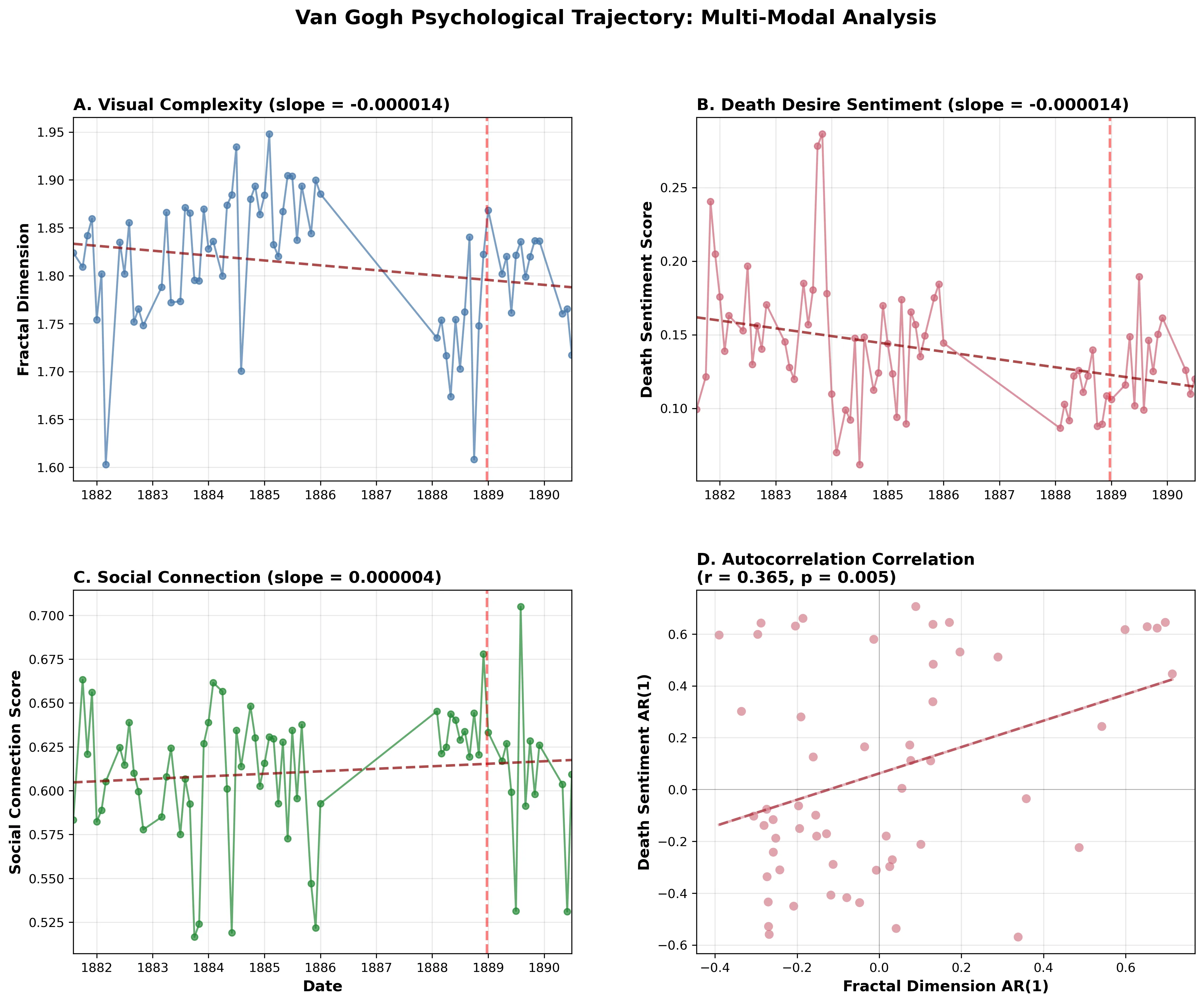
A swing that gets pushed usually swings and quickly calms down. But if the swing is nearly broken, each swing lasts longer, and returning to rest becomes harder. The same principle—'critical slowing down' (prolonged return to equilibrium)—is what scientists looked for in Van Gogh's mental state. They ran 727 letter fragments through a computer program, assessing how often words about melancholy, desire for death, or fear appeared. In parallel, for 569 paintings, they calculated the fractal dimension — simply put, they measured how densely and restlessly the lines on the canvas intertwine. The higher the number, the more fine details and 'jitter' in the composition.
The most striking signal came from the 1888 incident. A few months before it, three indicators at once (readiness for dangerous acts, attraction to death, and visual complexity of the canvases) spiked sharply and began to fluctuate wildly. And a couple of weeks before the crisis, the fluctuations suddenly subsided, as if the system froze for a moment before the breakdown. After the event, the indicators stabilized again, but at a new, more alarming level. This picture closely resembles the behavior of a sick ecosystem before collapse or climate before a sharp regime shift.
This approach could be useful not only for history. If we learn to detect 'slowing down' in a person's language, behavior, or creativity in advance, we might predict severe psychological breakdowns, and intervene before the swing breaks.
Fractal dimension is calculated not only for paintings. For example, the 'Mona Lisa' has a dimension of about 1.5, while a typical Van Gogh painting is above 1.7 due to thick, swirling brushstrokes.
In Ted Chiang's story 'Understand,' the protagonist gains the ability to see mathematical patterns in emotions and art — almost like the algorithm that 'read' Van Gogh's crisis.