An ecosystem is a community of living organisms — plants, animals, microbes — interacting with each other and with their physical surroundings, such as soil, water, and climate. The concept emphasizes that life does not exist in isolation: every organism is part of a network of energy flows, nutrient cycles, and feedback loops that connect the living and non-living worlds. Ecosystems range in scale from a puddle to an entire forest, and their boundaries are often fuzzy, defined more by the flows of matter and energy than by sharp edges.
History
The term 'ecosystem' was coined by British ecologist Arthur Tansley in 1935, who proposed it to emphasize the integration of living organisms and their physical environment as a single system.
How it works
The core mechanism is the transfer of energy and matter. Sunlight is captured by producers (plants and some microbes) and converted into chemical energy, which then passes through consumers (herbivores, predators) and decomposers. Nutrients like carbon, nitrogen, and phosphorus cycle through the system, being taken up by organisms and released back into the environment. Interactions such as predation, competition, and symbiosis shape the population dynamics, while physical factors like temperature and water availability set the stage. The system is not static: disturbances, like fires or storms, can reset parts of it, and the landscape itself can act as a 'ratchet' that maintains diversity by creating patches of different conditions.
In practice
Ecosystem concepts guide conservation planning, such as designing wildlife corridors and managing fisheries, and are used in urban planning to mimic natural flows, as seen in 'city as organism' approaches to transport and green infrastructure.
Fun fact
Some ecosystems, like deep-sea hydrothermal vents, run on chemical energy from the Earth's interior rather than sunlight, supporting entire communities of tube worms and bacteria in total darkness.
Every fall, Issaquah Creek in Washington State turns into a maternity ward for thousands of salmon. The fish swim in, spawn, and die, and the water carries away their molecular traces: fragments of DNA, short-lived RNA, chemical marks on the genetic text. From September through November 2024, researchers collected a liter of water every week and ran it through a filter to catch those traces.
In an aquarium the size of a dining table, two schools of black neon tetras swim in adjacent compartments separated by a transparent wall. They cannot touch each other, but they see every movement. And here's the surprising part: when one school decides to turn left, the other does the same a moment later. It's like two pendulums hanging behind glass, starting to swing in rhythm.
The liver is an orchestra in which every cell plays its part from a shared score. Males and females have different scores: in males, the genes responsible for detoxifying foreign substances and steroid hormones sound louder, while in females, the genes for fat metabolism and bile acids do.
A forest does not live in a static world. Between winter and summer, day and night, conditions shift, and each fluctuation is like a rhythm that all its inhabitants must keep pace with. Yet until now, ecologists have mostly studied how communities of living beings persist in an unchanging environment, like testing a bridge's strength only in calm weather.
Rare species in a large community are like thin branches on a tree: a random gust can easily snap them. Even if conditions are stable, a small population simply lacks enough individuals to survive a bad season. In a new study, scientists added this factor to an ecosystem model and watched the community clean itself out.
A cluster of glowing dots drifts through the darkness, now compressing into islands, now spreading out in waves. These are not fish or birds: this is a mathematical model of active matter, where each particle spends its own energy on movement, and also is born, dies, and competes with neighbors for space.
A mosquito swarm resembles a living cloud — hundreds of bodies circle together, but no one lines up or mimics a neighbor's movements like starlings or fish. For a long time, it was unclear what held such unity together. The authors of a new study suggested that the insects communicate by sound.
In 1970, mathematician John Conway invented the Game of Life — a cellular field where just three rules generate surprisingly complex patterns. Forty years later, SmoothLife appeared: a version where space is no longer cellular but smooth, like a blurred patch. The authors of the new study took an even simpler variant of this continuous game: now everything changes smoothly in time as well.
A web where lions eat zebras and hyenas finish the leftovers is not just a list of dinners. It's a survival map for an entire region. When the climate shifts, animals move, and the map tears. To understand where it will tear and where it will hold, you need to find its unchanging 'skeleton'—the connections that repeat across different places.
A bacterium swims toward food. A chemical signal guides it forward, but with each movement the signal changes. A loop emerges: sensation, action, new sensation. The authors turned this loop into a measurable quantity.
In the web of life, predators and prey exchange carbon and water, and each act of eating slightly increases the universe's disorder. But the intrusion of disease turns this system into a giant seesaw. When a mid-level predator gets sick, its hunting abilities decline, and it becomes easy prey.
A family tree becomes a tangle if you account for adopted children and remarriages. Evolution often resembles such a tangle: although the Standard Model, the traditional view of divergent evolution where species branch like a tree, paints a neat tree of species, in reality genes travel not only by inheritance but also directly between unrelated organisms — a process…
Imagine a packed subway car at rush hour. Passengers don't just stand there: they breathe, release moisture, squeeze toward exits, and sometimes get stuck in doors, blocking movement. Now imagine these passengers can remodel the car's walls, add handrails, or turn the floor into gel.
A desert where every step reshapes the terrain. Dunes settle, new slopes emerge, and the next step is dictated by what you've just trampled. That's roughly how "sandscapes" work — a mathematical model inspired by living systems.
In 1960, the Tatel radio telescope spent weeks listening to emptiness around Tau Ceti and Epsilon Eridani. Project Ozma was searching for technosignatures — traces of another mind at work.
A runner loses on both a smooth track and sticky sand. Seems hopeless. But if the surface underfoot starts changing every few seconds (track, then sand) the runner suddenly stops falling behind. He doesn't get faster; the environment just doesn't get a chance to 'crush' his weakness.
That's exactly what the authors found when studying a simple predator–prey model.
In 1944, Erwin Schrödinger asked the question "What is life?", foreshadowing quantum explanations of biology. Almost a century later, physicists return to this puzzle, armed with the apparatus of quantum field theory.
Life is a constant dance between order and chaos. Back in the mid-20th century, Erwin Schrödinger noted that living things feed not so much on matter as on "negative entropy"—the ability to maintain their own order by increasing disorder around them.
Every year, the food we eat costs humanity tens of millions of years of life due to unhealthy diets. At the same time, a third of all greenhouse gases warming the planet are produced along the journey from farm to plate. It seems obvious: switch to healthier eating, and we'll save the climate and improve our health. But new research shows these two goals don't always go hand in hand.
Billions of tiny motors hum inside every living creature. Cells ceaselessly pump substances, burn sugar, and build new proteins, and all this invisible motion warms us from within. To maintain order, life must dissipate heat into the environment, like a stove that never goes out.
The power of this internal heating is almost independent of size.
A city is a living system: it consumes resources, produces waste, and its 'circulatory system'—the road network — delivers people and goods to their destinations. But while engineers design transport arteries as rigid geometry of straight lines, nature has spent millions of years perfecting ideal distribution networks.
From carbon, nitrogen, oxygen, and sulfur, you can assemble 10⁶⁰ different small molecules: that's a 1 with 60 zeros, more than the stars in the visible universe. Life uses only a tiny fraction of this menu, but not randomly.
A tightrope walker inches across a chasm. As long as they keep their balance and avoid sudden moves, they're safe. But one overcorrection, and a fall is inevitable. Life works much the same way at every level — from proteins inside a cell to entire ecosystems.
In the freshwater lakes, cyanobacteria Microcystis often cause toxic blooms. They gather into colonies — elastic little spheres, like dense jelly. The cells are glued together by a special substance based on carbon, acting as a powerful natural adhesive. Scientists tested these "jelly balls" for the first time and found their strength astonishing.
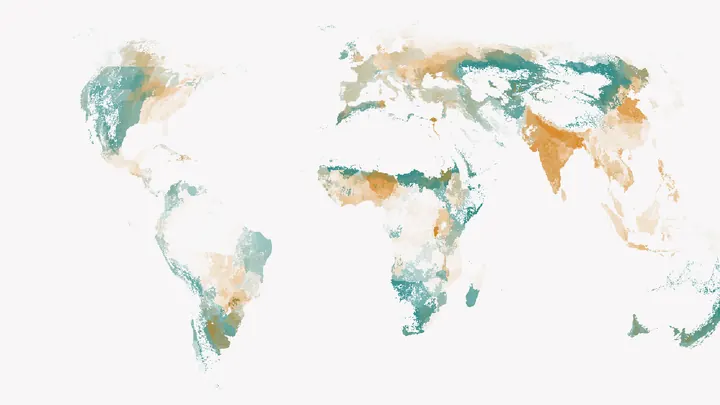
Drylands are like skin cracking from dehydration. When rainfall decreases, plants don't vanish overnight: they rearrange, leaving bare patches of soil between them. These patterns are visible even from space.
Scientists compared satellite images of eight arid regions, from the Sahel in Africa to Australian deserts.
Imagine a mountain range where height represents an organism's fitness. Every point on the slope is a particular set of genes. Evolution climbs upward, but the terrain of this phylogenetic network landscape is cut by ridges and valleys.
A landscape cut by roads or rivers into isolated patches resembles a shared apartment after partitions are installed: residents no longer bump into each other in the common hallway. Species that once competed for the same food or space now live apart. Competition weakens, and those that would have lost to pushier neighbors in a continuous landscape now survive.
When a crowd of bacteria (mostly composed of carbon) gathers in a droplet of water, a synchronized round dance begins: millions of tiny ones glide along giant ellipses, like dancers on a ballroom floor. Without a conductor, complex patterns emerge from simple movements.
A Network That Decides When to Stop
A crowd grows: each new person joins the group with a probability that depends on how large the group already is. If the group is small, joining is easy; if it is huge, people start to hesitate, and growth slows down. This mechanism, called feedback, changes the entire behavior of the network.
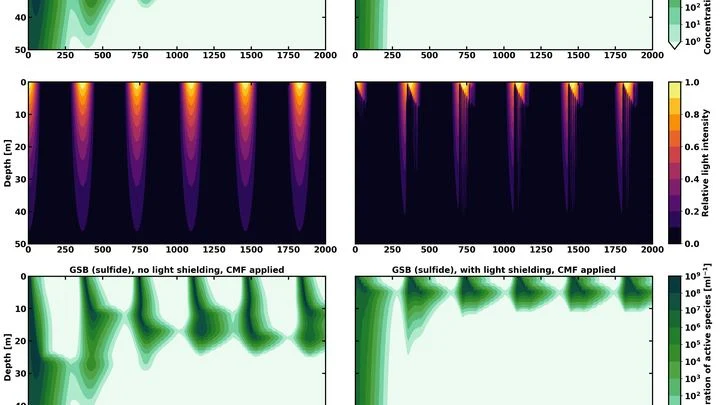
Simple equations that describe fox and rabbit cycles have been turned to bacteria on distant exoplanets, like K2-18 b. These worlds hold deep oceans under thick hydrogen skies. Like duckweed on a pond, light-eating microbes cover the sunlit water surface, stealing light from those below.
Microbial communities are like a noisy orchestra: thousands of instruments, and it's hard to tell who's playing the lead. In the gut, ocean, or soil, millions of bacterial species live, and scientists need to figure out which ones truly matter for human health or soil fertility.
The new approach works like smart laundry sorting.
In two neighboring ponds, the same microorganisms swim. Food appears now in one, now in the other — randomly, with no rule. After a month, there are a hundred times more of them in the first pond than in the second. No one chose where to live. Just luck.
This is how disequilibrium works. While the environment keeps changing, abundances don't have time to even out.
An ecosystem is like a swing that someone is subtly pushing. Previously, it was thought that the main concern was that the swing wouldn't swing too wildly. But the authors of this work showed that the greater danger is when the equilibrium point itself slides toward a place where the swing can no longer return.
Scientists built a model of Earth with all living organisms removed — from bacteria to trees. Over billions of years, this 'empty house' didn't turn into an icy desert. Volcanoes, like a furnace, release carbon dioxide, and rock weathering, like a thermostat, absorbs it.
Imagine a house of cards where each card supports the others. One wobbles, and the neighbors start to lean. Earth's climate system works similarly: ice sheets, ocean currents, tropical forests, all are connected. If one element crosses a threshold, it can drag the rest down with it.