A regime shift is a sudden, often persistent change in the behavior of a system that has been in one stable state for a long time. In a time series, this appears as an abrupt jump in the average value, variance, or other statistical properties. For example, a lake might switch from clear water to a turbid, algae-dominated state, or a financial market might shift from low volatility to high volatility. These shifts are often caused by a gradual change in an external condition that eventually crosses a threshold, after which the system rapidly reorganizes into a new state.
History
The concept gained prominence in ecology in the 1960s and 1970s, with work by C.S. Holling and others on multiple stable states in ecosystems. It was later applied to climate science, particularly to explain abrupt climate changes in the paleoclimate record.
How it works
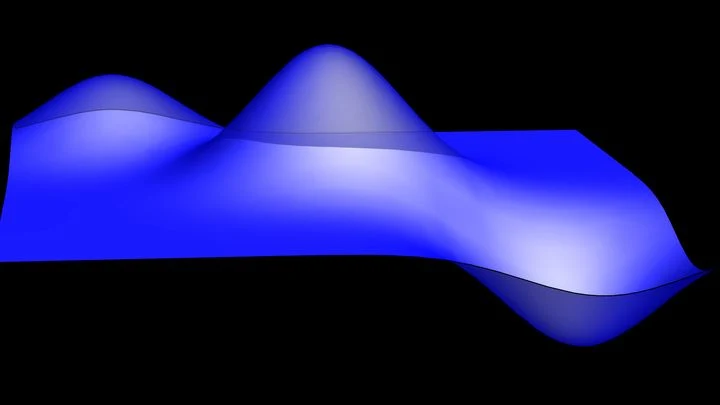
Many systems have multiple possible stable states. A small perturbation around a stable state decays, keeping the system there. But if an external driver (like temperature or nutrient input) changes slowly, it can alter the shape of the system's 'energy landscape,' making one stable state disappear or become unstable. When this happens, the system is forced to move quickly to another stable state. This movement is often much faster than the original driver change, hence the appearance of a sudden shift.
In practice
It is used in ecosystem management to anticipate and possibly prevent undesirable shifts, such as the collapse of a fishery or the desertification of a grassland.
Fun fact
Some climate models suggest that the Atlantic Meridional Overturning Circulation, which drives the Gulf Stream, could undergo a regime shift if global warming continues, leading to drastic cooling in Europe.
Picture a wind map over a mountain range. The wind mostly blows downhill, following elevation changes. But if you look closely, in some valleys the air swirls into little eddies that keep the wind from simply flowing down. That is exactly what the mutation field in human DNA looks like.
A forest does not live in a static world. Between winter and summer, day and night, conditions shift, and each fluctuation is like a rhythm that all its inhabitants must keep pace with. Yet until now, ecologists have mostly studied how communities of living beings persist in an unchanging environment, like testing a bridge's strength only in calm weather.
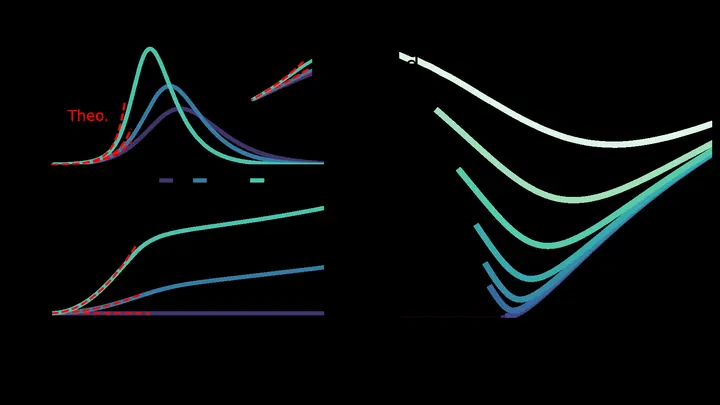
A superfluid gas is like a crowd of people marching in step: each atom knows where to go and doesn't fall out of the common rhythm. But this crowd has three 'valleys'—three different directions it can take. In a new experiment, physicists made one valley slightly more 'favorable' than the others and watched how the crowd darted between them.
Two gardeners haggle over water from a magical well. One proposes how many buckets to take, the other can agree or refuse. If the deal goes through, the water decreases; if not, the well gradually refills. This haggling repeats hundreds of times, and the gardeners' habits sometimes change randomly, as if they're trying new tactics.
Traditionally, machine learning algorithms operate in a static environment, like water flowing along a pre-cut channel without changing its shape. The new method flips this paradigm: it lets an agent simultaneously master actions and deliberately modify the very environment it inhabits.
A runner loses on both a smooth track and sticky sand. Seems hopeless. But if the surface underfoot starts changing every few seconds (track, then sand) the runner suddenly stops falling behind. He doesn't get faster; the environment just doesn't get a chance to 'crush' his weakness.
That's exactly what the authors found when studying a simple predator–prey model.
The heart doesn't beat like a metronome: its rhythm dances to the time of day. Each of us has a moment when our pulse hits its peak. This peak is like the hand of an internal clock, and it shifts from person to person.
But what moves that hand? Researchers gave people smartwatches and tracked them for nearly a month.
Inside every cell, a complex network of genes determines what it will become — a nerve cell, a muscle cell, or part of the skin. This choice often resembles flipping a toggle switch: two stable positions, and the cell decides which way to tip. But cells have a feature rarely considered in such models: they divide.
A living sheet of cells resembles a crowd on an escalator. In a calm state, everyone moves smoothly, but as soon as a crush occurs, movement comes to a halt. Similarly, cell layers under load can suddenly stiffen, turning from a pliable mass into an elastic scaffold.
Toss a handful of coins on a table: each one lands heads or tails on its own. Now imagine the coins start flipping over, nudging each other. That's roughly how neutrinos behave in a very dense environment.
Many chemical transformations resemble assembling furniture in complete darkness: you see the starting parts and the finished cabinet, but the assembly itself remains a mystery. The intermediate states, like awkward positions of the craftsman's hands, vanish too quickly to be discerned.
If you check where an electron is every second, its quantum properties change. It's like a child playing hide-and-seek but constantly being called by name: they freeze and stop running. In the particle world, such a "caller" is a measurement. It prevents particles from freely forming a shared quantum state, or entanglement.
A ship gliding through water constantly rubs against it, like a palm against a rough surface. This friction eats fuel and slows progress. One way to reduce it is to blow air under the hull: water stops sticking to the hull, and drag drops. But air is finicky: sometimes it helps, sometimes it hurts.
A pot of water sits on the stove. The temperature drops: plus one degree, zero, minus one — the water stays liquid. But at some point, a light breath is enough to make the whole mass instantly freeze into ice. Physicists call such jumps first-order phase transitions.
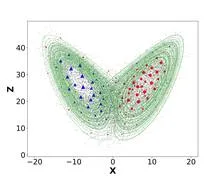
The heart beats steadily, then slips into arrhythmia. The climate holds its familiar rhythm for decades, then shifts to a new state over a single summer. Such regime shifts are like a flick of a switch, but in real data we see only a noisy one-dimensional signal in which the moment of the break is hidden.
An epidemic is like a fire in a dry forest: a spark flares up, the flames leap from tree to tree, and within a week the whole area is burning. A hundred years ago, scientists devised a simple mathematical model for such a fire: they divided people into those who had not yet fallen ill, those who were ill, and those who had already recovered.
A quiet tube with a heated grid inside. The voltage on the grid is suddenly raised, and the tube starts to hum, sustaining itself. This is not a malfunction but a transition to another stable state, like a ball rolling over a hill into a neighboring hollow.
A rubber band is stretched, and suddenly snaps. In the atomic world, a similar picture emerges: the string binding particles can break. In a new study, physicists took a chain of Rydberg atoms and tracked how such a string breaks.
Under weak tension, the string breaks completely, and the system splits into several independent pieces, as if a rubber band shattered into segments.
Water in a glass settles down once you stop stirring it. Oil in an engine dampens vibrations. It seems viscosity is always about damping. But in some flows, it's the opposite: add friction, and waves start to grow as if from nowhere.
Physicists have found a simple explanation.
A group of people searches for a lost item in a large park. Some get tired and leave, others join along the way. The number of searchers is constantly changing. How does this affect the search time? Until now, science had no clear answer.
In a new study, a general model of such a process has been built. In it, independent participants randomly enter and leave the search.
Two glasses of water: one scalding hot, the other just warm. The warm should cool first — but in the 1960s, a student from Tanzania noticed that hot ice cream freezes faster. This paradox was named the Mpemba effect. Recently, physicists found its quantum analog.
Everything tends toward equilibrium: tea cools, a pendulum swings to rest. The measure of this movement is entropy — growing disorder. But sometimes hot water freezes before warm. The Mpemba effect isn't just a curiosity: it shows up in the quantum world too. Scientists have devised a way to control this paradox.
A water droplet falls onto a lotus leaf and bounces off without leaving a trace. Nature has perfected this self-cleaning marvel over millions of years, and engineers have long tried to replicate it. But if the droplet hits too fast, it shatters into splashes, losing mass and leaving wet marks on the surface.
In winter, air over the Northern Hemisphere does not move haphazardly; it spends days at a time in the same pattern before rearranging itself. These patterns are like rooms in a maze: the system enters, lingers, then finds a door to another room. Each room has its own weather: somewhere over Europe it is warm and humid, while over Siberia it is frosty and clear.
Imagine an interpreter who gets distracted by every rustle in the hall. The more rustles, the more errors in the translation, even though the meaning of the speech hasn't changed. The same happens with data: if measurements are unevenly spaced, standard analytical tools start "hearing" changes that never occurred in the underlying process.
In a tropical forest, the dry season gives way to the rainy season, and with the weather, the rules of life change: some animals go into hibernation, while others come out of hiding. Likewise, in complex systems, from climate to economics, the links between processes are not set in stone. They depend on a hidden "regime" that itself switches from time to time.
A kitchen thermometer doesn't creep upward gradually when you turn on the stove: first it stays put for a while, then suddenly jumps a few degrees. According to researchers' calculations, global temperature behaved much the same way from 1950 to 2013.