Attraction is the fundamental tendency of particles and massive bodies to draw closer together. In physics, it is most commonly associated with gravity, which pulls masses toward each other, and electromagnetism, which binds opposite charges. Attraction shapes the universe at every scale, from the orbits of planets to the formation of atoms and molecules. It is the counterpoint to repulsion, and the balance between the two determines the structure and stability of matter.
History
The concept of attraction was formalized by Isaac Newton in 1687 with his law of universal gravitation, though earlier thinkers like Kepler and Hooke had hinted at it. The electromagnetic force was unified by James Clerk Maxwell in the 1860s.
How it works
Attraction arises from fundamental forces. Gravity, described by general relativity, curves spacetime around mass, causing objects to follow paths that bring them together. Electromagnetic attraction occurs when opposite charges exchange virtual photons, pulling them toward each other. At the quantum level, attraction can also emerge from more complex interactions, such as the exchange of phonons in superconductors, where electrons, normally repelling, form pairs.
In practice
Attraction is harnessed in technologies like particle accelerators, where magnetic fields guide charged particles, and in medical imaging, where magnetic attraction aligns atomic nuclei for MRI scans.
Fun fact
In quantum mechanics, attraction can sometimes be mediated by repulsiveforces, such as in certain exotic superconductors where electron pairing arises from magnetic fluctuations.
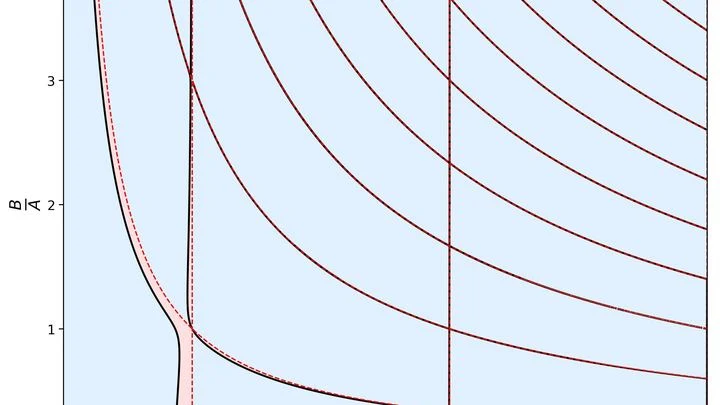
A thrown stone arcs through the air, but a planet around the Sun follows a closed curve. Why an ellipse, and not a circle or a spiral? Kepler's first law provides the answer, but its usual proof requires heavy computation. This work offers a shorter path — through a single simple ratio of velocities.
A lead sphere hangs above another lead sphere. According to the usual laws of gravitation, they attract each other exactly along the vertical — along the line connecting their centers.
Two floats on the waves. Throw a stone into water, and the ripples will spread, rocking both floats one after another — not simultaneously. In the quantum world, such rocking is called entanglement: particles, like floats, begin moving in sync.
Gravitational waves are not vibrations of matter, but tremors of spacetime itself, predicted by Albert Einstein. They travel at the speed of light and pass through objects, stretching and squeezing them.
Two grains of salt fall into a glass of water. They dissolve, and sodium and chloride ions spread throughout the volume. The schoolbook truth is simple: like charges repel, opposite charges attract. But recent experiments with tiny spheres in liquids have revealed a picture that breaks this rule.
A handful of rice thrown into a glass of water scatters — the grains spread apart. Now imagine each grain propels itself forward with stubborn persistence and bounces off softly upon collision. Such particles are called active: they spend their own energy to move, like bacteria or microscopic robots.
A balloon inflates on its own, even though no one is blowing it up. That's roughly how the accelerated expansion of the universe looks, and to explain it, scientists usually invoke dark energy, an invisible and poorly understood force. But what if the balloon expands because new air molecules are continuously appearing inside it?
Gravity is like a stretched trampoline: massive bodies press into it, making other bodies roll toward them. This shared curvature of space, gravity, affects everyone, but it doesn't convey secret messages.
When stars at the edges of galaxies rotate faster than calculations based on visible mass predict, standard cosmology invokes the hypothesis of hidden dark matter — invisible substance that reveals itself only through gravity. A new study offers an alternative that requires no new particles.
A particle wanders through a medium scattered with obstacles. Sometimes it pushes them aside like a snowplow, and it was thought that this pushing is what eventually stops the motion. But in three-dimensional space, that mechanism doesn't work.
It turns out that stopping arises from rare events: every so often, a particle randomly finds itself in a trap, and all exits close, as if doors slam shut.
Schrödinger's cat, according to quantum rules, can be both alive and dead at once. But a table can't pull that off. When a massive object tries to be in two places, its mass curves spacetime so drastically that instead of two points, a single deep depression forms, and the object rolls into it.
The familiar picture: gravity always attracts. But if a mass is in quantum superposition (that is, in two places at once, like an object in a double-exposure photograph) everything flips. Quantum theory allows a particle to be both here and there in a literal sense: its position is described by a wave function smeared across space.
Gravity always pulls — an apple falls down, planets orbit in circles. But by placing a source of gravity in two places at once, you can get the opposite. Physicists have proposed an experiment: a massive body is put into a quantum state, smeared across space like a cloud. Then a tiny particle is shot into that cloud.
Two massive spheres in the cosmic void. Push one, and the second will feel the push only after a moment: gravitational influence travels, like an echo of a shout in the mountains, with inevitable delay. This is how curved space transmits signals locally, step by step — predicted by Einstein long ago.