Fractaldimension is a mathematical measure that quantifies how completely an object fills the space it occupies, going beyond the familiar integer dimensions of 0 (points), 1 (lines), 2 (planes), and 3 (volumes). A smooth sheet has dimension 2, but a crumpled, wrinkled, or porous structure can have a dimension between 2 and 3, reflecting its intermediate complexity. Similarly, a scattered set of points might have a dimension less than 1, indicating it is sparser than a continuous line.
History
The term was coined by Benoit Mandelbrot in 1975, building on earlier work by mathematicians like Felix Hausdorff and Gaston Julia, who explored non-integer dimensions and self-similar sets in the early 20th century.
How it works
The concept is built on scaling relationships: if you zoom in on a fractal, its structure repeats or its measured length or area changes in a power-law fashion. The fractal dimension is computed from this scaling exponent — for example, by counting how many smaller boxes are needed to cover the object as the box size shrinks. A coastline that gets longer as you measure with a smaller ruler has a dimension between 1 and 2, because it is more complex than a straight line but less filling than a plane.
In practice
Fractaldimensions are used to characterize rough surfaces in materials science, analyze galaxy clustering in cosmology, and even model the branching of blood vessels or the structure of porous rocks in oil exploration.
Fun fact
The large-scale structure of the universe — the cosmic web of galaxy clusters and voids — has been measured to have a fractaldimension of about 1.2 to 1.5, meaning it is far more clumpy than a uniform distribution.
The night sky looks like a random scattering of stars. But zoom out to enormous distances, and the chaos disappears. Galaxies gather into long filaments and flat walls, with colossal voids gaping between them — cosmic voids. This structure is called the cosmic web.
Dim the lights. The stage belongs to a shadow theater, with just r puppeteers, but the screen obeys the laws of hyperbolic geometry. Every wave of the hand births a pattern that mathematicians call a discrete group of isometries.
A handful of matches falls on the table. Each lies however it lands, but in our minds we turn each into an arrow — from one end to the other. Now ask: can you get from one point to another by moving only in the direction of the arrows? A group of points where you can reach any one from any other is called a strongly connected cluster.
Imagine a city where streets are not straight but winding, with dead ends and hidden passages. A bike courier will take much longer to deliver a package than in a city with a regular grid of roads. Similarly, molecules inside living tissue: their path depends on how "tangled" the tissue structure is.
Scientists built a model that describes the movement of molecules in such a "tangled" environment.
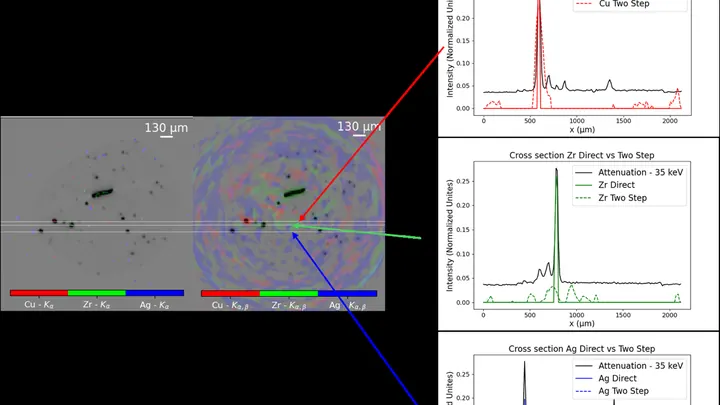
Conventional X-ray fluorescence analysis works like a meticulous scribe: to learn the composition of a picture, it walks over every square centimeter and logs whether lead or copper is present. For a flat sheet, that's tolerable, but for a three-dimensional object, it's torture.
On the surface of a thin film of bismuth iron oxide, you can see neat stripes, like furrows in a plowed field. What lies beneath them has remained a mystery until now.
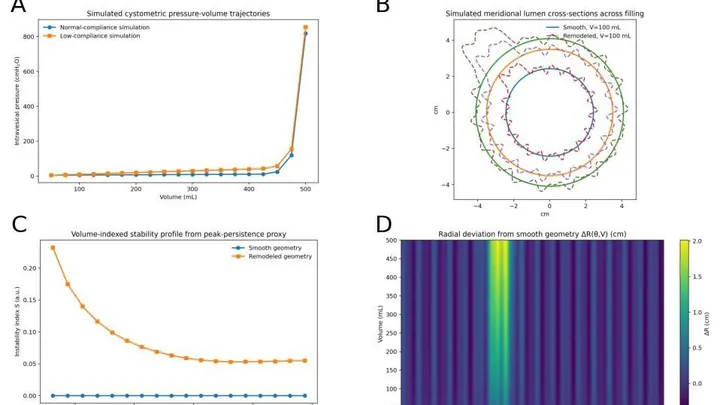
The bladder is like a balloon: as it fills, the wall stretches and the shape changes. Doctors usually monitor the pressure inside and how much fluid has entered, but they rarely look at the geometry itself — how the surface curves. Yet irregularities can appear before the usual metrics deteriorate.
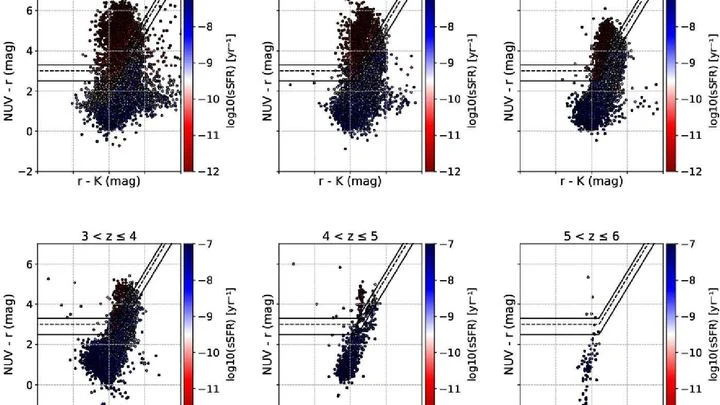
If you spill a handful of colorful beads on the floor, they will land differently: some will clump together, others will scatter into corners. Roughly the same way, galaxies of different colors (blue, green, and red) are scattered across the universe. Scientists decided to measure how 'clumpy' their distribution is using a number called the fractal dimension.
In the dark clouds of interstellar gas where stars are born, matter gathers into dense knots — future cradles of stars. Astronomers measure distances between these knots from sky photographs, but a photograph is flat while the cloud is volumetric. Converting from plane to volume is not as simple as it seems.