Popular

Physics and Society physics.soc-ph

9 articles

Structure, dynamics and collective behavior of societies and groups. Quantitative analysis of social networks and other complex networks. Physics and engineering of infrastructure.

articles

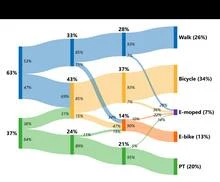
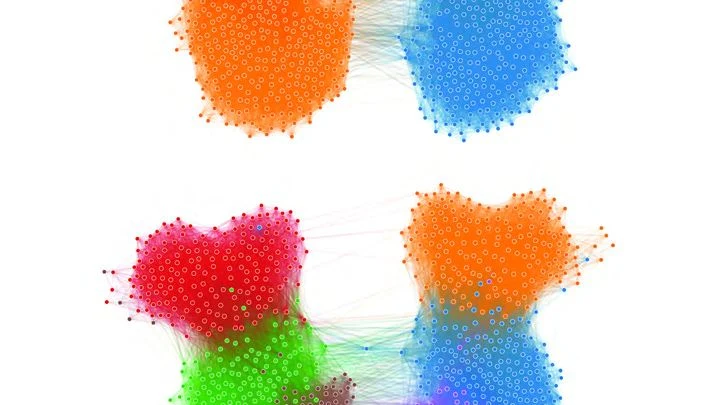
Train Station Delta: Three Types of Passengers

Some grab a rental scooter, others cling to the bus handrail, and some stay loyal to their own bicycle. Knowing these types helps cities avoid traffic jams and make the journey from the station comfortable for everyone.
arXiv:2505.03297 · 2025-05-06

Crowd as a Fluid: The Physics of a Crush

In a very dense crowd, people interact through pressure, like particles in a fluid. New models that account for compressive forces accurately predict when a crush begins, helping to save lives.
arXiv:2505.05826 · 2025-05-09

Social Laser: Why We Act in Sync

Scientists applied the laser principle to crowd behavior. People are like atoms: they get charged by news and slogans. Once enough charge builds up, a single impulse triggers synchronized action. The model promises to predict mass events.
arXiv:2510.16012 · 2025-10-15

How Artificial Intelligence Becomes a Scientist's Partner

Algorithms sift through millions of options, suggesting new ideas to scientists—from medicines to distant planets. Robotic labs then test these hypotheses immediately, making science faster and more accessible.
arXiv:2511.20976 · 2025-11-26

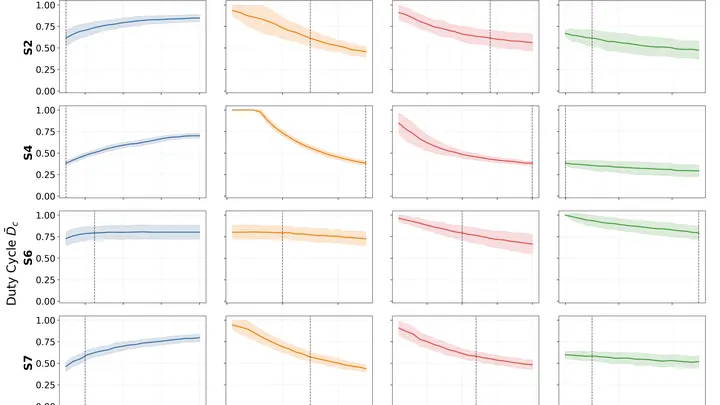
Pulse of Civilization: The Rhythm That Determines Survival

Scientists calculated a thousand years of the future across ten scenarios. It turns out civilizations pulse: periods of prosperity alternate with decline, like heartbeats. The active time fraction ranges from 38% to 100%. The main factors are the rate of resource depletion and the resilience of know
arXiv:2604.13774 · 2026-04-15

The Loeb Scale: When a Strange Rock Isn’t Just a Rock

The Loeb scale rates the weirdness of an interstellar object on a five-point scale. A ‘candidate’ level isn’t proof, but a green light for intensive observations. Ignoring it is more dangerous than being wrong.
arXiv:2604.20896 · 2026-04-21

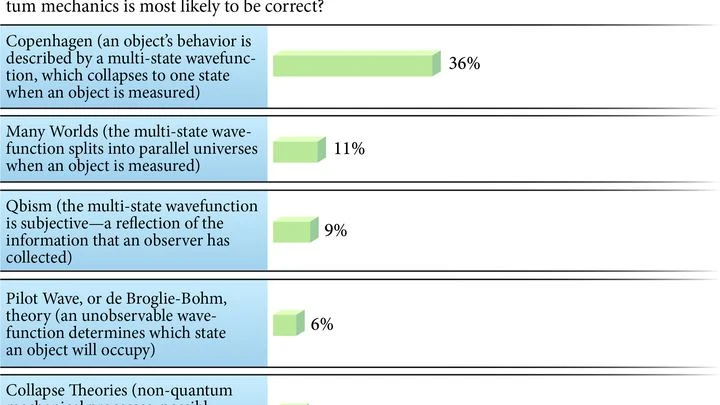
Big Mysteries: Survey Reveals Physicists' Disagreements

Hundreds of scientists answered questions about the deepest mysteries of the Universe. The results showed that topics which seem settled in textbooks actually provoke fierce debate. Science is not a set of dogmas but a living dialogue, and this research confirms it.
arXiv:2605.11058v1 · 2026-05-11

Self-Running Quantum Clocks

Two entangled particles exchange energy: one gives, the other receives, but together they maintain balance. If you only watch the first, its oscillations seem eternal — the hidden partner acts as an invisible motor. This is reminiscent of time crystals — structures that change cyclically without ext
arXiv:2605.19917 · 2026-05-19

The City as an Organism: Nature’s Lessons for Roads Without Gridlock

Nature’s arteries—river systems, leaf veins—have operated flawlessly for millions of years. A new study reveals how to transfer this brilliant engineering to city roads. The result: networks that grow, adapt, and require almost no maintenance.
arXiv:2605.23766 · 2026-05-22