How Ideas Learn from Each Other express
The human mind is like a construction set that builds itself. New ideas don't die with their creators: they are passed on, mixed, and selected. This process is called cultural evolution: useful inventions stick, useless ones are forgotten. That's how a ratchet works — a mechanism that only turns forward.
But what exactly happens in the head when one thought displaces another? The authors of the study hypothesized that it's all about tuning the connections between neurons — much like how artificial neural networks learn. They created a population of virtual agents with simple neural networks inside. Each agent received a mixture of hidden "root causes" as input, as if hearing several voices at once, and tried to separate them by adjusting connection weights.
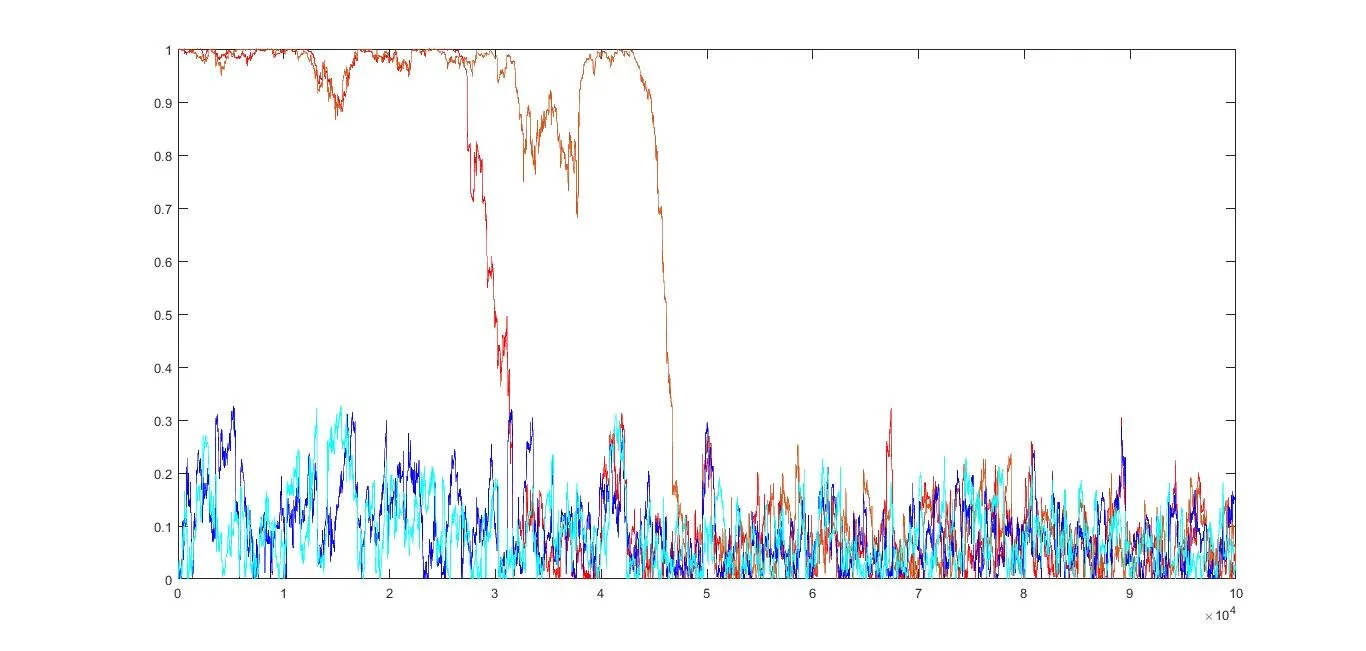
Then the agents were allowed to communicate. But not randomly — selectively: they could pass on only their most successful guesses about the hidden causes. This mode was called "Light." On their own, many agents failed at the task, but in a group with such exchange, they began to find increasingly accurate solutions. One improvement latched onto another — the ratchet started turning.
The model is deliberately simple. It has no language, no abstract thinking — only neurons and signals. But it's precisely this transparency that reveals a mechanism that previously stayed in the shadows: how raw guesses turn into shared knowledge.
Original abstract
as written by the authors arXiv:2607.24886
It has been proposed (Richerson and Boyd, 2008) that human intelligence is underpinned by a ratchet-like process called Cultural Evolution in which ideas, originated by individuals, can selectively spread by social learning and replace older, less fruitful ones. Useful ideas can thus accumulate beyond the lifetime of individuals. Although both social and individual learning are thought to be achieved by the selective activity-dependent adjustment of synaptic strengths in an artificial neural net-like manner, there have been relatively few attempts to incorporate neural networks into Cultural Evolution models. This has led to controversy and uncertainty about how cultural traits are created, transformed, transmitted and selected. We have constructed a transparent model of Cultural Evolution based on simple neural networks, and here we show that a population of communicating agents can learn progressively better descriptions of its environment. Specifically we generate input vectors by linearly combining hidden "causes", which agents can learn from in a nonlinear, Hebbian, manner, thus discovering synaptic weights that "unmix" the data to reveal the hidden causes. We previously showed that if agents can communicate their current estimates of hidden causes to other agents, in a selective manner we call "Light", the interacting population can learn unmixing weights under conditions where most noninteracting individuals cannot. Here we show that with "Light" a population can learn progressively better solutions, in a ratchet-like manner. Although our model is highly simplified, this simplicity allows insight into cultural evolution mechanisms that have hitherto been obscure, and provides a stepping stone to more complex, but still relatively transparent, analyses.
Hebb's rule, used in the model, is often summarized as: "Neurons that fire together wire together." It was proposed by psychologist Donald Hebb in 1949, long before powerful computers existed.