concept

neural language acquisition

How neural networks and brains learn and process human language and symbolic communication.
40 related articles

Description

Neural language acquisition is the study of how both biological brains and artificial neural networks learn to understand and produce human language. In humans, this involves a complex interplay of innate cognitive biases, exposure to linguistic input, and the gradual refinement of neural circuits that map sounds, words, and grammar to meaning. For machines, it refers to the process by which deep learning models, trained on vast amounts of text, develop internal representations that allow them to generate coherent sentences, translate between languages, and answer questions.

History

The modern computational study of language acquisition began with Noam Chomsky's critique of behaviorist models in the 1950s, but the connectionist approach, using neural networks to model language learning, gained traction in the 1980s with the work of Rumelhart and McClelland. The current era of transformer-based language models began with the 2017 paper 'Attention Is All You Need'.

How it works

In biological systems, language acquisition relies on the brain's remarkable plasticity, particularly in regions like Broca's and Wernicke's areas. As a child hears speech, neural connections are strengthened or pruned based on statistical regularities in the input, forming hierarchical representations from phonemes to syntax. In artificial neural networks, a similar principle operates through backpropagation: the model adjusts millions of parameters to minimize the difference between its predicted next word and the actual next word in a training corpus, gradually building distributed representations that capture semantic and syntactic patterns.

In practice

This research underpins technologies like machine translation, voice assistants, and text generation systems, as well as informing therapeutic approaches for language disorders.

Fun fact

Human infants can distinguish between all phonetic sounds of all languages until about six months of age, after which their perception narrows to the sounds of their native language.
Concept graph →

Related articles · 40

Scales for Thoughts: How to Measure Whether a Neural Interface Really Speaks
In the 1980s, the DARPA speech recognition challenge settled the debate between statistical methods and hand-written rules, setting a common standard for the entire field.
Epidemics as Dialogue: How Language Models Teach Epidemiologists to Listen to Human Behavior
In March 2020, France emptied out: people stopped going to work, school, and cafés, and the streets filled with silence. Epidemiologists stared at the graphs and understood that the virus was not spreading on its own, but through handshakes, conversations, and metro rides. But how could they predict how many contacts a person would keep if the government announced new restrictions?
An Atlas of Physics Inside a Neutrino Model: A Library That Its Intended Reader Never Opens
In the Antarctic ice, a ghost particle leaves behind only a faint flash of blue light. The IceCube detector captures these flashes, and from them we need to infer where the particle came from. The PolarBERT model has learned to do this, but what exactly it sees inside has remained a mystery.
The Bridge That Wears Down When the Foundation Weakens
At a crowded reception, an older person asks their conversation partner to repeat themselves again and again: the words drown in the hum of voices. This is what the bridge looks like, the one that carries sound from the ear to meaning. While that bridge holds, noise merely gets in the way, but it doesn't cut the conversation short.
Memory After Class: How a Child's Brain Locks In Episodes
The classroom goes quiet after the lesson, but the echo still rings in the child's head: faces, objects, places. It is this echo, not the lesson itself, that decides what will stay in memory. For the first time, researchers have caught it in children aged 6 to 17. Children memorized scenes inside an MRI scanner: they were shown a room, then an object or a face in a particular spot.
q-bio.OT2026-08-253 minarXiv:2608.90051
Pulse in the Depths: How Brain Arteries Deform Tissue
Every heartbeat sends a wave through the cerebral arteries that not only pushes blood but also briefly inflates the vessel. The arterial wall, like a tightly stretched rubber tube, passes that motion to the neighboring brain tissue, and the brain pulses ever so slightly in time with the heartbeat.
How the Visual Cortex Conducts the Thalamus
The brain is like an orchestra, with the cortex as the conductor and the thalamus as the first violin. The thalamus relays signals from the eyes to the visual cortex. But the cortex can also send commands back, tuning the thalamus for the task at hand. This was once a hypothesis, but now it's been tested in humans.
Machine Learning2026-08-022 minarXiv:2608.01481express
Reading Thoughts from Magnetic Fields
A magnetoencephalograph, a helmet-like device with hundreds of sensors, picks up the weak magnetic fields generated by active neurons. When a person listens to speech, these signals contain imprints of the heard words. But extracting them is tricky: signals from thousands of sources merge into a tangled mess.
Mini-brains learn to ignore repeated stimuli
A stadium packed with fans hears the announcer’s voice for the first time, and instantly the whole place erupts. The message sounds again and again. Only a handful of people in nearby rows respond. That’s roughly how neural networks behave in brain organoids — tiny lab-grown replicas of the brain.
How Ideas Learn from Each Other
The human mind is like a construction set that builds itself. New ideas don't die with their creators: they are passed on, mixed, and selected. This process is called cultural evolution: useful inventions stick, useless ones are forgotten. That's how a ratchet works — a mechanism that only turns forward. But what exactly happens in the head when one thought displaces another?
Signal Processing2026-07-161 minarXiv:2607.14938express
Where Are You? Radio Waves Know the Answer
Radio signals in a room act just like sound in a concert hall: bouncing off walls and objects, they create a unique pattern — a silent melody for every location. Your phone, like a keen ear, catches this melody amid noise and distortion. It remembers which chord matches the corner of the couch, and which one fits the doorway.
Machine Learning2026-07-161 minarXiv:2607.14995express
How to Teach AI Not to Confuse Similar MRI Scans
Ordinary AI looks at medical images like puzzles made of unfamiliar pieces: it considers any two unmatched pictures completely different. It's like trying to tell twins apart without knowing they're related. In medicine, however, patients with the same condition look nearly identical on MRI, and the algorithm mistakes 'relatives'.
eess.AS2026-07-161 minarXiv:2607.15243express
The Illusion of Accuracy: How AI Testing in Acoustics Misleads
An AI predicting room acoustics is like a student taking an exam with a cheat sheet. If the test points are the same as the training ones, the model simply memorizes the acoustic 'fingerprint' of each position — like a student recognizing a question by the dog-eared corner.
eess.SY2026-07-151 minarXiv:2607.13387express
A Smart Navigator That Doesn’t Trust Itself
A typical tracking program resembles a navigator steering a ship by the stars. But as soon as the sky clouds over, coordinates drift, and entropy (a measure of uncertainty) builds up in the data. The new algorithm gets a ‘co‑pilot’ — a module that monitors how confident the main navigator is.
Living Mind: Why AI Without a Body Remains Blind
The modern standard approach to AI training is like a child locked in a library: he remembers millions of books but doesn't know that fire burns and falling hurts.
Language Amnesia in Neural Networks: A Solution Exists!
A large neural network like Whisper masters hundreds of languages and resembles the standard model of the universe: everything is balanced. But training on a rare language disrupts this equilibrium — it turns into a black hole, pulling in all training resources. The network starts forgetting the other languages.
math.OC2026-07-131 minarXiv:2607.11344express
Taming Chaos: How Algorithms Predict the Future
Complex machinery, from drones to surgical robots, sometimes behaves like a wild mustang: full of disorder and whims, where the slightest touch triggers a storm. Instead of rote memorization of formulas, the new method observes the system like a horse breaker.
q-bio.MN2026-07-033 minarXiv:2607.03545
The Cellular Orchestra: How Genes Learn to Play in Tune with Chaos
In embryonic development, a cell resembles a musician in a vast orchestra: it must play its part, following a conductor — the gradient of signaling molecules. But the conductor is unreliable: morphogen concentrations constantly fluctuate. How then does a cellist not veer into a violin melody?
cs.FL2026-07-013 minarXiv:2607.00742
The Odd-Jury Automaton: How Symmetric Difference Speeds Up Computation
In the courtroom, a string is presented as input. Twelve jurors (computation paths) examine it symbol by symbol. Each can render a 'guilty' (accept) or 'not guilty' verdict. For a conventional nondeterministic automaton (NFA), one 'yes' vote suffices.
A Machine That Comes Up with Theories About Thinking
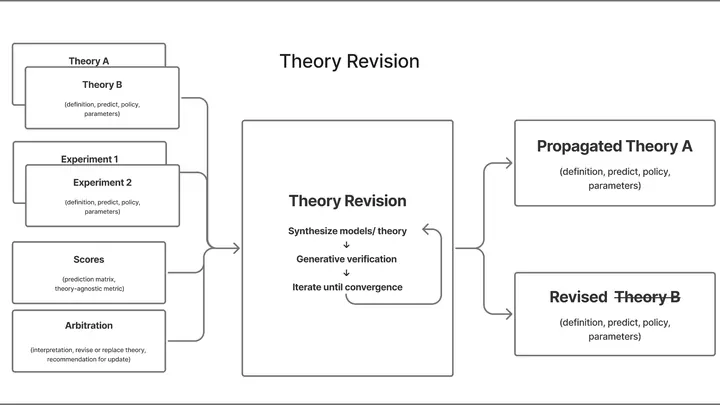
A closed loop: the machine proposes an idea, tests it on people, sees the failures, and spawns a new, more accurate guess. That's how AutoCog works — an automatic cognitive scientist. Previously, in the science of thinking (cognitive science), the hardest part, coming up with a theory, was done only by humans.
When the Mind Honestly Says 'I Don't Know'
A person looks at a door lock and sees a keyhole. They know that a key is inserted and turned. But if instead of a keyhole there's a touch panel, the familiar frame breaks. The person doesn't just make a mistake: they realize that the usual approach won't work and can say, "There's no place for a key here; a different approach is needed." Such an honest stop with an explanation is rare for machines.
q-bio.QM2026-05-221 minarXiv:2605.23745express
A Chemical Computer in a Test Tube
Molecules float in a test tube. Their abundance (say, the concentration of some protein) becomes the input signal. And the output isn't just a cloudy solution but a clear yes-or-no answer. The authors build a chemical cascade that does exactly that.
Handwriting Without an Alphabet: How the Brain Draws Letters It Has Never Seen
The hand traces the word "mom" in the air — familiar arcs and strokes. The brain, meanwhile, is not flipping through a photo of each letter. It launches a chain of simple movements.
Neurons Speak Plain Language
An artist paints a picture, glancing at the audience in the hall. If the viewer smiles, the artist adds more red and rounded lines to the canvas; if the viewer frowns, the artist removes blue and sharpens the angles.
Optics2026-05-022 minarXiv:2605.01306express
Seeing the Invisible Gas: Lasers and Machine Learning
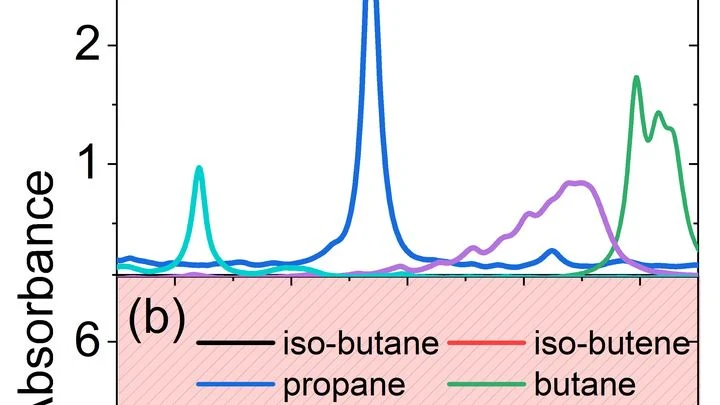
A hundred people are talking at once in a large hall. You try to hear one, but voices blend, some whisper, and you don't even suspect the existence of others. That's roughly how a conventional laser gas analyzer feels when dozens of substances mix in a combustion chamber or a factory pipe.
Smell and Color, Wired Together
A summer meadow surfaces in memory not just as a picture — along with it come the scent of grass and the warmth of the sun. The brain glues sensations into a single image, and that image holds up better than any one sensation alone. But exactly how neurons stitch the visual to the olfactory has long been a mystery.
Computer Vision2026-04-251 minarXiv:2604.23137express
Two Eyes Are Better Than One: How a Neural Network Learns to See Tumors
A doctor studies a brain scan: somewhere in the tangle of tissue, a tumor is hiding. One glance picks out small spots and edges, another takes in the overall shape and location. A person combines both, but across hundreds of scans that gets tedious. A new program does the same thing automatically.
cs.IR2026-04-203 minarXiv:2607.00004
Teaching Neural Networks a Common Language: Overcoming the Vocabulary Gap
52.4 nDCG@10—that's the result ModernBERT achieves after Vocabulary Transfer. Just yesterday it stumbled over letter case, and today it outranks the best sparse retrievers. A neural network flunks search because it can't agree on words. 'Token' and 'token' are two distinct universes to it.
How the Brain Conducts Speech
Speech is like an orchestra where every note must sound at just the right moment. The brain turns a thought into a chain of sounds in a fraction of a second, and until now it was unclear how it manages this hierarchy — from individual sounds to syllables to whole words.
How the Brain Packs a Picture
Neurons in the brain and nodes in artificial neural networks don't just fire with simple yes/no signals; they also handle smoothly varying quantities, like where an object is and how big it is. But neural responses are finicky: the same stimulus triggers slightly different bursts of activity each time.
The Brain Learns by Making Neurons More Alike
A chef's knife and a peeler each handle different tasks, but when a cook learns a new recipe, they often grab the same knife for everything. The brain seems to do the same when mastering a new skill of distinguishing patterns. In the experiment, monkeys trained for weeks to tell apart barely noticeable differences in complex patterns.
Ideas Nobody Was Looking For
Science is like a city where residents pave the streets themselves. Where paths are already worn, new houses go up, while untouched vacant lots go unnoticed — not because building there is impossible, but because no one ever looks.
Machine Learning2026-03-011 minarXiv:2603.01274express
Transparent Chemistry: How AI Explains Its Predictions
A medicinal chemist is like a detective searching for the right compound among millions of suspects. Modern neural networks speed up the search but behave like a witness who says "it's him" and refuses to elaborate. In pharma, such secrecy is dangerous: a spurious correlation could send a toxic compound to the next stage of trials.
Machine Learning2026-02-262 minarXiv:2602.23179express
How Language Models Spot Repeats in Proteins
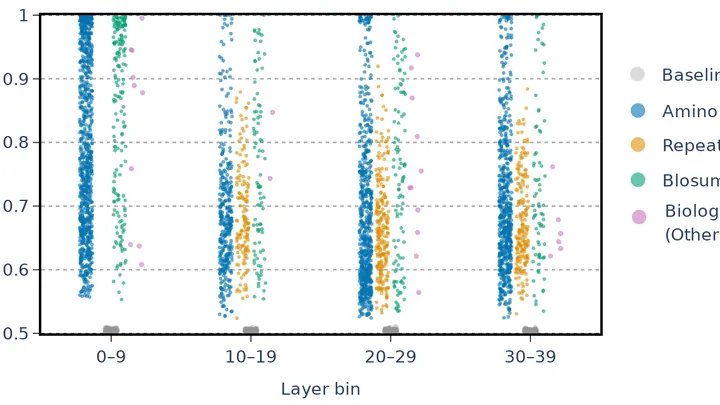
Proteins are chains of amino acids, and they often contain repeated chunks. Sometimes the repeats are exact, like the same phrase said twice. Sometimes they come with typos: a couple of letters swapped, but the meaning is the same. These repeats matter: they help the protein fold into the right shape and do its job.
q-bio.QM2026-02-262 minarXiv:2602.23269express
Training Neural Networks on Less, but Smarter
Proteins in nature are as numerous as grains of sand on a beach, and each has its own job: some break down food, others build cells. But to understand what a specific protein does, it must be studied in the lab — a slow and expensive process.
Machine Learning2026-01-311 minarXiv:2602.00526express
Breathing Turns into Sleep
At night, a person breathes, and the rhythm of that breathing can tell you a lot about their sleep. But usually, doctors look at the brain's electrical waves — recorded by sensors on the head. New work shows how to reconstruct those waves from breathing alone, without touching the head. The model acts as a translator from the language of the body to the language of the brain.
Machine Learning2026-01-213 minarXiv:2601.15530express
Catching Alzheimer's Without a Poke
A detective is looking for a criminal in a file of mugshots, but the portraits are mixed up. Usually, they expect a man with a gray beard, but the culprit is young and clean-shaven. Similarly, doctors often fail to recognize Alzheimer's disease in those who show unusual symptoms — not memory loss, but problems with vision or speech.
Medical Physics2026-01-021 minarXiv:2601.00685express
Brain Radiation Therapy: One Click Instead of Manual Setup
When a tumor affects the entire brain, doctors irradiate the whole organ. It's a reliable method, but setting up the radiation is painstaking: you need to adjust parameters so the tumor gets the right dose while the eyes and lenses suffer as little as possible. A specialist typically spends about 15 minutes manually tweaking settings in the software.