Fountain of Debris: Where the Dust Settled After the DART Impact ✛
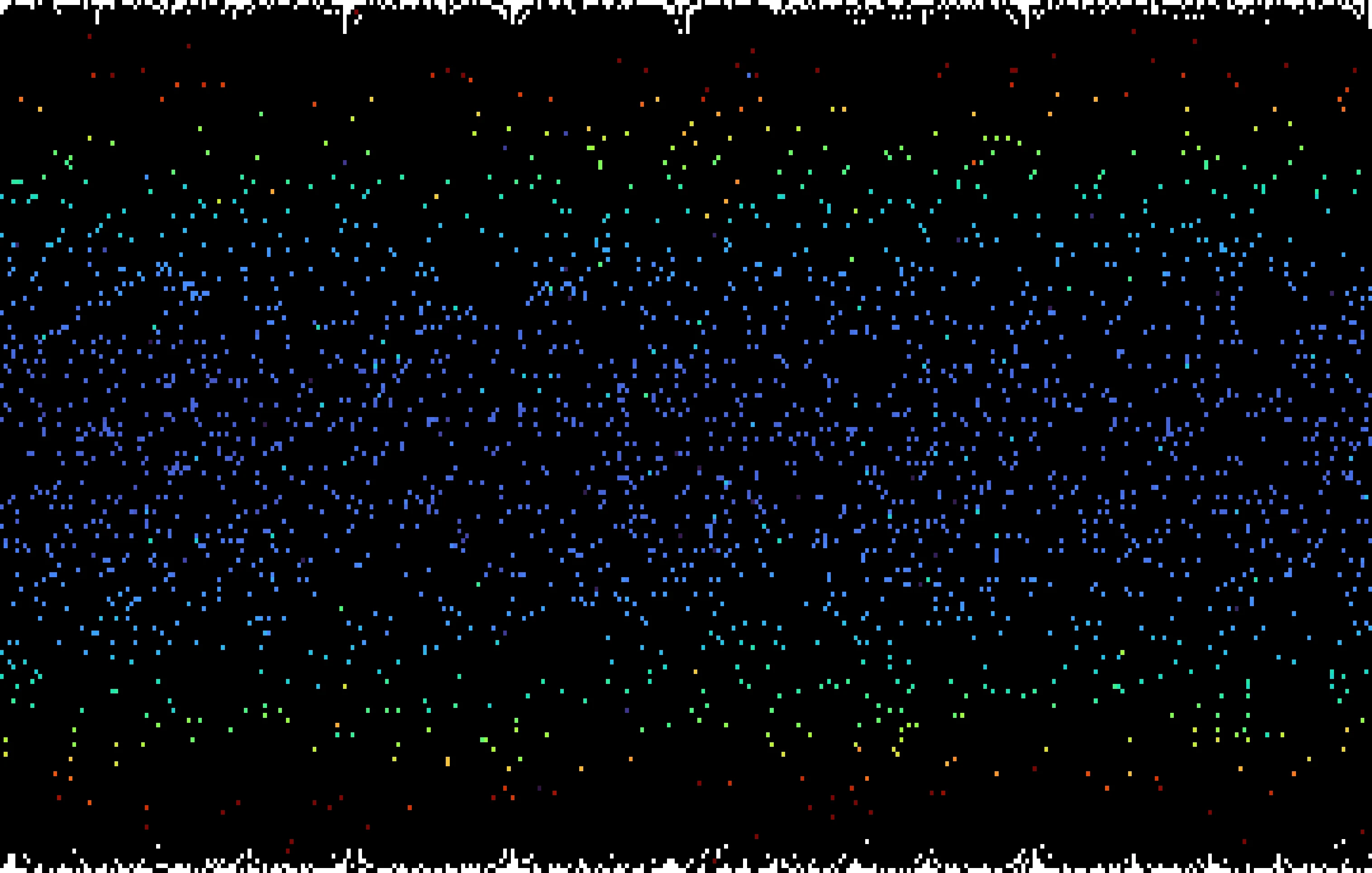
On September 26, 2022, the DART probe slammed into the natural satellite at a speed of 6,6 km/s. A fountain of debris burst into space. Rocks, dust, sand grains — everything erupted in a silent flash.
Two years later, a numerical simulation of 20 million trajectories revealed the fate of each particle. 93,5% of the ejecta left the system forever. Like splashes from a garden hose, they were accelerated by Sun (light pressure, a weak but constant push). The gravity of the asteroids proved too weak.
But the fountain did not disappear without a trace. A tiny fraction — 0,002% — remained nearby. Some fell back onto both bodies. On Dimorphos, the layer reached 1,5 mm. On the main asteroid Didymos, the picture is more complex.
Everything hinged on the direction of the ejecta cone. It was measured with the help of the Edwin Hubble and the LICIACube cubesat. When the cone points nearly opposite to the impact, a compact 'patch' forms on Didymos. The layer thickness there is 3–11,5 mm. This is tens of times greater than elsewhere.
Such a fallout map is not just a curious fact. In 2026, the Hera mission will arrive. Its instruments will verify the calculations. But the residual swarm of particles is still dangerous. The spacecraft could collide with it.
The fountain of debris has almost dried up. Its trace remains — a pattern of dust on the rocks. When Hera takes its first images, the imprint of the impact itself will be revealed.
If Dimorphos were the size of a football field, the layer of fallen dust would be thinner than a human hair.
Kinetic impact is a favorite technique of Hollywood blockbusters from 'Armageddon' to 'Don't Look Up', but DART tested it in reality for the first time without nuclear charges.