The leading explanation for the Moon's origin is the giant-impact hypothesis: a Mars-sized body, sometimes called Theia, struck the young Earth about 4.5 billion years ago. The collision vaporized part of Earth's mantle and the impactor, forming a disk of debris around Earth that eventually coalesced into the Moon. This idea elegantly explains the Moon's large size relative to Earth, its lack of a substantial iron core, and the similar isotopic composition of lunar and terrestrial rocks — a geochemical puzzle that older capture or fission models struggled with.
History
The hypothesis was proposed in the mid-1970s by William Hartmann and Donald Davis, and independently by Alastair Cameron and William Ward, following the Apollo missions that revealed the Moon's geochemical similarity to Earth.
How it works
The impactor's iron core merged with Earth's core, while the lighter rocky material from both bodies was ejected into orbit. This debris formed a hot, partially molten ring around Earth. Over thousands of years, gravitational clumping assembled the debris into the Moon. Because the material came mostly from the mantles of both bodies, the Moon is depleted in iron and has a composition close to Earth's outer layers, matching observations.
In practice
It guides planetary formation models and helps interpret the early history of the Earth-Moon system, including the timing of Earth's core formation and the onset of plate tectonics.
Fun fact
The Moon is actually older than its oldest surface rocks — the lunar crust crystallized about 150 million years before the oldest samples brought back by Apollo astronauts.
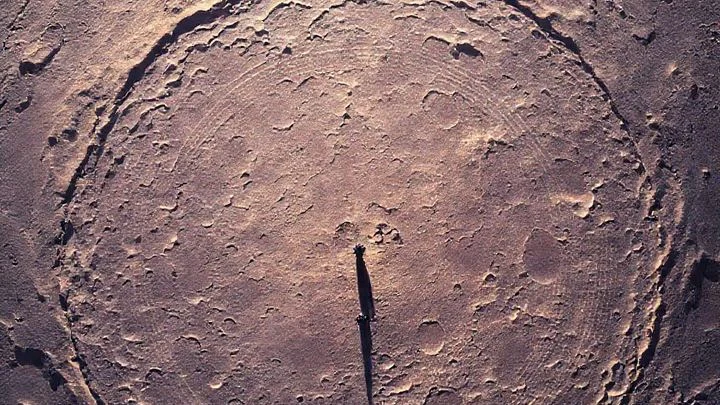
On the surface of the Moon and asteroids, you can find pits smaller than a pinhead but with shiny, melted rims. Such marks are left by tiny meteorites, but the exact impact speed at which melting occurs remained unclear.
On September 26, 2022, the DART probe slammed into the natural satellite at a speed of 6,6 km/s. A fountain of debris burst into space. Rocks, dust, sand grains — everything erupted in a silent flash.
Two years later, a numerical simulation of 20 million trajectories revealed the fate of each particle.
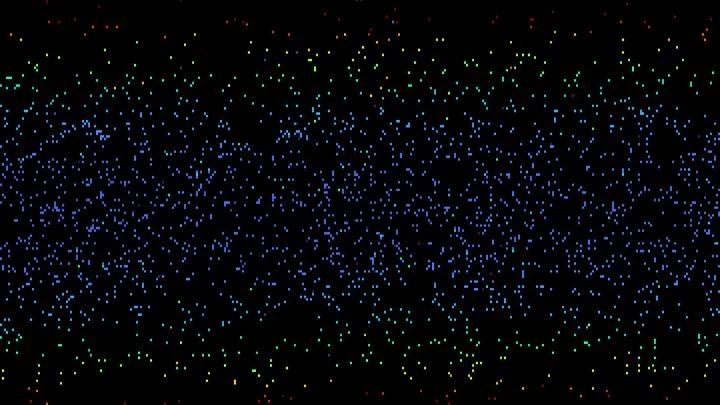
The Moon is an airless sphere of dense rocky grit called regolith. When fast particles from space slam into it, muons are born in the soil — unstable relatives of electrons, but two hundred times heavier. Most fly downward and fade away in the depths. But those that pop upward into the vacuum can travel tens of kilometers before decaying.
A ball, almost weightless for its size, circles its star every four days. Planet TOI-2195 A b is a real riddle: by mass it's slightly heavier than Neptune, yet bloated to Jovian volumes. If there were an ocean big enough, this exoplanet would float on its surface like a giant inflatable ball.
Young Earth was a boiling sphere of liquid rock, while Theia, which crashed into it, had had time to cool and solidify. It’s like dropping a chunk of cold butter into a pot of soup: the soup splashes out, but the butter barely moves. Similarly, Earth’s interior spewed into space, forming a cloud of cosmic dust and debris.
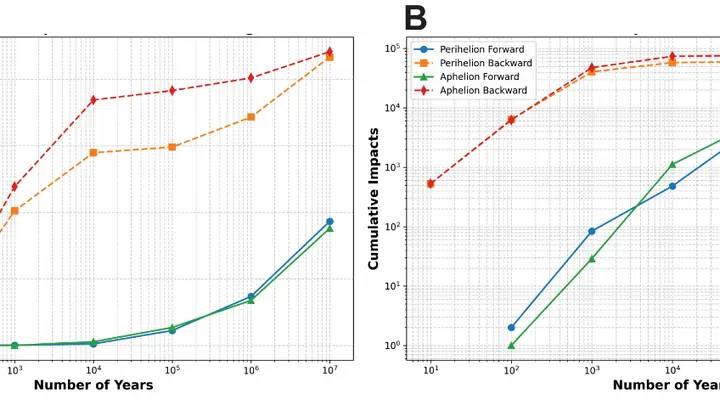
On the periphery of the Solar System lurk thousands of objects comparable in size to an exoplanet — a body of planetary mass not bound to our star. Their orbits are chaotic, and from time to time the trajectory of such a wanderer crosses Earth's path.
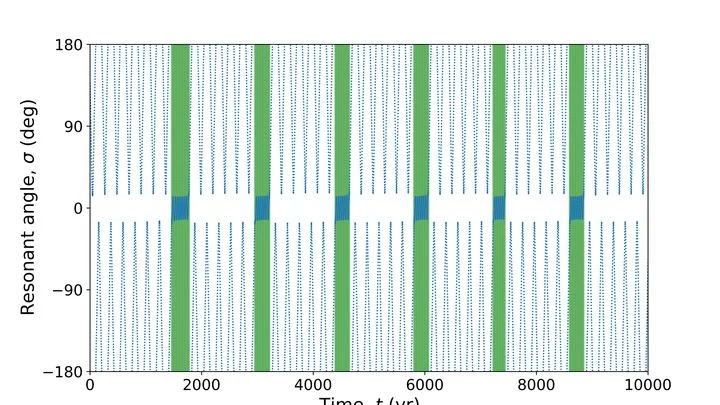
Eight hundred million years ago, in the main asteroid belt, a giant inkwell shattered. The parent body, over a hundred kilometers in diameter, made of primitive carbonaceous chondrites, suddenly broke apart near the J3:1 resonance with Jupiter.
The idea of extraterrestrial origin of life has long excited minds. Fred Hoyle believed bacteria travel between stars. A new study tested a similar but closer route: from Mars to Earth. In ancient times, Mars had water, and asteroid impacts knocked rocks with microbes into space.
Back in the 1960s, physicist Joseph Weber tried to catch gravitational waves using aluminum cylinders: they were supposed to tremble like tuning forks from the ripples of spacetime.
If you don’t stir a layered cocktail, the heavy syrup sinks to the bottom. A young planet is much the same — a seething ocean of molten rock. As it cools, minerals crystallize: some, like iron, get heavy and sink, while others float. You’d think a dense layer would pile up at the core.
At the edge of the solar system, far beyond Neptune's orbit, something is knocking icy chunks off their paths. Their orbits are stretched and tilted in the same way, as if an invisible hand arranged them in a pattern.
The light from a distant star is never steady. It shimmers like heat over hot asphalt. When astronomers pointed JWST at the star TOI 700, they saw this shimmer especially clearly: every 16 minutes, the brightness changed by a tiny fraction, just 46 parts per million.For comparison: if you placed a light bulb a kilometer away, this change would be…
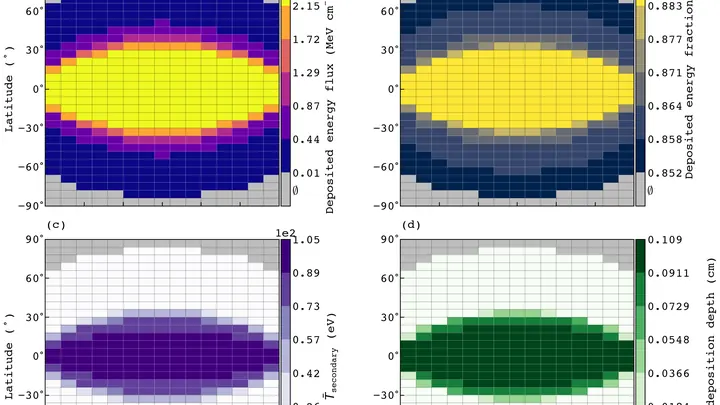
Europa's surface is an icy armor continuously bombarded by charged particles from Jupiter's magnetosphere. Electrons slam into the ice's crystal lattice, lose energy, and kick off chemical reactions. Until now, there was no tool to show how deep such bombardment pierces the ice.
When a baker kneads dough, the grains of flour can tell you which mill they came from. It's the same with Earth: the composition of iron in its depths preserves a memory of where the pieces that assembled the planet were born.
In its youth, Earth resembled a beehive: it grew by sticking together from countless rocky chunks. When the main construction was over, a late swarm of meteorites rained down on the young planet — the so-called late veneer. These impacts, scientists thought, brought platinum, gold, and other rare metals to Earth's upper layers.
The light of every star is its unique passport, but the entries are written in the language of spectra and colors. For old giants, such documents are almost indistinguishable: their spectra overlap, and deciphering the details by hand was practically impossible.
Saturn's system 300 million years ago resembled a crowded dance floor. The most massive moon, Titan, began to migrate, and this movement threw its neighbors off balance. One moon crashed into Titan; the debris swirled into a vortex, gathering into Hyperion.
In the northern part of Arabia Terra, there are fields that look like a giant brain: ridges and troughs wind like convolutions. On Earth, similar patterns form in cold regions when water in the soil freezes and thaws, causing stones to sort themselves into stripes. But the Martian ridges are taller — averaging 3.29 meters — while Earth's mechanisms produce less than half a meter.
Gravitational waves are ripples in spacetime curvature that imperceptibly stretch and squeeze everything around. But the Moon, like a bell, catches these waves: as a gravitational wave passes through it, it makes our satellite vibrate.
Titan, discovered by Christiaan Huygens in 1655, resembles a canvas that is constantly being repainted. Impacts from cosmic dust and asteroids leave crater marks on it. But an invisible artist, the moon's own forces, time and again covers everything with a fresh layer, erasing old strokes.
Kamo'oalewa is Earth's partner in a peculiar gravitational dance: it orbits the Sun almost in unison with us, edging closer and then pulling away. Its color — the palette of reflected light — matches the lunar surface. Hence the initial thought: it's a chunk of the Moon from the Giordano Bruno crater.
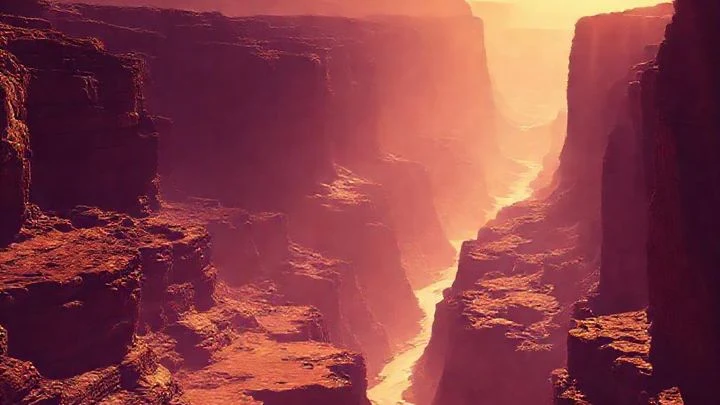
For a long time, the climate of ancient Mars remained a mystery: the beds of dried-up rivers spoke of water, but models couldn't explain how it got there — after all, 4 billion years ago the Sun shone 30% dimmer. New research shows that the planet swayed, as if on a swing, between long glaciations and short wet epochs.
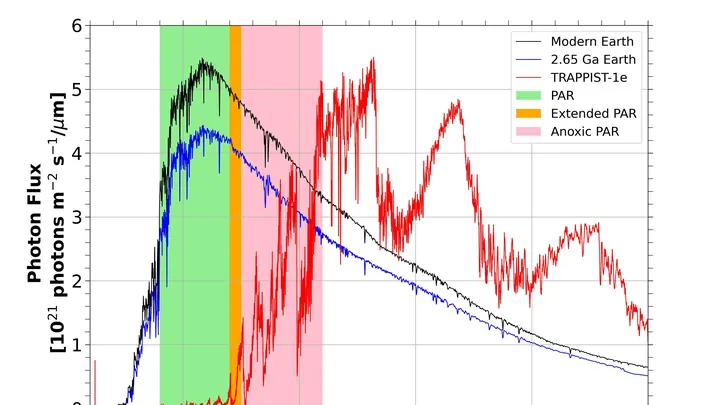
On the exoplanet TRAPPIST-1, oxygenic photosynthesis, the process by which light energy is converted into chemical energy with oxygen as a byproduct, is losing the race for survival. This M-dwarf star emits mostly in the infrared, not in the visible range like the Sun.
In the darkness of interstellar space drift millions of rogue planets — worlds not bound to any star. They are almost impossible to see, but when such a wanderer passes in front of a distant star, its gravity bends the light and momentarily creates a cosmic magnifying glass.
When countless asteroids pummeled the young Earth, they tore chunks from its mantle. These fragments spiraled in a cosmic disk around the planet and, like a snowball in a blizzard, fused into the Moon.
Lunar rocks brought a puzzle: their age is 4.35 billion years, but the Moon itself should have appeared 150 million years earlier. The missing time is hidden in tidal heating. When the Moon hung closer to Earth, Earth's gravity acted like tireless hands: it constantly kneaded and bent the satellite.
The Moon is not just a rocky sphere, but a giant bell. Passing through it, gravitational waves cause it to vibrate almost imperceptibly. This tremor was predicted by Einstein, and Weber was the first to try to hear it with Earth-based detectors.
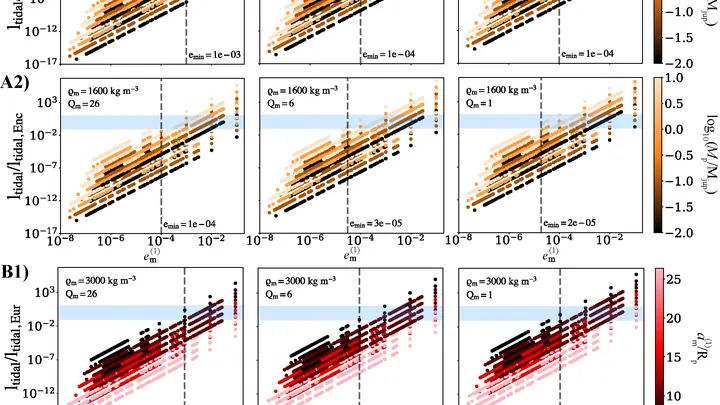
The planet's gravity rhythmically squeezes and kneads the moon like dough: from this constant 'kneading', the interior heats up, and oceans of water can persist under the icy crust for ages.
In the Galaxy, there are plenty of rogue planets, thrown out by supernova explosions.
After the Moon's birth, Earth resembled a sizzling lump of dough: a continuous liquid magma and a dense shroud of gases. The Moon acted like a giant spoon, constantly kneading this lump with its gravity. Friction generated heat, delaying cooling.
The Moon can have its own tiny moon — like a nesting doll, but in space. The outer doll is a planet, the middle one is a moon, the inner one is a small moon-satellite, or submoon. Ньютон showed that all bodies attract each other, and gravity holds them together.
The Moon harbors a secret that has puzzled planetary scientists for decades: its isotopic composition is almost indistinguishable from Earth's. According to the canonical giant impact model, the Moon should have inherited most of its material from the impactor Theia, a Mars-sized planet that slammed into the young Earth.