Concentration in chemistry refers to the amount of a solute present in a given quantity of solution or solvent. It is commonly expressed in moles per liter (molarity), but can also be given as massfraction, parts per million, or percentage. Concentration governs reaction rates, equilibrium positions, and many physical properties of solutions, such as osmotic pressure and boiling point elevation.
History
The quantitative study of concentration began with the work of Jacobus Henricus van 't Hoff and Svante Arrhenius in the late 19th century, who developed the laws of chemical equilibrium and the concept of molarity. Earlier, Robert Boyle and others had noted the relationship between pressure and gas concentration (Boyle's law).
How it works
The effect of concentration is rooted in the frequency of molecularcollisions. In a more concentrated solution, solute particles are closer together, increasing the chance of effective collisions that lead to chemical reactions. For example, in a reaction A + B → C, doubling the concentration of A doubles the rate if the reaction is first-order in A. Concentration also drives diffusion and osmosis, as particles move from high to low concentration to achieve equilibrium.
In practice
Concentration is controlled in countless industrial processes, from brewing and pharmaceuticals to water treatment. In medicine, intravenous fluids are carefully formulated to match blood plasma concentration, and in environmental science, pollutant concentrations are monitored to ensure safety.
Fun fact
The pH scale is a logarithmic measure of hydrogen ion concentration, where each unit change represents a tenfold change in acidity—so a solution with pH 3 is ten times more acidic than one with pH 4.
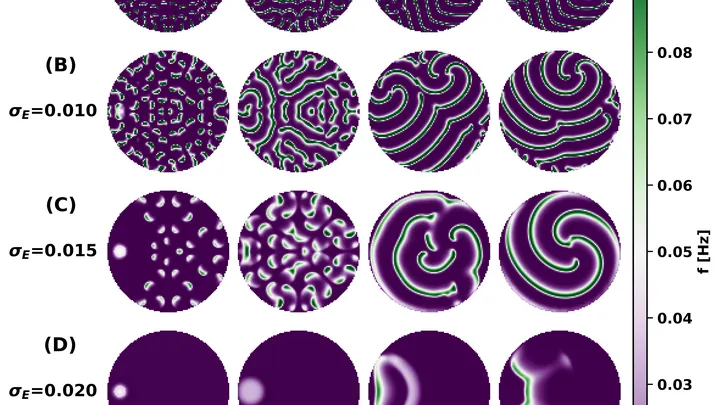
Two ink reservoirs stand on opposite sides of the cell junction. From them, two types of monomers flow onto the membrane, and when they meet, they form viscous droplets of complexes. The droplets barely move, but the free monomers dart around as fast as perfume molecules in a room.
A proton beam aimed at a tumor cuts through soft tissue like a knife through butter, but its range depends on the subtle properties of water, the stuff we're mostly made of. Water is the body's main component, and how quickly protons slow down in it determines exactly where they deposit their energy.
If a smell seeps into a room through a slightly open door, you could stand in the middle and sniff. But the most accurate way to catch the moment the smell arrives is to stand right at the threshold. A cell behaves much the same way when it needs to measure the concentration of a substance around it.
When sugar goes into tea, it dissolves. But why doesn't it just fall back out? It's all about chemical potential — a quantity that shows how 'favorable' it is for a substance to be in a given place and state. For a pure substance, it's easy to calculate, but for a mixture of several components, it's a real puzzle.
Inside every cell, things are constantly meeting and parting. Some pairs hold tight, like Velcro, while others barely touch, like pollen on the wind. These fleeting touches, where the binding strength is comparable to a grain of salt dissolving in a glass of water, govern many of the cell's signals and decisions.
Inside every cell, construction never stops: molecules constantly cluster together and drift apart. Sometimes they form dense droplets, like oil in water, but without a membrane. These droplets act as temporary storage: they hold proteins, gene copies, or DNA repair tools.
Molecules float in a test tube. Their abundance (say, the concentration of some protein) becomes the input signal. And the output isn't just a cloudy solution but a clear yes-or-no answer.
The authors build a chemical cascade that does exactly that.
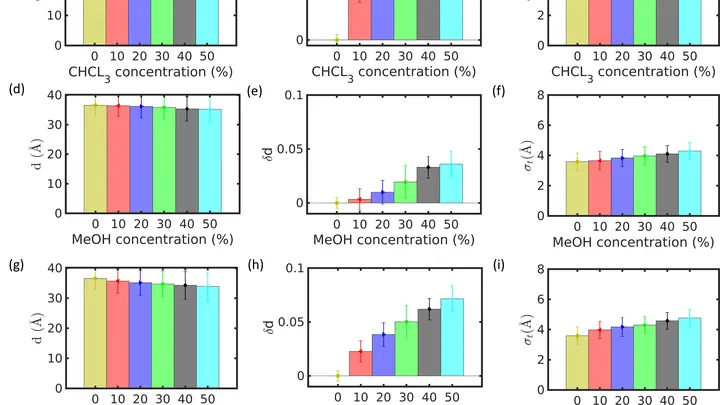
A cell membrane is like a picket fence of tightly packed molecules — long as matchsticks, with a water-loving head and a water-fearing tail. It's not just a wrapper but a living barrier: it lets the right things in, keeps the wrong ones out, and holds its shape. But add a bit of chloroform or alcohol to the water, and that fence starts to sway.
Spread a handful of coins on the table. Each coin is a possible outcome: heads, tails, or something else. If we know how chaotic this set is (its entropy), which combinations of probabilities will we encounter more often? It turns out the answer depends on how much chaos we allow.
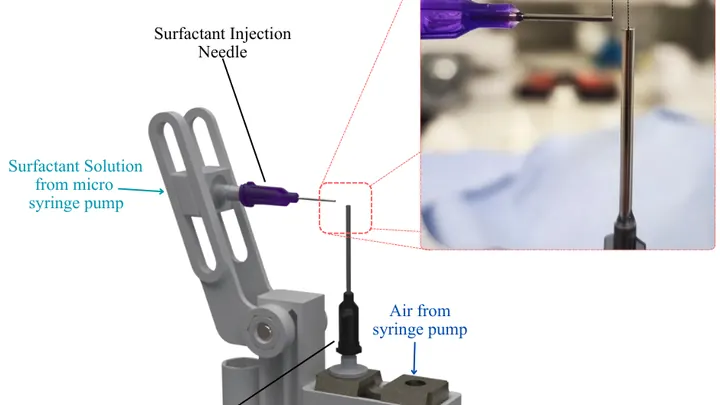
An air bubble escapes from a thin needle at the bottom of a glass and shoots upward. In clean water, it behaves like a spring: it flattens, then stretches, exchanging energy between motion and shape. Add a drop of soap to the water, and the bubble immediately calms down, becomes an almost perfect sphere, and rises smoothly without trembling.
A neuron that has just calmed down is like a pianist lifting their hands from the keys. But inside, silent work continues: tiny pumps push chloride ions outward, returning the instrument to a state of readiness. If the pumps fall behind, chloride builds up, and then an inhibitory signal meant to quiet the cell suddenly starts exciting it.
Water is the only common liquid that doesn't immediately contract when cooled. Ice melts, and water becomes denser, but only up to 4 degrees Celsius. Beyond that, with further cooling, it expands again. This quirk explains why fish survive in freezing ponds: the densest water sinks to the bottom, while a lighter cold layer stays on top and turns into ice.
A seven-metal alloy is like a team where every player is pulling the blanket their own way. Atoms of iron, cobalt, nickel, aluminum, titanium, tantalum, and vanadium can either fall into a strict pattern or scatter into random positions. This determines whether the material will be as strong as steel or as light as aluminum.
Gold on carbon is a classic pairing in chemistry. Such materials speed up important reactions, like producing vinyl chloride for plastics. But until now, no one had seen in detail how gold atoms behave on a graphite surface when the whole thing is immersed in a liquid.
The proton is not a solid ball. Inside, it's a seething mix of quarks and gluons. Gluons are the particles that glue quarks together, much like wood glue binds pieces of wood. The question is: how much of the proton's "weight" comes from this glue? Physicists have calculated this on a computer by discretizing space and time into a fine grid.
Salt in a glass of water is a crowd of charged particles. When there's plenty of water, each particle floats on its own, wrapped in a thick fur coat of water molecules. But as you keep adding salt, the water runs out for everyone, and the particles start seeking each other out. First, they stick together in pairs, then in larger clumps.