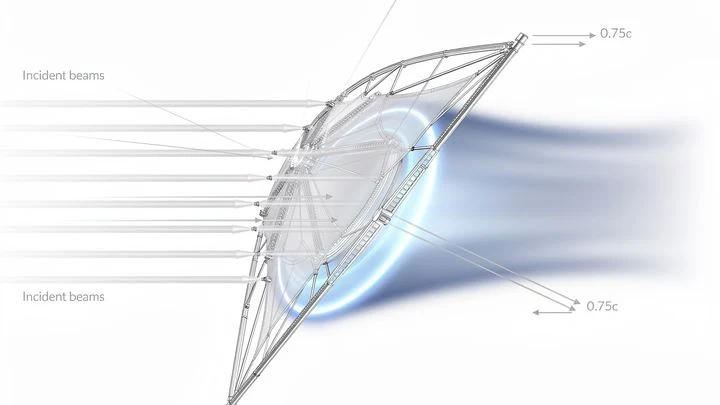
Lightpressure, also known as radiation pressure, is the force exerted by electromagnetic radiation on a surface. Although light has no mass, it carries momentum, and when photons strike a surface, they transfer that momentum, producing a small but measurable push. This pressure is crucial in astrophysics, where it drives stellar winds and can even blow away the outer layers of stars, and it is the principle behind solar sails for spacecraft propulsion.
History
The concept was first proposed by Johannes Kepler in the 17th century to explain why comet tails always point away from the Sun, and it was later derived theoretically by James Clerk Maxwell in 1873 from his equations of electromagnetism.
How it works
When a photon hits a surface, it can be absorbed or reflected. If absorbed, its momentum is transferred entirely to the surface; if reflected, the momentum transfer is twice as large because the photon's momentum reverses direction. The total force is the rate of momentum transfer per unit area. For sunlight at Earth's distance from the Sun, the pressure is about 4.5 × 10⁻⁶ newtons per square meter — tiny, but over large areas and long times, it can have significant effects.
In practice
Lightpressure is used in solar sail technology for spacecraft propulsion, and it must be accounted for in the orbits of satellites and in the design of high-power laser systems.
Fun fact
A solar sail the size of a football field would experience about 0.01 newtons of force from sunlight — enough to slowly accelerate a small spacecraft to high speeds over months.
A laser hits an atom, and tears out an electron. The brighter the light, the stronger the kick, and the faster the electron flies away. That's how the familiar picture works, where light is a smooth wave. But what if the light isn't smooth but 'squeezed,' with quantum fluctuations, like the trembling of a string?
Imagine a three-faced dancer on the crest of a light wave. One face is a catcher, absorbing incoming photons. The second is a perfect mirror, throwing light back. The third is frosted glass, scattering rays in all directions. As long as speed is low, the dance is harmonious. But at near-light speeds, the choreography breaks.
This is like a surfer chasing a wave.
In the heart of a molecular cloud, a massive star is born. Its ultraviolet light ionizes hydrogen, and the cloud flares in the Lyman-alpha line. But for the photon, this flare is not liberation but imprisonment in a hall of mirrors.