Cosmic dust consists of solid microparticles of carbon, silicates, and ices, born in the atmospheres of cool giant stars or during supernova explosions. It absorbs ultraviolet and visible light, re-emitting energy in the infrared range. Dense dust clouds can completely hide objects in the optical spectrum, so astronomers use infrared and radio telescopes to study them.
History
The existence of dark regions in the Milky Way has been known since antiquity, but their nature remained a mystery for a long time. In the 18th century, William Herschel suggested they were 'holes in the heavens'. Only in the early 20th century did Edward Barnard and other astronomers prove that they are clouds of light-absorbing matter. A decisive contribution was made by Robert Trumpler in 1930, who showed that distant star clusters appear redder and dimmer due to interstellar absorption, revealing the existence of scattering dust particles. Later, spectroscopic and infrared observations allowed detailed study of the composition and distribution of dust.
How it works
Cosmic dust interacts with electromagnetic radiation through absorption (photons turn into thermal energy) and scattering (photons change direction). Mie theory is used to describe scattering on spherical particles, and the Rayleigh approximation for very small particles. Dust also emits in the infrared range according to Planck's radiation law, modified for emissivity depending on composition. Chemical reactions on the surface of dust grains, including the formation of molecular hydrogen, are catalyzed by low temperatures and a large surface area. Elongated particles, aligned by the galactic magnetic field, cause partial linear polarization of transmitted light (polarimetry).
In practice
Cosmic dust forms planets and even living organisms; moreover, dust clouds scatter radio waves, creating interference for satellite communications and navigation.
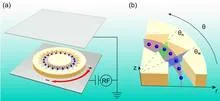
In a ring-shaped channel between two toothed rings, microspheres are suspended: some with a radius of 8 micrometers, others 14. The discharge is switched on, and the particles start moving. The small ones go one way, the large ones the other. It is like a shopping mall where escalators for people of different heights run in opposite directions.
A filament of the cosmic web stretches through the young universe, and strung along it like beads on a necklace are galaxies. In the core of the SSA22 protocluster, which in a few billion years will become the center of a massive cluster, these beads are still hot and dusty: stars are being born inside them, and cold gas serves as fuel.
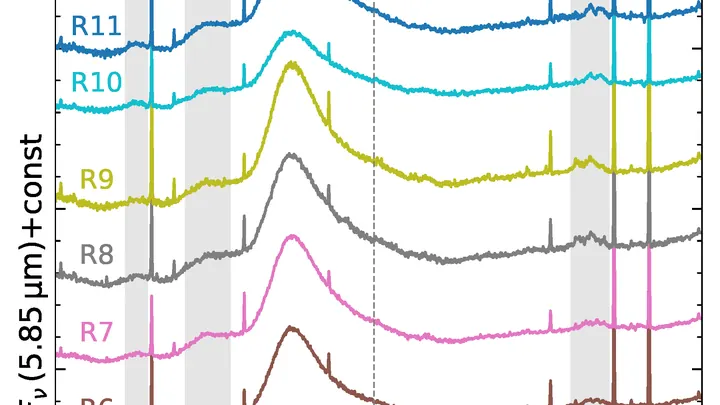
The Tarantula Nebula is a giant stellar nursery in a neighboring galaxy. Hundreds of thousands of stars are born there, and their light illuminates clouds of dust. This dust glows in the infrared, and its spectrum shows mysterious bands. For a long time, astronomers debated which molecules produce them.
In the southern sky, behind a dense veil of dust, hides a source of gamma rays — the most energetic light in the Universe. It shines so brightly that it can be seen even through this veil, but the object itself remains invisible. Astronomers pointed the ALMA radio telescope at the neighboring gas clouds and saw a pattern that gave the invisible object away.
Light from a distant galaxy reaches us through its own dust. This dust is not a smooth haze but ragged clouds, like wisps of cotton. Old models treated it as a uniform mist, and then the galaxy didn't add up energetically: too much light disappeared in the ultraviolet and too little came back in the infrared.
Astronomers did what a cook does when they dice a potato instead of tossing it in whole.
The night sky is full of deceptive lights. Astronomers were searching for galaxies that ignited in the first few hundred million years after the Big Bang: their light has traveled to us for nearly 13 billion years. Six faint smudges were selected from images taken by the Hubble and Spitzer space telescopes.
In the coldest, darkest corners of space, dust grains get covered in ice, like a window on a frosty day. This ice isn't just frozen water: it also contains carbon monoxide and carbon dioxide. From such ice, comets and planets may eventually assemble. But until now, it was unclear how the dust grain itself affects the ice that forms on it.
In July 1969, as Apollo 11 flew toward the Moon, astronauts noticed something unusual: brief flashes of light that appeared even with their eyes closed. At first, this was attributed to fatigue, but the flashes recurred in different crews. Gradually, it became clear: cosmic rays were to blame — tiny particles hurtling through space at tremendous speeds.
An accountant tallies up all the factories, warehouses, and shops, but the balance doesn't add up — half the inventory seems to have evaporated. That's roughly how astronomers have spent decades searching for ordinary matter in the present-day Universe.
The night sky looks calm, but in reality, invisible particles, cosmic rays, are constantly flying through us. Among them are electrons and their antimatter counterparts, positrons. When they collide with detectors on satellites or balloons, the instruments record their energy.
When stars are born in a galaxy, they make hydrogen glow, like a neon sign, but on a cosmic scale. This light could tell us a lot about how many stars are forming, but on its way to us, it passes through cosmic dust. Dust is like a fogged-up window: it dims the glow and alters its color.
Boiling milk develops a trembling skin. By watching its movements, you can guess the strength of the fire beneath the pot and the fat content of the milk. In a similar way, astrophysicists peer into the ancient microwave radiation — the oldest light that has reached us from an era when the universe was only 380,000 years old.
In the first moments after the Big Bang, the universe resembled a boiling cauldron. According to one hypothesis, dark matter, the invisible substance that holds galaxies together, could have been born there.
A homogeneous, spherical cloud of cosmic dust begins to contract under its own gravity. At some point, by classical laws, it should collapse into a point of infinite density — a singularity.
In dark interstellar clouds where new stars are born, chemistry starts with a tiny particle — the trihydrogen ion (H₃⁺). It collides with other atoms and sets off a cascade of reactions that build ever more complex molecules. For a long time, it was thought that the main reaction producing it, H₂⁺ colliding with H₂, only happens in the gas phase.
The five-hundred-meter FAST radio telescope picked up a signal at the 21-centimeter wavelength — the telltale glow of cold hydrogen. The signal came from a cloud named Cloud-9. It hangs in space near the galaxy M94, but it contains not a single star.
Cosmic rays aren't rays in the usual sense: they're fast particles bombarding Earth from all directions. Mostly they're protons and atomic nuclei. Their energies vary widely, from modest to fantastically huge. When such a particle heads our way and the Moon or Sun gets in its path, it gets absorbed.
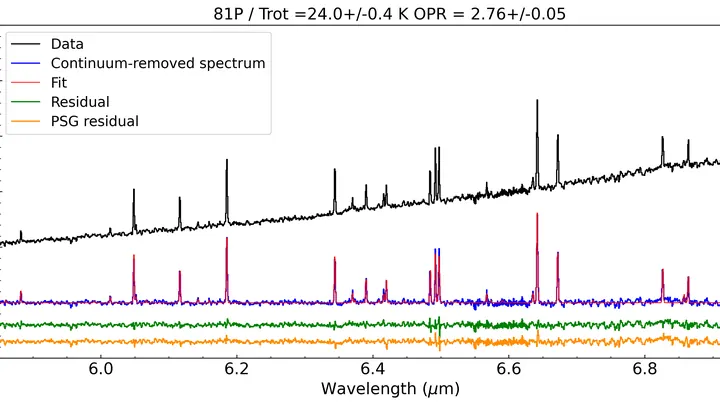
In March 2023, the James Webb Space Telescope pointed its instruments at the short-period comet 81P/Wild 2. This celestial body, about the size of a small town (nucleus radius around 1.77 km), is already familiar to scientists: in 2006, the Stardust probe flew through its tail and collected dust samples that were later studied in Earth laboratories.
Around a just-ignited star swirls a vortex of dust and gas. This vortex, the protoplanetary disk, grows by accreting material from the surrounding cloud.
In the first moments after the Big Bang, the universe was a searing 'soup' of particles. As it cooled, phase transitions occurred — much like water turning to ice. At one such moment, magnetic monopoles of dark matter could have been born: tiny clumps of field with a single magnetic pole.
In the furnace of star formation, the heat reaches 900 degrees Celsius, like a glowing blast furnace. It is in this hellish heat that cosmic crystals are born. Astronomers have for the first time caught the moment when crystalline dust appears right during an accretion flare (when the star gobbles up surrounding gas) at the very young star EC 53, still cocooned in dense gas.
In the black depths of space, on the surfaces of tiny icy dust grains, a quiet construction is underway. There, where temperatures drop to near absolute zero and harsh radiation abounds, the ordinary amino acid glycine, the simplest protein building block, links up with itself.
In a dark room, music plays. Powder is scattered on the floor — fine, almost invisible. Low frequencies make it gather into intricate patterns: filaments, clumps, voids. In much the same way, gravity over billions of years weaves galaxies into the cosmic web — except here, attraction does the work instead of sound waves.
Jupiter's atmosphere resembles a layered cake, where each layer plays its role. Scientists took data from four instruments at once (VLT/MUSE, Cassini/VIMS, IRTF/SpeX, and Juno/JIRAM) and built a model of clouds and ammonia in the planet's equatorial zone, from 0.1 to 10 bar (pressure equivalent to hundreds of kilometers below Earth's…
A disk of gas and dust spins around the young star HV Tau C, nearly edge-on to us. The James Webb Space Telescope examined its spectrum and detected the glow of hot molecular hydrogen (H₂). This revealed a wide, bipolar wind blasting from the inner regions far beyond the disk.
In the first fractions of a second after the Big Bang, the universe was a stage of rapid change. A stretched rubber sheet that cools quickly becomes covered with microscopic cracks. A similar process on a cosmic scale could have given rise to cosmic strings — ultra-thin but super-dense threads of energy stretching across the entire universe.
These strings are not just defects in space.
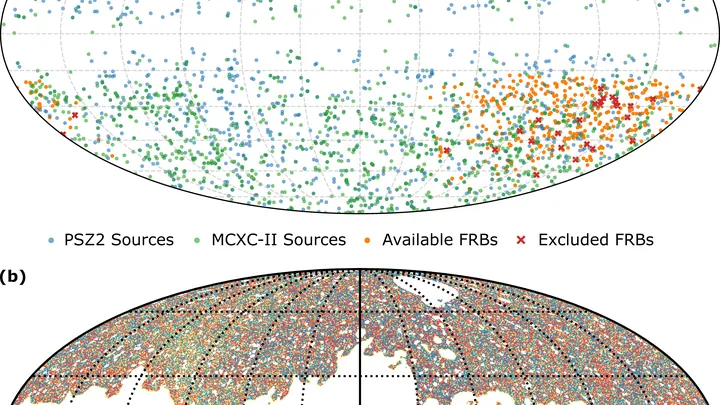
A fast radio burst is a short but powerful flash of radio waves from deep space. As it travels to us, the signal passes through clouds of tenuous gas, and the more gas it encounters, the more the signal is smeared across frequencies. Astronomers call this delay the dispersion measure — essentially, it's a "weighing" of all the matter along the line of sight.
On September 26, 2022, the DART probe slammed into the natural satellite at a speed of 6,6 km/s. A fountain of debris burst into space. Rocks, dust, sand grains — everything erupted in a silent flash.
Two years later, a numerical simulation of 20 million trajectories revealed the fate of each particle.
In southern India, in the city of Madurai, from 2018 to 2022, an unusual 'catcher' of cosmic particles stood — the mini-ICAL prototype, weighing 85 tons. It is a 600-times scaled-down version of the future neutrino detector (those elusive ghost particles) that will be built deep underground.
In 2008, the Spitzer telescope aimed at the star HD 15407A and detected a strong infrared excess. Fifteen years later, in 2023, JWST repeated the measurements. The light from the dust had dimmed by 14%. But the mineral composition of the dust remained the same, like a fingerprint taken in different years.
A speed of 7,5 kilometers per second is the threshold beyond which a cosmic collision turns dust grains into a chemical reactor. In the interstellar medium drift tiny cosmic dust grains — the legacy of dying stars.
The star AB Aur is young, about 4 million years old. Around it swirls a dense disk of gas and dust. Recently, a long gas stream, a flow of material from the surrounding cloud, crashed into it.
Boiling water in a pot is a good place to start. Bubbles of steam rise, pop, and the surface settles down. Something similar might have happened in the first moments of the universe's life with a special field filling space: bubbles of a new phase inflated and collided, like islands of steam in liquid.
Two cities endure a series of fires. In one, the wind carries ash far beyond the outskirts, leaving the sky clear. In the other, ash settles as a dense veil, painting sunsets crimson. Roughly the same thing, just on a galactic scale, happens with supernova explosions, the final flares of massive stars.
Dark matter is invisible to telescopes, but its gravity was revealed half a century ago by Vera Rubin. Since then, physicists have explored dozens of hypotheses, and one of the most elegant is primordial black holes, formed in the first moments after the Big Bang.
In 2016, astronomers saw something incredible: a distant star, named Icarus, flared up for several weeks, crossing the abyss of space. Gravitational lensing, an effect predicted by Einstein, had kicked in: a massive object bends spacetime and focuses light like a giant magnifying glass.
The Moon is an airless sphere of dense rocky grit called regolith. When fast particles from space slam into it, muons are born in the soil — unstable relatives of electrons, but two hundred times heavier. Most fly downward and fade away in the depths. But those that pop upward into the vacuum can travel tens of kilometers before decaying.
Dark matter — the invisible architect of the universe, holding galaxies from flying apart. Thanks to the pioneering work of Fritz Zwicky and Vera Rubin we know: ordinary matter in the cosmos is just a negligible impurity. But what lies behind this dark matter?
Around some young stars where star formation has recently ended, there swirl not just dust rings but actual planetary battlefields — extreme debris disks.
When a giant planet grows, it pulls in gas. Some of that gas swirls around it into a small disk — called a circumplanetary disk. It is in such disks that moons are thought to form. For the planet PDS 70 c, located 370 light-years away, such a disk was directly observed using the ALMA antenna array in the millimeter range.