Natural satellites are celestial bodies in orbit around planets. Their orbits are shaped by the planet's gravitational pull and centrifugal force of inertia. Moons can have different origins: captured asteroids, formed together with the planet, or ejected from a giant impact (like Earth's Moon).
History
The first observations of planetarysatellites were made by Galileo Galilei in 1610, when he discovered the four largest moons of Jupiter: Io, Europa, Ganymede, and Callisto. Around the same time, Johannes Kepler formulated laws describing the motion of planets and their satellites. Modern research includes the search for exomoons around distant stars and the study of subsurface oceans on Europa and Enceladus through missions like Europa Clipper.
How it works
A satellite is held in orbit by the planet's gravitational pull according to Newton's law of universal gravitation. The centrifugal force of inertia balances the attraction, creating an elliptical orbit according to Kepler's laws. Tidal forces, caused by the gravity gradient, slow rotation, leading to tidal locking (one side always faces the planet). The same mechanism causes tidal heating of the interior, fueling activity on Io and Enceladus.
In practice
Satellites stabilize the planet's axial tilt, influencing climate, and serve as bases for future interplanetary missions.
Fun fact
Some moons, such as Titan at Saturn, have a dense atmosphere and lakes of methane — the only bodies in the Solar System besides Earth with liquid basins on the surface.
As planets orbit the Sun, they don't just follow their paths: they give each other a slight tug. It's like a dance where each partner feels the movements of the others. Scientists set out to determine how strongly this mutual attraction alters the planets' trajectories.
It turns out there are small corrections that were previously overlooked.
The birth of a moon is a cosmic car crash. Two young planets collide, and a cloud of scorching debris swirls around the surviving world. From this disk, like clay on a potter's wheel, a satellite gradually takes shape. That's probably how our Moon came to be.
The gravitational dances of celestial bodies long remained silent to astronomers. We learned to catch the shadows of planets against stars with the transit method — a breakthrough that delivered thousands of worlds thanks to William Borucki and his Kepler telescope.
Dwarf galaxies orbiting the Milky Way look as if they’ve survived a gravitational storm. Their stellar bodies are stretched, scattered by tidal tails, and heated from within.
The Moon is a natural archive that has been collecting cosmic dust for billions of years. Among the microscopic grains that arrived from distant stars, there could be techno-specks — particles created by alien civilizations.
Young Earth was a boiling sphere of liquid rock, while Theia, which crashed into it, had had time to cool and solidify. It’s like dropping a chunk of cold butter into a pot of soup: the soup splashes out, but the butter barely moves. Similarly, Earth’s interior spewed into space, forming a cloud of cosmic dust and debris.
In the catalogs of exoplanets, there are many worlds with sizes between Earth and Neptune. They are divided into two groups: rocky super-Earths and gaseous mini-Neptunes. The Solar System has none of these, and scientists debate where they come from.
The authors of the study looked into each planet's 'passport'—its orbit.
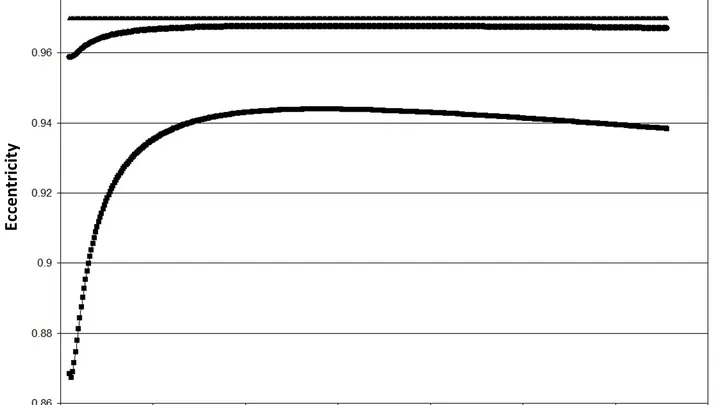
Among the hundreds of moons in the Solar System, Nereid dances the most desperate dance: diving toward Neptune as close as 1.4 million kilometers, then soaring away to 9.7 million — all within less than an Earth year. An eccentricity of 0.75 — the brand of a captured wanderer.
A streetlamp flickers as someone walks past. That's roughly how our nearest star, Proxima Centauri, behaves: it flares in response to the motion of its planets.
Astronomers observed the star with a highly sensitive instrument, the ESPRESSO spectrograph. It captures light and splits it into colors, much like a prism.
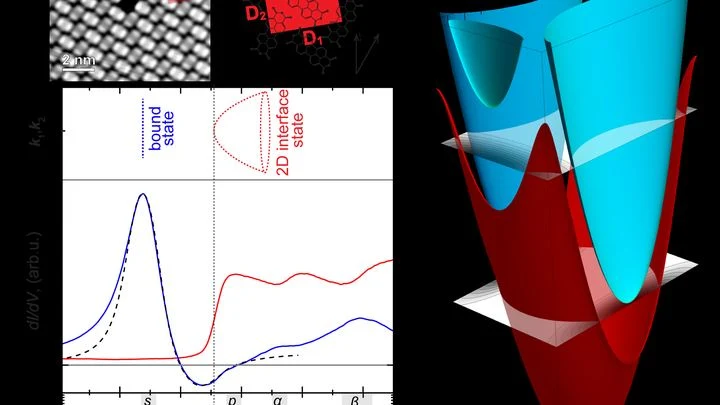
A wafer-thin film of organic molecules was grown on a silicon substrate. In this film, as if on a sheet of graph paper, tiny "pens"—artificial atoms — were laid out with the tip of a scanning tunneling microscope.
A lighthouse blinks every few seconds, but then begins to slowly brighten and dim over the course of a year. That is exactly what about a third of red giants do — huge stars in the late stages of life. Their normal pulsations take days or weeks, but on top of that, long secondary periods are visible: months and years.
The light from a distant star is never steady. It shimmers like heat over hot asphalt. When astronomers pointed JWST at the star TOI 700, they saw this shimmer especially clearly: every 16 minutes, the brightness changed by a tiny fraction, just 46 parts per million.For comparison: if you placed a light bulb a kilometer away, this change would be…
A rock knocked off one planet by an asteroid impact hurtles through space and lands on another. If microbial spores are hiding inside, they might survive the cold, the radiation, and the rough landing. That's panspermia — the idea that life travels between worlds. But imagining such a journey is one thing; calculating every step is quite another.
Every 1151 years, seven planets of the Solar System, from Mercury to Neptune, find themselves at almost the same points in their orbits. Their positions scatter by less than a degree, as if the celestial mechanism is wound to the same tune. This rhythm was discovered by comparing planetary positions over 2600 years using precise tables of celestial motion.
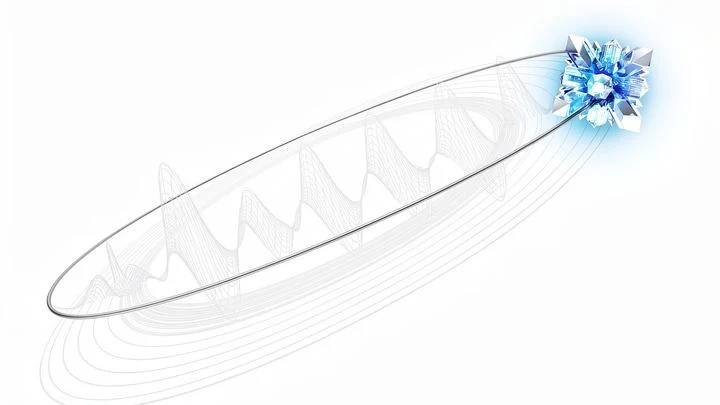
Around distant icy bodies the size of a city, circling beyond Neptune, rings of dust and ice have been found. Small moons often whirl nearby. Mathematical analysis shows that a moon's gravity rocks the ring like a swing, making it tilt.
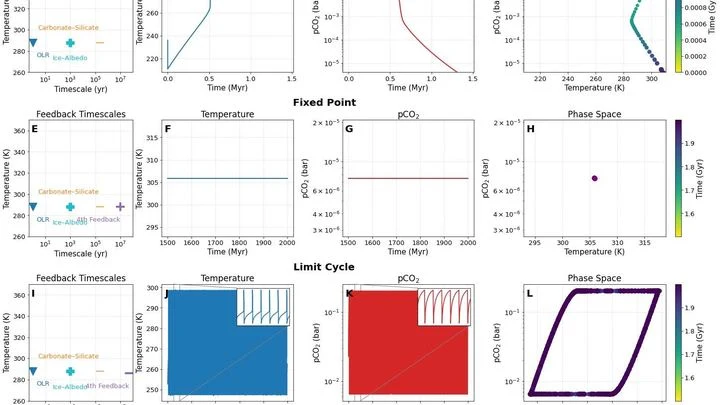
A planet's climate is like an old spring mattress: press down on one edge, the springs compress; let go, they rebound and put everything back. Earth has three such springs, working as a team. Carbon dioxide weathers out of rocks, clouds reflect sunlight, and ice caps bounce heat back into space. Together, they keep the planet from boiling or freezing.
Saturn's system 300 million years ago resembled a crowded dance floor. The most massive moon, Titan, began to migrate, and this movement threw its neighbors off balance. One moon crashed into Titan; the debris swirled into a vortex, gathering into Hyperion.
Lunar dust looks like gray sand, but there's not a breath of air in it. Oxygen is there — tightly bound in the rocks, like sugar in caramel. To get it out, you need to break chemical bonds, and scientists are looking for the simplest way.
In the lab, they took artificial lunar soil made from samples from the Apollo missions and China's Chang'e.
Space works like a billiard table. Massive outer planets, like heavy balls, transfer their energy to light inner worlds. Such a gravitational kick can fling a small planet out of the stellar system. It turns into a free-floating wanderer — a rogue exoplanet without a star.
Detecting these invisible bodies is hard: they neither emit nor reflect light.
When countless asteroids pummeled the young Earth, they tore chunks from its mantle. These fragments spiraled in a cosmic disk around the planet and, like a snowball in a blizzard, fused into the Moon.
The Moon is not just a rocky sphere, but a giant bell. Passing through it, gravitational waves cause it to vibrate almost imperceptibly. This tremor was predicted by Einstein, and Weber was the first to try to hear it with Earth-based detectors.
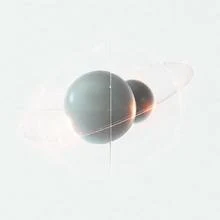
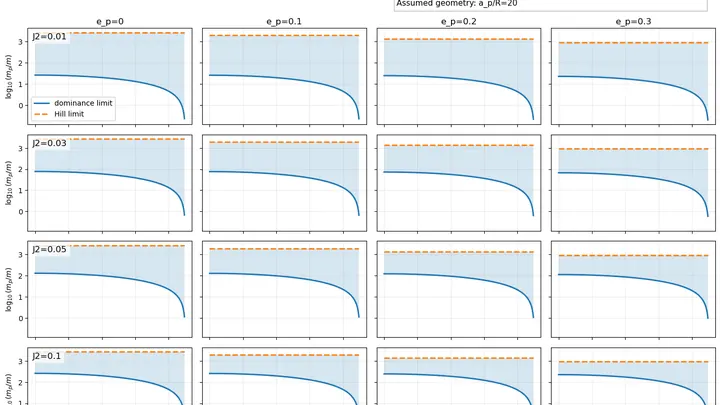
The Moon can have its own tiny moon — like a nesting doll, but in space. The outer doll is a planet, the middle one is a moon, the inner one is a small moon-satellite, or submoon. Ньютон showed that all bodies attract each other, and gravity holds them together.