Spin Focus in a Quantum Wire express
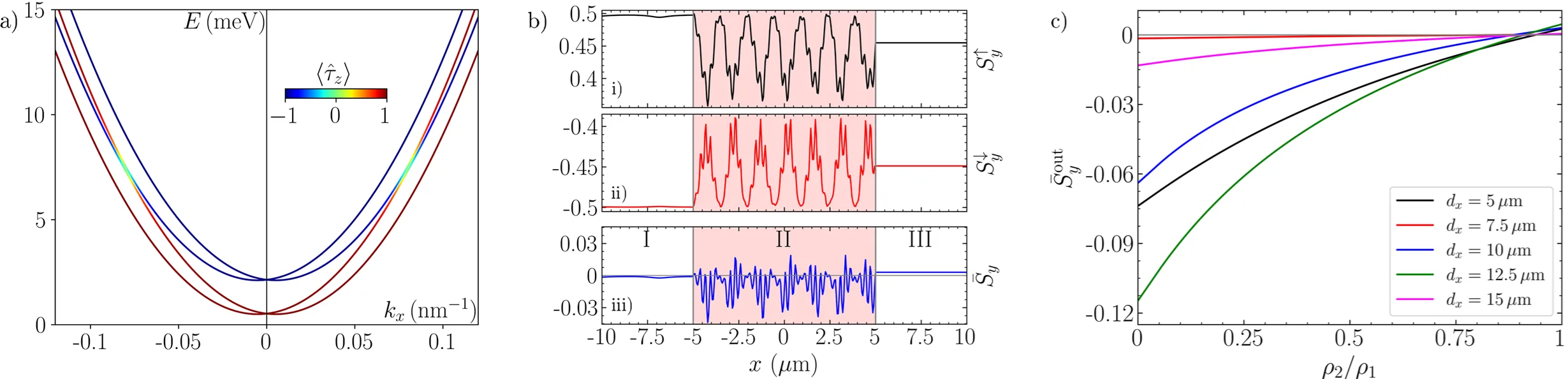
A quantum wire is like a high-speed highway where electrons race in a dense stream. Each electron has its own rotation, spin, and until now it was thought that splitting this stream into two lanes, for 'left' and 'right' rotation, without losing quantum order was nearly impossible. You'd need either strong magnets or complex tricks that waste energy.
The authors found a workaround. They focused on systems where the electron spins at the Fermi level (the highest occupied energy step) are not aligned but slightly tilted relative to each other. This misalignment is the key to sorting. It can be created by adding an extra degree of freedom, pseudospin, to a material with spin-orbit coupling. Pseudospin arises because an electron can occupy different positions in the crystal lattice: different valleys, sublattices, or orbital angular momenta. It's like adding a color code to your highway pass.
On ordinary semiconductor wires and oxide nanowires, they achieved 10% spin separation efficiency. Crucially, quantum coherence, the very order that makes quantum computers work, is preserved. Previously, it was thought that one excludes the other, but the highway with 'colored' lanes turned out to be free of traffic jams. Now engineers have a clear recipe: to create a spin filter in a quantum wire, you just need to choose the right material with misaligned spins at the Fermi level. This is a step toward compact spin transistors and quantum logic elements without bulky magnets.
Original abstract
as written by the authors arXiv:2608.00599v1
We report a previously overlooked general mechanism to obtain highly efficient spin selectivity in conventional time-reversal symmetric one-dimensional systems without invoking phase decoherence. We reveal that Rashba quantum wires featuring non-collinear spin states at the Fermi level inherently possess spin-selective transport properties. We show that this spin noncollinearity can be systematically designed and engineered by introducing an additional pseudospin degree of freedom - such as valley, sublattice, or orbital angular momentum - into spin-orbit coupled systems. By applying this framework to multi-subband semiconducting quantum wires and oxide nanowires, we establish a generalized route toward quantum-coherent spin selectivity up to 10 %. Our findings offer practical design principles for spin-selective transport devices.
The term 'spin' was introduced by Wolfgang Pauli in 1925, and only later was it discovered that it is a purely quantum phenomenon with no classical analog.
In Hannu Rajaniemi's novel 'The Quantum Thief', spin states are used to store consciousness, such technologies start with wires like these.