Spin-orbit coupling is a fundamental interaction in quantum physics where an electron's intrinsic angular momentum (its 'spin') is coupled to its motion through space (its 'orbital' angular momentum). This coupling arises from relativistic effects: from the electron's perspective, the electric field of the atomic nucleus appears as a magnetic field, which interacts with the electron's magnetic moment associated with its spin. This interaction is crucial for understanding the fine structure of atomic spectra, the electronic properties of solids, and the behavior of materials used in quantum technologies. It is the key mechanism behind phenomena such as the anomalous Hall effect, topological insulators, and the manipulation of quantum states in diamond-based sensors.
History
The concept of spin-orbit coupling was introduced to explain the fine structure of atomic spectra in the 1920s, with key contributions from Gregory Breit, Llewellyn Thomas, and others. It was later incorporated into the Dirac equation, which naturally describes the interaction.
How it works
In an atom, an electron moving around the nucleus experiences a magnetic field due to its own orbital motion (in its rest frame). This magnetic field interacts with the electron's spin magnetic moment, creating an energy shift that depends on the relative orientation of the spin and the orbital angular momentum. The strength of this coupling scales with the atomic number (Z) to the fourth power, making it much stronger in heavy elements. In solid-state materials, spin-orbit coupling can lead to a mixing of spin and momentum states, allowing electric fields to control spin orientation—a principle used in spintronics. In diamond with nitrogen-vacancy (NV) centers, spin-orbit coupling influences the energy levels of the defect, enabling optical readout of the spin state, which is essential for quantum sensing.
In practice
Spin-orbit coupling is exploited in spintronic devices for data storage and processing, in topological insulators for dissipationless electronics, and in diamond quantum sensors for high-precision magnetometry and thermometry.
Fun fact
The strength of spin-orbit coupling in a material can be tuned by applying strain or electric fields, allowing researchers to switch a material between being a conventional conductor and a topological insulator.
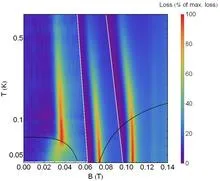
Tuning a radio receiver to a station that changes frequency as you cross a phase boundary: that is how you might picture the challenge facing the researchers. In the metal YbRh2Si2, electrons behave as "heavy" particles: their effective mass is hundreds of times that of a free electron.
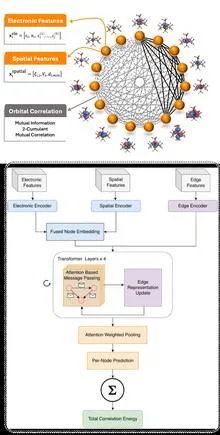
A cartographer who draws not mountains and rivers but invisible bonds between electrons: that's one way to describe the new neural network. Instead of atomic coordinates, it takes molecular orbitals and draws a graph where nodes are orbitals and edges are measures of their quantum entanglement.
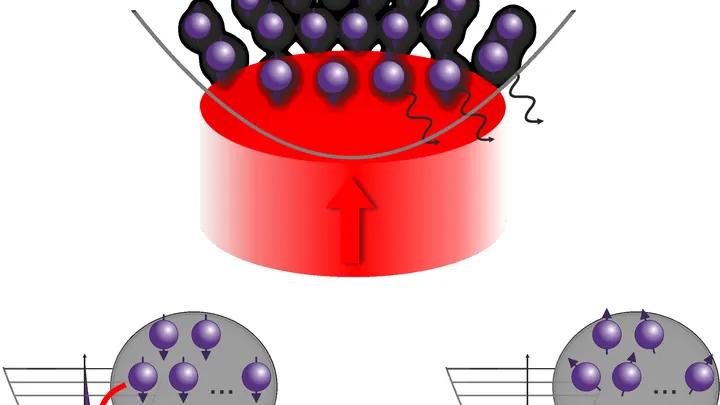
A laser pulse slams into a gas cloud and knocks electrons out of it, leaving behind a bubble: a cavity almost devoid of particles. This bubble races through the plasma at nearly the speed of light, and its walls drag along the electrons trapped inside, much like a speedboat tows a water skier.
Earth's magnetic field is not constant: it trembles from the solar wind, from distant thunderstorms, and from the subway running nearby. To notice these tremors, you need an instrument that doesn't tremble itself. Physicists have built such an instrument from ytterbium atoms cooled to nearly absolute zero.
A lone erbium atom sits on a silver substrate, and its spin, the electron's internal rotation, stores quantum information. Previously, flipping this spin required a magnetic pulse: a blunt tool that disturbs neighbors and works slowly. Now physicists from Germany and Korea have shown that a single electric voltage suffices.
A laser beam is like a swift vortex that briefly captures a passing electron. As the particle moves through the pulse, its spin (the intrinsic rotation, like a tiny top) experiences a weak kick. After leaving the beam, the top no longer points in the same direction; it has turned a little.
$$10^{-35}$$ seconds. A tiny instant during which the Universe manages to expand by a factor of $$10^{26}$$. Immediately after, it goes through thousands of rapid transformations — like a ball bouncing along a chain of tunnels. This cascade is the essence of chain inflation, first proposed by Alan Guth.
A quantum chain is like a string of lights, where the bulbs are the spins of particles. Ideally, all bulbs glow in sync, following a common rhythm: that's symmetry. But if you cut off a piece of the string, the rhythm can get out of step: within that segment, symmetry is broken.
Physicists study a chain of strongly interacting particles (the XYZ model).
A pair of black holes circles in a dance, gradually drawing closer. They lose energy and spin — a process known as angular momentum radiation. In standard Einstein theory, only gravitational waves carry away angular momentum.
Imagine a spiral staircase with balls rolling down. Some are twisted to the right, others to the left. The steps are arranged so that right-twisted balls slip through faster, while left-twisted ones get stuck. Something similar happens inside helical molecules — for example, in the double helix of DNA.
Two sheets of tungsten diselenide (not carbon, but a compound of tungsten and selenium) are rotated relative to each other by a tiny angle, about 5 degrees. This creates a moiré pattern: an enlarged periodic lattice where electrons behave very differently than in a regular crystal.
An atomic nucleus is not just a ball of protons and neutrons. It has a shape, and that shape can change. The tin-116 nucleus was long considered almost perfectly spherical: it has 50 protons — a 'magic' number that usually gives a nucleus spherical symmetry. But a new ultra-precise measurement showed otherwise.
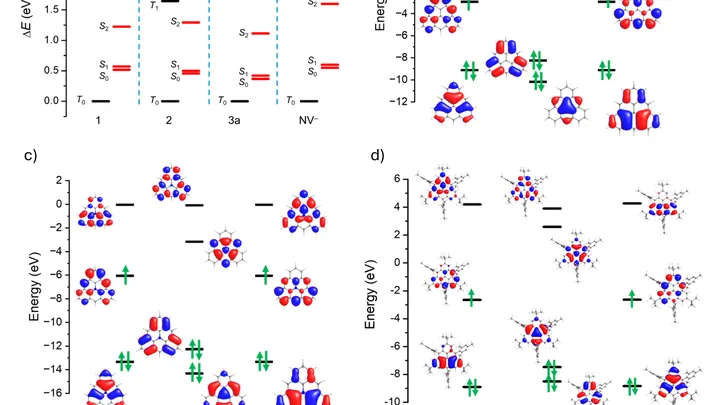
At the heart of a future quantum computer might lie a tiny organic molecule shaped like a triangle. It has two 'extra' electrons that don't pair up. Such molecules are called diradicals, and their electrons can store information in a special, quantum way.
Quantum computers of the future will likely communicate via light. An atom stores information, and a photon carries it across the network. But an atom doesn't hang still: it jitters and oscillates, and this motion can corrupt the signal.
Previously, engineers could only calculate for a stationary atom.
A sheet of paper with square grid, one with diamond grid, and one with honeycomb — three different universes for an ant. Change the sheet, and the rules of movement change. That's roughly how electrons experience the crystal lattice: geometry dictates whether they become little magnets, superconductors, or something else. In ordinary materials, the lattice is as rigid as if engraved.
A tiny crystal of charged atoms, trapped in a trap, trembles with heat. Each ion oscillates like a ball on a spring, and these vibrations hinder using the crystal for precise quantum operations. Usually, excess energy is removed with a laser — the beam hits the ions and slows their motion, like a stream of air damping a pendulum.
Spacetime can be imagined as a tightly stretched fabric. A massive body dents it, guiding light. Rotation twists the fabric into a spiral. Such a gravitational funnel can entangle a passing photon with the very source of rotation — say, a tiny mirror. Quantum entanglement springs up: an invisible thread binding their fates.
Any measuring device is spoiled by quantum noise — the chaotic jitters of elementary particles. To tame it, physicists used a trick on calcium fluoride molecules, much like squeezing a balloon: press in one spot, and it bulges in another.
Imagine an orchestra where every musician plays their own part without listening to the others. Suddenly, without any visible command, neighboring musicians begin to sync perfectly, yet there is still no overall melody.
Run a current through a spring of organic molecules, and the electrons that come out are almost all spinning the same way. This trick is called chiral spin selectivity, and it has long puzzled physicists. In light atoms, spin (the particle's intrinsic rotation) is too weakly coupled to charge motion to achieve nearly perfect sorting.
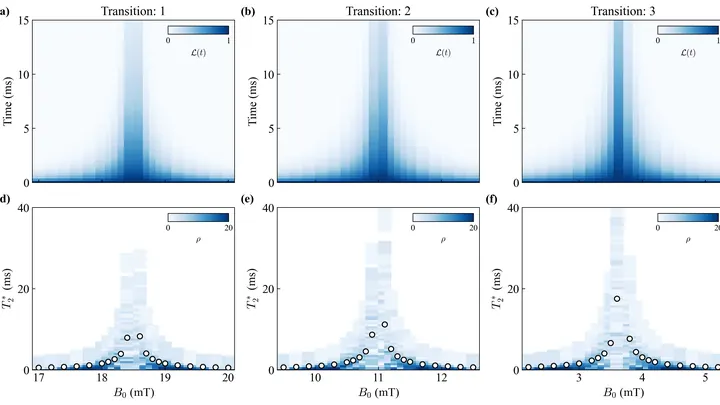
In a boron nitride crystal, the perfect atomic lattice is sometimes disrupted: an atom is missing here, or replaced by a foreign one there. Under a powerful microscope, these tiny imperfections appear as traps for electrons: they capture particles and start to emit light, and they also respond to magnetic fields.
The dance floor is packed: everyone moves on their own, no one holds hands. Suddenly the music gets louder and more rhythmic — neighbors start grabbing each other, forming pairs that spin in sync. That's roughly what the experiment looked like in the lab, where a cloud of lithium atoms, cooled to near absolute zero, was made to suddenly strengthen its mutual attraction.
Holding a phone number in your head while people shout and slam doors around you is nearly impossible. That's roughly the life of a quantum bit, a qubit, in an ordinary material: the nuclei of neighboring atoms, like tiny magnets, constantly jostle it and erase information. To keep a qubit from forgetting, you need to find it a quiet spot.
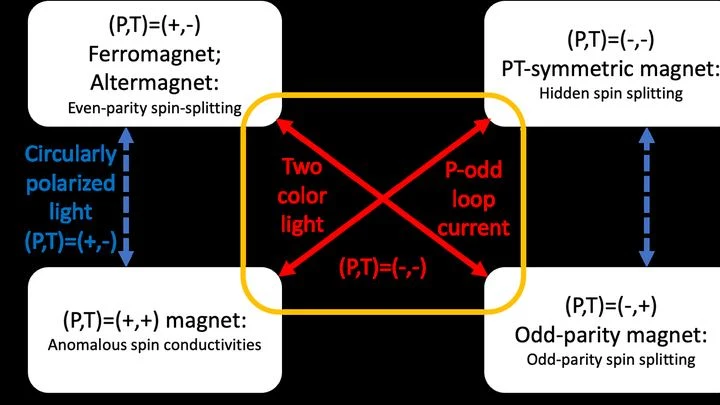
In a piece of ordinary magnet, all electron spins, tiny magnetic arrows, point in the same direction. It's a formation of soldiers facing their commander. This order is called a collinear altermagnet.
A juggler tosses clubs while sitting on a spinning chair. If he starts spinning the clubs all in one direction, the chair will rotate the opposite way — otherwise, the conservation of angular momentum would be violated.
Picture a crowded hall where each person is a molecule, and their private conversation is the motion of electrons within it. Normally, everyone talks to themselves, and the overall buzz is chaotic. But if a bright spotlight is turned on in the center, it begins to conduct the crowd: people synchronize their movements, even though the light merely reflects off the walls.
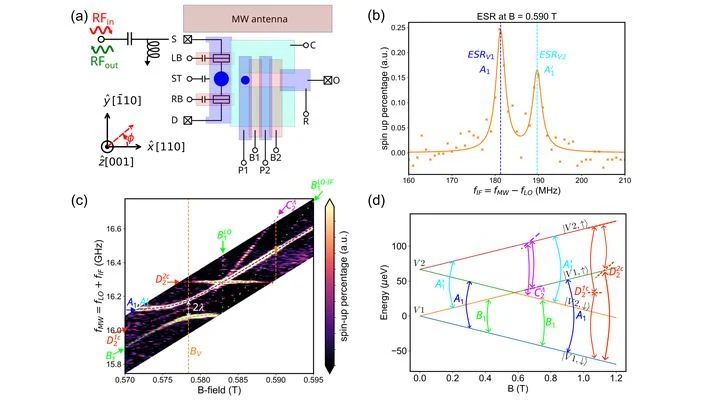
Silicon is the very material that powers the processors in every phone and laptop. Now, researchers have learned to trap a single electron in it and control its spin — a tiny magnet that can point 'up' or 'down'. It's like holding a spinning top: you can tilt and turn its axis, but here, instead of hands, you use an electric field.
In the first moments of the universe's existence, space was filled with hot plasma, where particles emerged and disappeared like bubbles in a boiling pot. The traces of these processes, stretched to gigantic sizes by expansion, are preserved in the cosmic microwave background — ancient light that has reached us across billions of years.
A whisper in a roaring waterfall: that's roughly how physicists are hunting for the gravitomagnetic effect, the tiny influence of gravity on the rotation of particles. In highly charged ions, where electrons are stripped away almost completely, this effect should be more noticeable. But the atom itself creates an electric noise that drowns out the signal.
Two particles flying apart in opposite directions behave as a single whole: measuring one instantly determines the state of the other. Such quantum entanglement has long been known for light particles, but now it has been observed for the first time in heavy Z bosons — the carriers of the weak force.
A quantum magnetometer based on hydrogen nuclei works like noise-canceling headphones. It alternately "listens" to the field in two different ways: the noise is the same for both, but the desired signal is different. By subtracting one from the other, the device extracts the signal, reducing interference by more than 1000 times.
A woven bamboo basket is not just a household item: it's an exact blueprint for how atoms are arranged in the crystal YMn₆Sn₆. Six manganese atoms form hexagons that assemble into a pattern reminiscent of the Japanese kagome. In such a lattice, electrons usually behave uniformly, like passengers in a crowded subway car.
A ring of magnetic atoms resembles a round dance where each participant holds hands with their neighbors. In ordinary magnets, each atom has its own permanent magnetic moment, and they interact like little arrows striving to align opposite to each other.
Two layers of a magnetic material, rotated relative to each other by fractions of a degree, like two slightly offset screens on a window. In their normal state, they don't produce anything special, but at a certain twist angle, an unexpected effect emerges.
A laser strikes a strontium atom, and two electrons fly out at once. Previously, it was thought that in such double ionization each electron acts on its own: one is knocked out first, the second later, randomly.
A tiny diamond hangs in the air, held by an electric field like a speck of dust in a beam of light. Hidden inside are defects — places where a carbon atom is replaced by nitrogen, with a vacancy nearby. These defects behave like little magnets that can be flipped with laser and microwaves.
When light knocks an electron out of a molecule, the remaining electrons don't just sit still: they rearrange, like passengers in a train car when one gets off at a stop. In ordinary molecules, this rearrangement is barely noticeable, but in chiral molecules, mirror images like left and right hands, it can make the orbitals rotate.
A qubit is like a tenant in a tiny apartment: it usually takes the ground floor to avoid distractions from upstairs neighbors. In germanium quantum dots, where spin qubits live, this tenant is a hole: that is, a missing electron. The hole has a spin that acts like a tiny magnetic needle.
An ordinary superconductor is like a squad of soldiers marching in pairs: electrons pair up, and their spins (internal 'tops') point in opposite directions. A magnetic field easily flips such pairs, destroying superconductivity.
In UTe₂, things are different.