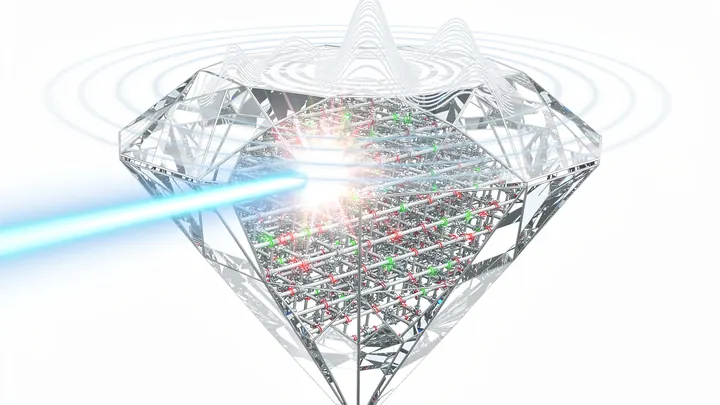
A solid-state qubit is a quantum bit implemented in a solid material, such as a nitrogen-vacancy (NV) center in diamond, a phosphorus atom in silicon, or a superconducting circuit. Unlike trapped ions or photons, solid-state qubits are embedded in a chip, making them scalable for quantum computing and easily integrated with existing electronics. The nuclear spin of an atom in a solid can maintain quantum coherence for remarkably long times, even at room temperature in the case of diamond, which is why these systems are a leading candidate for practical quantum memories and sensors.
History
The concept of using solid-state spins for quantum information was proposed in the late 1990s, with the first demonstration of a solid-state qubit in a silicon-based system in 2002 by Bruce Kane's proposal and later experiments. The NV center in diamond was first used as a single qubit in 2004 by the group of Jörg Wrachtrup.
How it works
The qubit is typically a spin-1/2 system (like a nuclear spin or an electron spin) that can be in a superposition of 'up' and 'down' states. In diamond, an NV center consists of a nitrogen atom next to a vacancy, and its electron spin can be initialized, manipulated, and read out using microwave pulses and laser light. The nuclear spin of the nitrogen atom (or nearby carbon-13) serves as a long-lived memory. In silicon, a phosphorus donor's nuclear spin is controlled via microwave fields and read out through single-electron transistors. The key is isolating the spin from environmental noise (like fluctuating magnetic fields) while still allowing controlled interactions for quantum gates.
Diamond NV centers can maintain quantum coherence for over a millisecond at room temperature — a million times longer than the time it takes for a classical computer to perform a single operation.
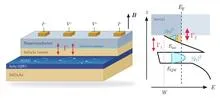
A thin layer of indium arsenide lies hidden under a superconducting film, like a voice beneath the noise of a crowd. In such a hybrid, current takes the path of least resistance and flows almost entirely through the metal, leaving the semiconductor inaudible to standard probes.
A ship in a bottle is assembled from the inside, not the outside: masts and sails are pulled through the narrow neck, and once inside the glass they settle into the right pose on their own. Chemists have done something similar with a single cobaltocene molecule, which they pulled into the gap between layers of a two-dimensional crystal.
Earth's magnetic field is not constant: it trembles from the solar wind, from distant thunderstorms, and from the subway running nearby. To notice these tremors, you need an instrument that doesn't tremble itself. Physicists have built such an instrument from ytterbium atoms cooled to nearly absolute zero.
A bridge where pedestrians and cyclists flow together without getting in each other's way. That's roughly how hybrid systems of superconductors and semiconductors work: the former carry current without loss, the latter control that current.
A lone erbium atom sits on a silver substrate, and its spin, the electron's internal rotation, stores quantum information. Previously, flipping this spin required a magnetic pulse: a blunt tool that disturbs neighbors and works slowly. Now physicists from Germany and Korea have shown that a single electric voltage suffices.
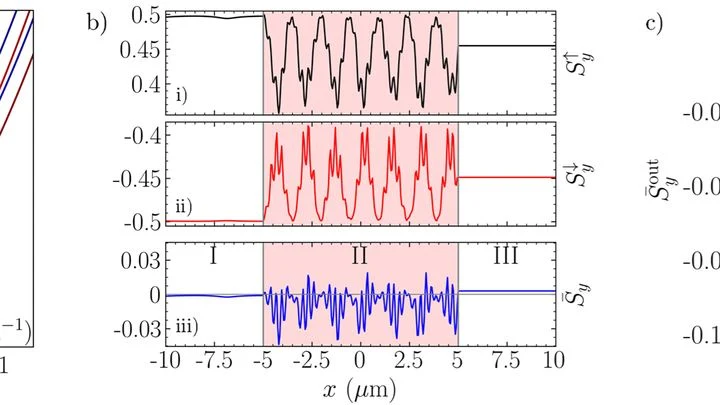
A quantum wire is like a high-speed highway where electrons race in a dense stream. Each electron has its own rotation, spin, and until now it was thought that splitting this stream into two lanes, for 'left' and 'right' rotation, without losing quantum order was nearly impossible. You'd need either strong magnets or complex tricks that waste energy.
Electrons in a solid usually either run freely (metal) or are locked in place (insulator). But sometimes strong mutual repulsion locks them into a halfway state: charges stand still, while spins, tiny magnetic arrows, continue to live their own life. This is called a Mott insulator.
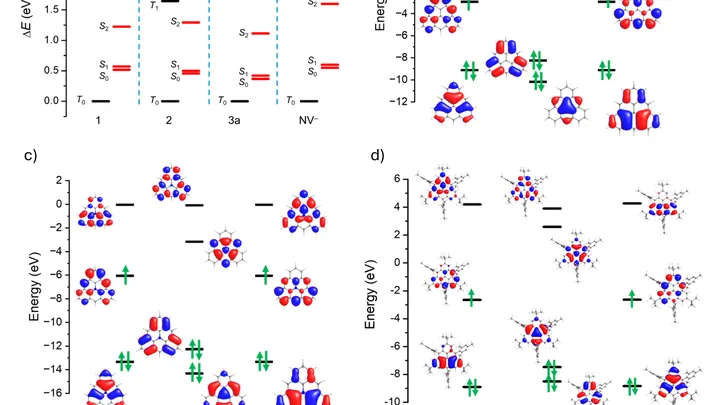
At the heart of a future quantum computer might lie a tiny organic molecule shaped like a triangle. It has two 'extra' electrons that don't pair up. Such molecules are called diradicals, and their electrons can store information in a special, quantum way.
A living cell constantly emits faint magnetic signals, as if whispering. Scientists eavesdrop on this whisper with two microscopic 'microphones'—magnetic field sensors.
Building a quantum network node is like teaching a dancer to balance on a carbon thread over an abyss. One leg must spring lightly from the wire, hurling photon-messengers into the external world. The other must grip the rope tightly, guarding precious quantum information.
In the depths of a diamond crystal, studded with NV centers, a symphony slumbers. Each defect is like a tuning fork, ready to respond to a passing acoustic wave. But alone, their voices are barely audible: the spin-phonon coupling is weaker than a whisper. A maestro is needed, one who can turn timid vibrations into a resounding choir.
A quantum computer is like an orchestra where each musician, a qubit, must play their part accurately and on time. Usually, musicians are seated in fixed positions and connected by conductors' consoles. But what if we let them move freely across the stage and turn the movement itself into part of the music?
In the world of atoms and particles, everything tends toward rest: particles lose energy, just as a swing slows down due to energy loss (friction). But many devices — from hydrogen masers to atomic clocks — live by repetitive cycles.
In diamond, as in any crystal, defects are common — empty sites or foreign atoms. When they capture an electron, they can glow or become magnetic, which is valuable for quantum devices. But the electron is easily lost, and to keep it, boron has to be added to the diamond — sort of like constantly warming up an engine so it runs in the cold.
In diamond quantum devices, there's a tiny defect — the nitrogen-vacancy center (a nitrogen atom plus a vacancy where a carbon atom should be). It acts as a switch that spontaneously flips back and forth: it can carry an extra electron or not, and this determines whether it emits light or not.
An ordinary pendulum swings at the same frequency as the push it receives. But in the quantum world, you can create a system that responds to a push two, three, or more times slower, as if it has its own rhythm. Such systems are called discrete time crystals.
Quantum networks need a mediator between storage — spin — and carrier — light. No single molecule had ever pulled off such a feat. But now physicists have found a solution. They placed a carbene molecule into a crystal and cooled it to -269°C.
A quantum bit (qubit) is a delicate thing. Even a little heat destroys it, like a random nudge topples a crystal wine glass. To protect this fragile information, physicists have built a three-dimensional quantum structure resembling a Russian doll.
Light in an optical fiber runs along the core, barely escaping outside. But if you get very close, you can feel a faint trembling of the field at the surface — the evanescent wave. It is in this 'light fog' above the surface of a tiny silicon ring that physicists have caught a single rubidium atom.
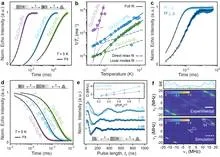
Holding a phone number in your head while people shout and slam doors around you is nearly impossible. That's roughly the life of a quantum bit, a qubit, in an ordinary material: the nuclei of neighboring atoms, like tiny magnets, constantly jostle it and erase information. To keep a qubit from forgetting, you need to find it a quiet spot.
A quantum computer is like an orchestra where each musician is an electron spin: its tiny magnetic moment. For the orchestra to play in harmony, the conductor must hear each musician individually.
Steam rising from hot metal is a familiar sight in the kitchen. But if you use rubidium instead of water, that cloud becomes a battery. It doesn't run on chemical reactions but on the quantum coordination of atoms.
Light can act as a courier carrying secret messages. But to ensure the courier doesn't lose a single letter, you need to meet and check it very quickly. The new chip made from a thin film of lithium niobate is like a turnstile that opens and closes in billionths of a second, letting light pulses through at just the right moment.
In a dark room, an invisible lamp flashes. Its light is unlike anything familiar: it has no steady brightness, only rare but powerful bursts. This is bright squeezed vacuum — a state of light with no ordinary wave but strong quantum fluctuations. It is with such light that physicists bombarded xenon atoms.
A spinning top, set in motion on a perfect surface, topples from the slightest tremor. Likewise, a quantum bit, created at a defect in a diamond, has its state destroyed by magnetic disorder from impurities and external interference.
Inside an exploding star, neutrinos race so densely that they start to influence each other. Their quantum states become entangled, like threads in a tight ball where you can no longer tell which is which. Ordinary computers struggle with this task, as the number of possible states grows avalanche-like.
In the crystal lattice of diamond, defects occasionally appear: a nitrogen atom grabs a foreign spot, and next to it gapes a void. Such a flaw turns into a supersensitive diamond compass: its magnetic needle quivers at the slightest external field. Paradoxically, a blemish that lowers a stone's value has become a coveted tool for physicists.
Physicists took 28 quantum tops, particles with intrinsic spin, and ran a cyclic process on a quantum computer predicted by Werner Heisenberg nearly a century ago. At first, each top spun however it pleased.
Ordinary soldering doesn't work for quantum circuits: when cooled to liquid helium temperatures, metal cracks, and the contacts themselves introduce noise. Engineers from the research group tried something different — a drop of gallium alloy that stays liquid at room temperature, like mercury in an old thermometer.
A rope braided from a hundred short strands can be twisted to the right or to the left. Each strand individually doesn't know which way the whole rope is twisted, but try to unravel it, and the difference immediately shows. That's roughly how the states physicists call symmetry-protected are arranged: locally they are indistinguishable, but globally they are different.
A fridge magnet attracts a paperclip: we can feel that field with our hands. Now shrink that field by a billion times. Atoms inside our bodies emit such weak signals, and they are very hard to catch.
Scientists built the sensor from special molecules that themselves behave like tiny magnets.
Light enters a tiny cavity with mirrored walls and hits an erbium atom hidden in a crystal. The atom absorbs the light and flips its nucleus into another state, like a toggle switch that clicks when pressed. But this switch is not ordinary: it obeys the laws of the quantum world and can be in two positions at once.
Silicon is like a universal building block: it goes into the chips in your phone, solar panels, and lasers. But if you squeeze it with immense force, the atoms rearrange into new patterns: these forms are called allotropes. One of them, Si-XIII, was first spotted more than twenty years ago, but its exact pattern remained a mystery.
A quantum bit is like a spinning top that must keep spinning steadily for a long time. In germanium, researchers have learned to set such tops spinning, but the floor around them is always trembling: electrical noise knocks the spin off course.
A crystal that inside resembles a sponge with a labyrinth of pores turns out to be capable of performing computations. The material, named DUT-8, consists of metal nodes and organic linkers forming an intricate lattice. Under the influence of different gases, this lattice slightly changes shape, like a house of cards that rearranges with a gentle breath.
A quantum computer is like an orchestra where every musician must play in perfect harmony. If even one instrument is off-key, the melody falls apart. Superconducting qubits play the role of these musicians, and their "off-key" is the loss of quantum coherence.
Three charged ytterbium atoms are arranged in a triangle inside an electromagnetic trap. Normally, they all communicate with each other, like three people at a table constantly exchanging remarks. But if one of them steps into the next room, the conversation continues between the remaining two.
In a silicon carbide crystal, which looks like a transparent stone, there are hidden defects — places where atoms are out of line. One such defect acts as a quantum node: an electron inside it spins and processes information, while the nucleus of a neighboring atom quietly stores it.
On a silicon chip that resembles a neighborhood, qubits, electrons with spin, live in separate 'houses.' Previously, neighbors could only chat over the fence, but now a road has been laid between them: along it, a qubit can ride to any of the four stops. The road is a bus that carries the electron without losing its quantum state.
A quantum computer is like an orchestra where electrons and nuclei play different instruments. Usually, the conductor needs two batons: microwaves for electrons and radio waves for nuclei.