Eclipses in the Binary Star System Have Come to an End express
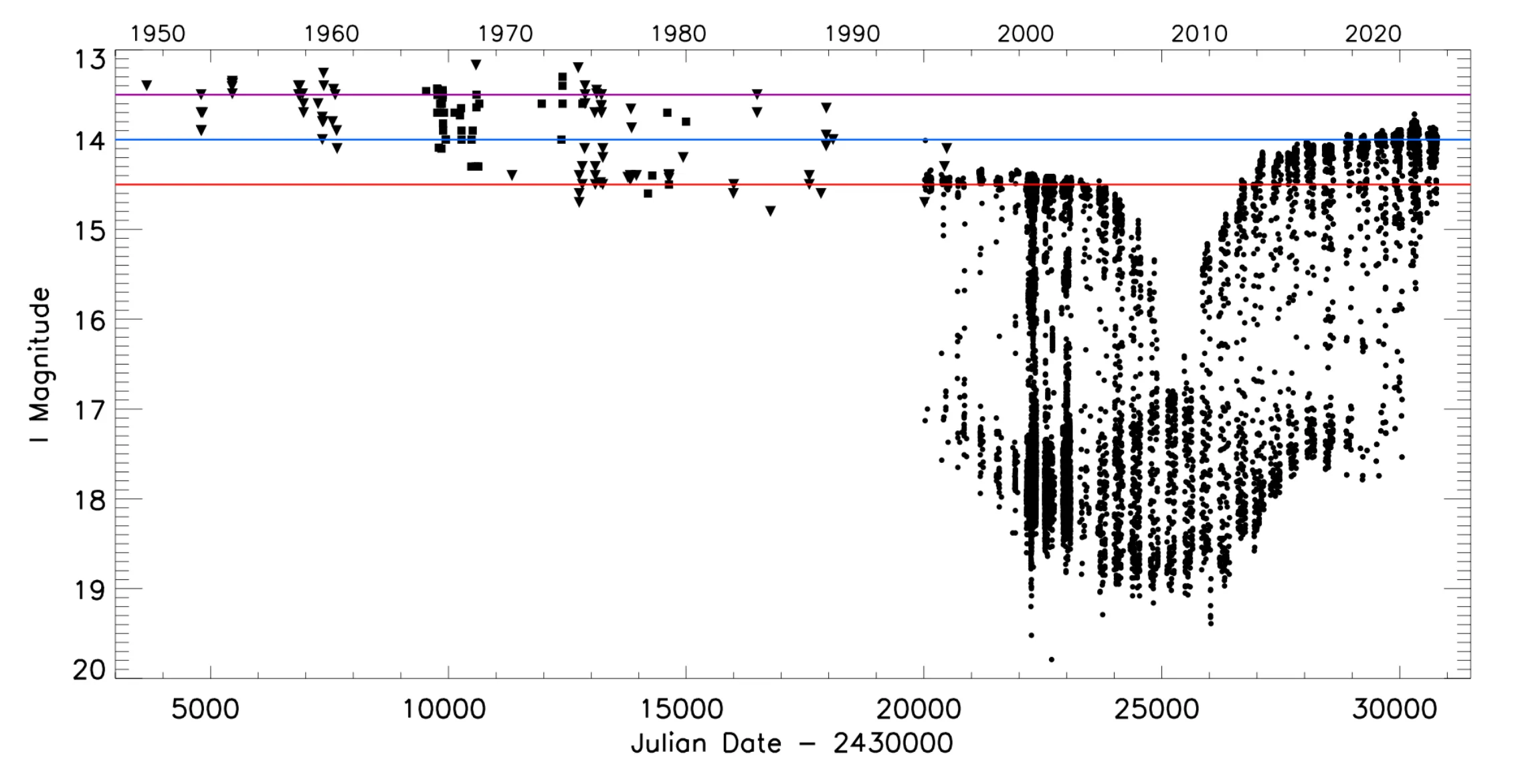
In the KH 15D system, two young stars orbit a common center, and between them and us lies a huge dust disk, like a curtain that sometimes hides the stars and sometimes reveals them. For seventy-five years, astronomers have watched this "theater of shadows": sometimes the light nearly went out, sometimes it flared up with renewed vigor. Now, combining old records with fresh observations from 2022–2025, scientists have seen that the curtain has stopped twitching — the large brightness swings have ended.
Eclipses in KH 15D occur when the stars alternately hide behind the dust disk. Previously, one star could be completely hidden, and the system dimmed by tens of times. Now both stars are visible almost always, and their combined light has become steadier. Astronomers have even refined the system's "clock": one revolution of the stars around each other takes 48.365 days — to an accuracy of five thousandths of a day. This rhythm has not faltered for three-quarters of a century.
The most interesting part is the dust disk itself. Its edge is not smooth but like a torn curtain edge: there are transparent patches and dense clumps. When a star passes behind such a clump, the light dims unevenly, as if through smoke. Scientists have noticed that the far edge of the disk is more transparent than the near edge, as if the curtain were thinner on one side. In these clumps, planets may be forming, and eclipse observations allow us to peer into the very process of their formation.
Now that the bright eclipses have ended, the system has become calmer, but no less valuable. Each passage of a star behind the translucent edge of the disk is a chance to measure what the future planetary system is made of. The dust curtain no longer puts on loud performances, but it continues to tell its story to those who know how to listen.
Original abstract
as written by the authors arXiv:2608.10142v1
The binary T Tauri system, KH 15D, is poised to provide unprecedented detail of gas and ices located between $$\sim$$3-5 AU of its circumbinary disk over the next few years. We analyze for the first time a complete set of ground-based time series photometry of the KH 15D system for which the 2022 October - 2025 April data have never been presented. By combining the latest $$I$$-band data with historical measurements, we show that the era of large amplitude photometric variability has ended. We define a revised photometric period of $$P$$ = 48.365 $$\pm$$ 0.005 days, which accurately phases data over a time span of seventy-five years. We adopt magnitudes and colors for the stars that define the epochs when either star A (1995-2008) or star B (2010-2012) is the primary source of the out-of-eclipse brightness of the system. We determine for the first time the effective optical depth for the system between 2002 and 2025 assuming gray extinction. The current out-of-eclipse system color is consistent with a combination of the light from both stars, supporting the previously suggested model in which the trailing edge of the circumbinary disk is more transparent than the leading edge. We continue to see evidence for ``clumps'' and variable transparency along ingress and egress when the stars are probing the occulting material and suggest that observations made during these phases should permit studies of the physical and chemical nature of the planet-forming zone with the circumbinary disk.
The orbital period of the stars in KH 15D has been refined to 48.365 days — more precise than the length of the Earth's year as known to 19th-century astronomers.