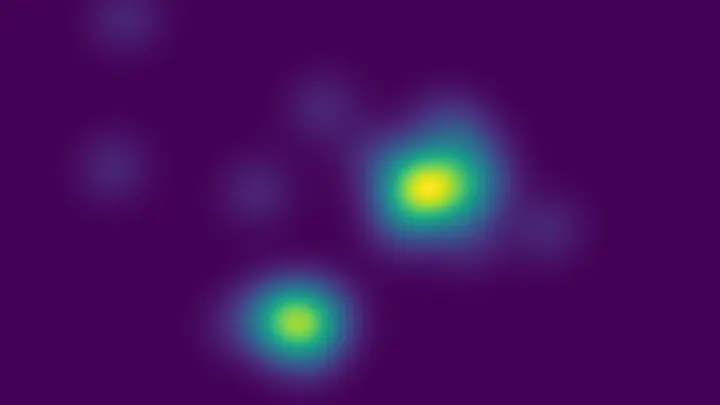
A dense clump is a localized region within a molecular cloud where the density of gas and dust is significantly higher than the surrounding medium. These clumps are the cradles of star formation: under the influence of gravity, they can collapse to form one or more stars. The study of dense clumps is crucial for understanding the initial conditions of star birth, including the mass distribution of stars and the efficiency of star formation in galaxies.
History
The concept of dense clumps in molecular clouds was established in the 1970s and 1980s with the advent of millimeter-wave astronomy, which allowed observations of the cold, dense gas where stars form. Key contributions came from astronomers like Bruce Elmegreen and Charles Lada.
How it works
Dense clumps form through turbulence, shocks, and gravitational instabilities within molecular clouds. When a clump becomes gravitationally bound, it begins to contract. As it contracts, it may fragment into smaller cores, each of which can form a star or a binary system. The process is regulated by magnetic fields, turbulence, and feedback from young stars, which can disperse the surrounding gas.
In practice
Dense clumps are observed with radio telescopes like ALMA to study star formation in our galaxy and beyond. This research informs models of galaxy evolution and the chemical enrichment of the universe.
Fun fact
The densest clumps in molecular clouds can have densities of over a million particles per cubic centimeter, which is still a much better vacuum than any laboratory vacuum on Earth.
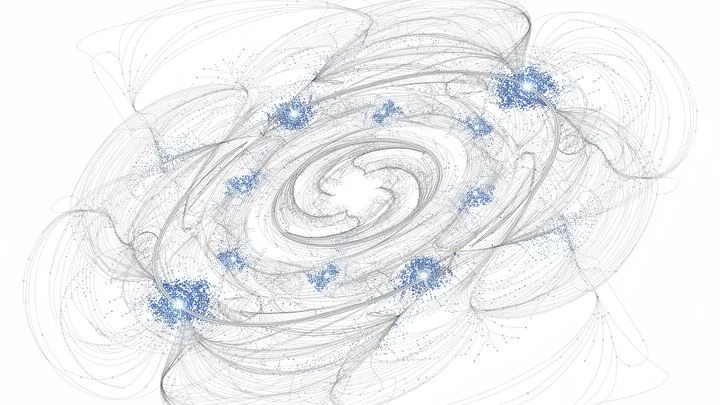
A filament of the cosmic web stretches through the young universe, and strung along it like beads on a necklace are galaxies. In the core of the SSA22 protocluster, which in a few billion years will become the center of a massive cluster, these beads are still hot and dusty: stars are being born inside them, and cold gas serves as fuel.
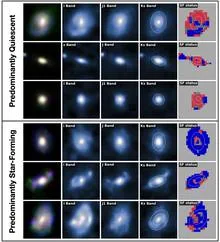
A ground-based image of a distant galaxy looks like a view through frosted glass: the atmosphere smears details, hiding the internal structure. Astronomers have long wanted to know where exactly star formation shuts off in galaxies, but ground-based telescopes could not resolve the subtle color gradients.
Light from a distant galaxy reaches us through its own dust. This dust is not a smooth haze but ragged clouds, like wisps of cotton. Old models treated it as a uniform mist, and then the galaxy didn't add up energetically: too much light disappeared in the ultraviolet and too little came back in the infrared.
Astronomers did what a cook does when they dice a potato instead of tossing it in whole.
Two stars circle each other like dancers who come together and drift apart. Over time, one swells, and its outer layers spill onto its neighbor. The star that receives foreign matter looks no different from a single star, but its surface remembers everything.
The explosion of a massive star is not just a flash: it's a blow to the surrounding gas. But until now, no one had looked at how the gas itself moves at the sites of such explosions. Now astronomers have gathered data on 33 nearby supernovae and for the first time measured the turbulence of the cold molecular gas around them.
In the furnace of star formation, the heat reaches 900 degrees Celsius, like a glowing blast furnace. It is in this hellish heat that cosmic crystals are born. Astronomers have for the first time caught the moment when crystalline dust appears right during an accretion flare (when the star gobbles up surrounding gas) at the very young star EC 53, still cocooned in dense gas.
Two cities endure a series of fires. In one, the wind carries ash far beyond the outskirts, leaving the sky clear. In the other, ash settles as a dense veil, painting sunsets crimson. Roughly the same thing, just on a galactic scale, happens with supernova explosions, the final flares of massive stars.
A heaping teaspoon, and the scale reads a billion tons. That's roughly what a teaspoon of neutron star matter would weigh if you could scoop it up and put it on a scale. Such objects are born after a supernova explosion: the star's core collapses into a sphere the size of a city, and the density exceeds that of an atomic nucleus.
In 2016, astronomers saw something incredible: a distant star, named Icarus, flared up for several weeks, crossing the abyss of space. Gravitational lensing, an effect predicted by Einstein, had kicked in: a massive object bends spacetime and focuses light like a giant magnifying glass.
Dark matter — the invisible architect of the universe, holding galaxies from flying apart. Thanks to the pioneering work of Fritz Zwicky and Vera Rubin we know: ordinary matter in the cosmos is just a negligible impurity. But what lies behind this dark matter?
The Orion Nebula is a showcase of astrophysics, a laboratory for studying star formation right in our backyard. For over a century, its light has been split into spectra, and each forbidden line whispers its own version of how many electrons per cubic centimeter.
In the heart of a dense star cluster, a true forge reigns: here stars, like glowing blanks, collide and merge under gravity, and these mergers are not a catastrophe but an opportunity. Each strike of the stellar hammer transfers spin to the future black hole.
Imagine an ancient manuscript, where a new story is written over an old text. Over time, the upper layer wears thin, and lines of the past show through. That’s exactly how globular clusters, the oldest stellar systems in the Universe, are structured, like a palimpsest.
In the young Universe, about ten billion years ago, galaxies resembled endless fields after a thunderstorm: everywhere, giant — thousands of light-years across — clumps of star formation were boiling up, where young stars were born with unbridled energy. Today, these patches are an almost vanished species: in nearby galaxies, raucous hotbeds are rare.
When a giant planet grows, it pulls in gas. Some of that gas swirls around it into a small disk — called a circumplanetary disk. It is in such disks that moons are thought to form. For the planet PDS 70 c, located 370 light-years away, such a disk was directly observed using the ALMA antenna array in the millimeter range.
The cosmological constant is causing the universe to expand at an accelerating rate. In the far future, when all matter has dispersed, only empty de Sitter space will remain — an ideal cosmic backdrop.
A fire hose blasts into a snowdrift. The water doesn't just shove the snow aside — at the point of impact, spray, steam, and a roar are born. That's roughly how jets behave: narrow streams of matter shooting out from around a black hole at enormous speeds.
The Universe is singing. Not in the usual sense: its symphony is recorded in tiny density variations from which galaxies and ourselves grew. After the Big Bang, space was almost uniform, but quantum fluctuations during inflation left a faint pattern — slightly more matter here, slightly less there.
Using the James Webb telescope, astronomers peered into an ancient quasar — the dazzling heart of a galaxy where a giant black hole sucks in matter. It turns out it doesn't just destroy, but also creates: its powerful outflows and shock waves act like a true cosmic mill.
In the heart of the Eagle Nebula, about 7000 light-years away, three giant pillars of gas and dust rise — the Pillars of Creation. Their shape is familiar to many from Hubble Space Telescope images. Now, Webb's infrared camera has allowed us to peer inside these dense cocoons where stars are born.
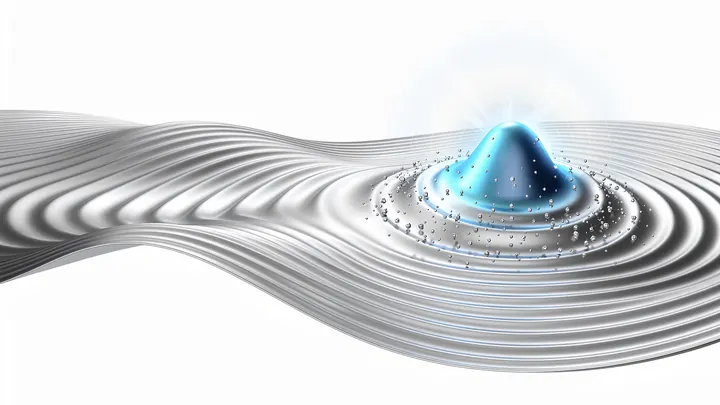
Drop a stone into a pond, and ripples spread outward. Something similar happens inside compact clumps of dark matter when they encounter a special medium — a scalar field. This field, which pervades everything around us, can spontaneously intensify in the depths of such objects, much like ripples on water growing ever taller and more pronounced.
In a city park, trees grow faster than in a deep forest — not because the soil is better, but because branches collide and seeds are exchanged more often. Galaxies in the Spiderweb protocluster behave much the same way. This vast clump of matter will become a mature cluster billions of years from now.
Black holes come in two types: tiny ones — the remnants of supernova explosions, and giants in the cores of galaxies. But where are the intermediate ones, with hundreds and thousands of solar masses? The answer may lie in star swarms, where black holes collide like balls on a billiard table and, merging, bulk up.
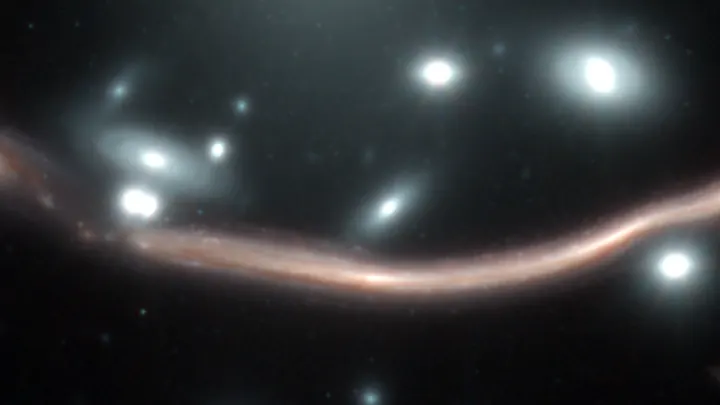
Light from the distant Dragon Galaxy has been traveling toward us for more than seven billion years. On its way, it passes by a huge galaxy cluster whose gravity bends the path of light like a lens. As a result, the galaxy appears brighter and larger than it really is, just as a magnifying glass enlarges fine print.
In the early Universe, star clusters were so dense that they gave birth to giants the size of the Solar System. If such a giant had taken the place of the Sun, its edge would have reached as far as Jupiter. These stars sometimes swallowed small black holes. The black hole would sink into the core and begin to grow, turning the star into a ghostly glow — a quasi-star.
In a large gas cloud where stars are born, the magnetic field lines are roughly aligned in one direction, like the fibers in a piece of felt. But look inside, into the dense clumps that will eventually become stars, and the picture changes: there the lines are twisted every which way, like a ball of yarn after a kitten has played with it.
In cold clouds of interstellar gas, long, dense filaments stretch out. Inside them, like overcrowded incubators, future stars are maturing. For a long time, it was thought that within such filaments, everything was governed by gravity: matter smoothly flows toward the centers, where density increases and eventually a star ignites.
In a dark cloud where no star has yet ignited, gas begins to pull together toward a common center. This is how the most massive stars in the Galaxy are born: those tens of times heavier than the Sun. Astronomers pointed radio telescopes at the cloud SDC335.579-0.292 and saw gas molecules lining up into streams falling inward.
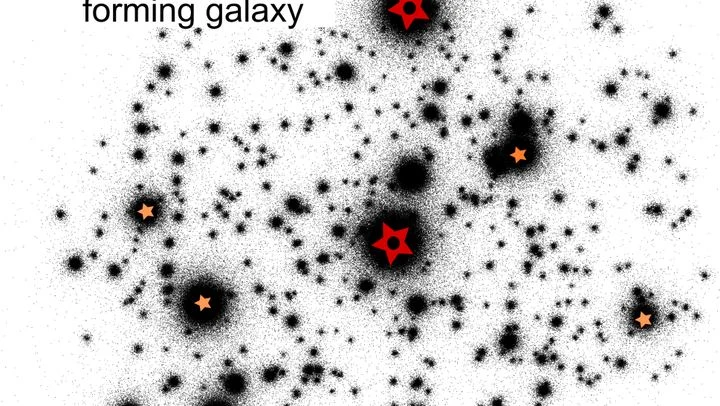
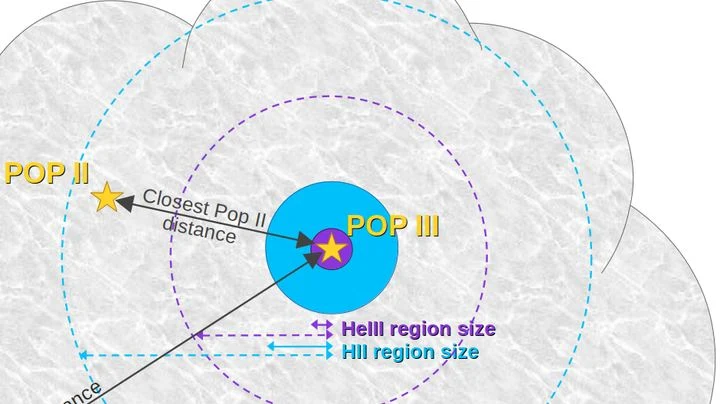
Immediately after the Big Bang, an idea championed by Georges Lemaître, the cosmos was a dark broth of hydrogen and helium. Then the first stars ignited — enormous, dazzlingly bright and hot, like sparks from a cosmic bonfire.
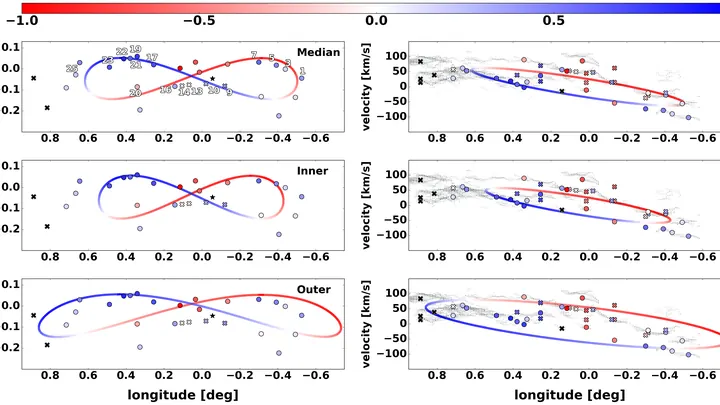
In the very center of the Milky Way, hidden behind a thick veil of dust, lies a giant accumulation of gas — the Central Molecular Zone. You can't see it with the naked eye: dust absorbs visible light, much like dense fog hides the lights of a city.
When a massive star dies, its core collapses into a neutron star, and the outer layers are blown off in an explosion. At that moment, an unimaginably dense cloud of neutrinos is born — particles that barely interact with matter but actively 'talk' to each other. There are so many of them that together they behave like a fluid, with waves rippling across it.
In the cold gas clouds where giant stars are born, everything is churning with motion. Gas compresses, swirls, and fragments into clumps — the future stars. For a long time, it was thought that the magnetic field brought order here: like invisible threads, it stretched clumps perpendicular to itself. But new observations showed the opposite.
Planets are born from dust. In a disk around a young star, tiny dust grains collide, stick together, and gradually grow like a snowball rolling down a hill. But there's a catch: the gas in the disk moves faster than the dust and drags on it, preventing it from clumping into large chunks.
For dust to stick together, there needs to be enough of it.
In the Norma cluster, the nearest rich galaxy cluster to us, astronomers have spotted a shock wave. It arose when one cluster plowed into another, like the bow wave of a ship cutting through water. This wave compressed and heated the gas between the galaxies.
Two galaxies sit right behind the wave front.
A gas cloud the size of a small galaxy is falling into the Milky Way at hundreds of kilometers per second. Such clouds are called high-velocity clouds, and until now no stars had been found in them — only gas. Now, in one of them, named Complex H, astronomers have spotted a pair of young star clusters.
When a massive star runs out of fuel, its core collapses and a shock wave races outward. But even before the star tears apart, particles that barely interact with ordinary matter may be born in its depths. If they decay into light, that energy leaks into the dense gas around the star.
This gas, like a blanket, wraps the star.
The kitchen where stars are baked works on a simple recipe: as much flour as you have, that's how many pies you get. For a long time, astronomers saw a strict relation between a galaxy's mass and how fast it forms stars, and they considered it a standalone rule. But a new study of 24,954 nearby galaxies shows that this relation is just a shadow of two more fundamental laws.
A distant galaxy birthing hundreds of stars should glow in oxygen. That's what astronomers thought: hot young stars heat the gas, which then emits a characteristic infrared glow at a wavelength of 63 microns. It's like steam rising from a boiling pot — a sure sign of vigorous activity.
The James Webb Space Telescope peered into the galaxy cluster AS1063 and spotted tens of thousands of globular clusters — dense stellar "knots" scattered throughout the cluster. Their positions matched the map of invisible mass, which is constructed from the bending of light from distant galaxies.
The young star PDS 66 is surrounded by a flat disk of gas and dust — the cradle of future planets. In the cold outer regions of such a disk, silicon and sulfur are usually hidden inside dust grains, but astronomers spotted a bright patch of gas at about 60 astronomical units from the star.