The Keck Telescope refers to the twin 10-meter optical and infrared telescopes at the W. M. Keck Observatory on Mauna Kea, Hawaii. They are among the largest ground-based telescopes in the world, designed for high-resolution spectroscopy and imaging across visible and infrared wavelengths. Their size and advanced instrumentation allow astronomers to study distant galaxies, exoplanets, and stellar phenomena with exceptional detail.
History
The first Keck telescope began operations in 1993, with the second following in 1996. The design was pioneered by Jerry Nelson and the Lawrence Berkeley Laboratory team, funded by the W. M. Keck Foundation.
How it works
Each Keck telescope uses a primary mirror made of 36 hexagonal segments that work together as a single 10-meter mirror, a technique called segmented mirror design. Adaptive optics systems correct for atmospheric distortion in real time, while spectrographs split light into component wavelengths to reveal the composition, temperature, and motion of celestial objects.
In practice
Used for high-resolution spectroscopy of distant quasars, exoplanet atmospheres, and galaxy formation studies, as well as supporting NASA missions like the search for habitable exoplanets.
Fun fact
The Keck telescopes are so sensitive they can detect a candle flame on the Moon's surface.
Light knocks electrons out of a crystal, and they fly toward the detector like arrows toward a target. From their trajectories, physicists reconstruct how electrons behaved inside the material: with what energy and in which direction they moved. But switch on a magnetic field, and the trajectories bend. The arrows start to curve, the target turns into a warped mirror, and the picture blurs.
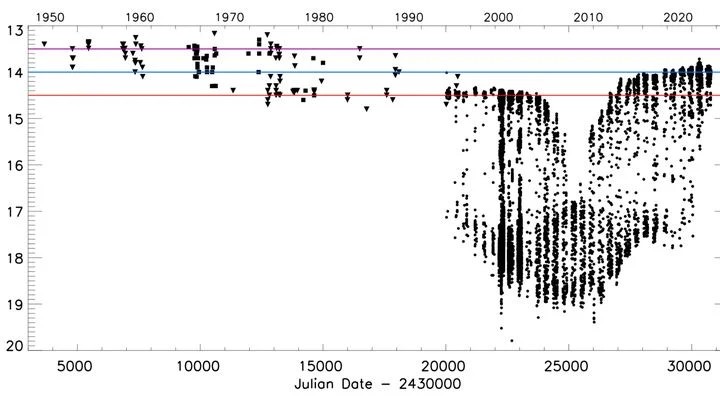
In the KH 15D system, two young stars orbit a common center, and between them and us lies a huge dust disk, like a curtain that sometimes hides the stars and sometimes reveals them. For seventy-five years, astronomers have watched this "theater of shadows": sometimes the light nearly went out, sometimes it flared up with renewed vigor.
When an orchestra of thousands of musicians plays in harmony, the credit goes not only to each player's talent but also to the invisible work of the conductor.
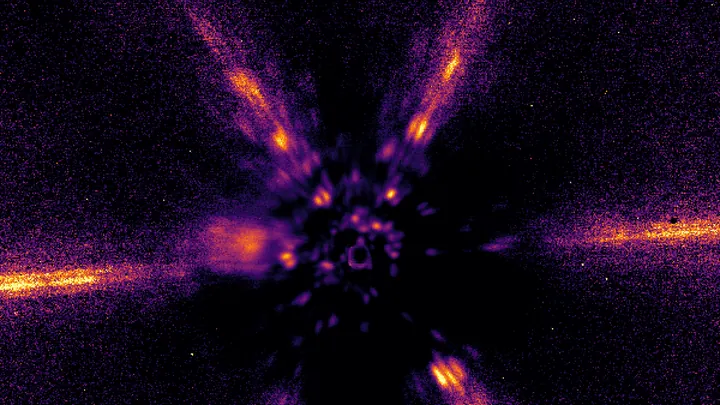
A spotlight blazes straight into your eyes, and a few steps away a tiny firefly flickers. That's roughly what it's like hunting for an Earth-like planet around a neighboring star: the planet is a hundred million to ten billion times fainter than its star, and in the sky they almost merge into a single point.
Galaxies, like giant whirlpools, sometimes collide and merge. In this chaos, gas compresses, new stars flare up, and a bright radio beacon is born at the very center. Its light — not visible to the eye, but radio waves — pierces through dust and gas like a siren through fog.
In the dark clouds of gas and dust where new stars are just igniting, the Keck Telescope in Hawaii picked out two faint points of light next to young stellar objects. These aren't stars but their companions — too light to shine on their own.
An ordinary magnetic compass freezes when lightning strikes nearby. A sudden jump in the magnetic field throws the needle off. A similar problem has been hindering scientists trying to measure magnetism in strong pulsed fields: those that switch on for a thousandth of a second.
The new setup tackles this with a laser beam.
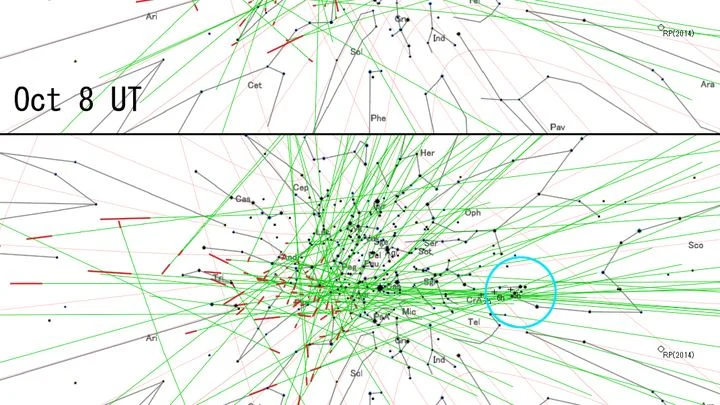
October 6, 2021, 8:30 PM Hawaii time. The StarCam camera on the dome of the Subaru Telescope gazes impassively at the sky, streaming the view on YouTube. Four and a half hours earlier, somewhere far away, Earth passed through an invisible trail — the dust tail of comet 15P/Finlay. Models predicted a peak, but would anyone see these 'shooting stars'?
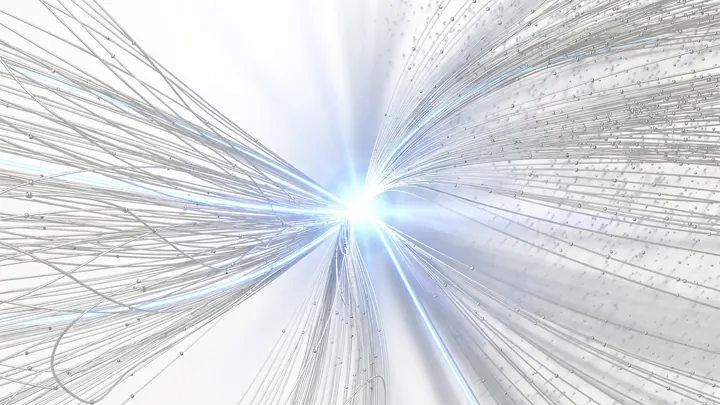
Cosmic rays are charged particles that fly to us from the depths of the Galaxy. If you plot how many particles arrive at each energy, the line runs smooth, then suddenly drops sharply.