An eclipse is an astronomical event that occurs when one celestial body moves into the shadow of another, temporarily blocking its light. The most familiar types are solar eclipses, where the Moon passes between the Sun and Earth, and lunar eclipses, where Earth passes between the Sun and the Moon, casting a shadow on the Moon. Eclipses have been observed and recorded for millennia and have played a significant role in the history of astronomy.
History
Eclipses have been recorded since ancient times, with Babylonian and Chinese astronomers predicting them as early as the 2nd millennium BCE. The Greek philosopher Thales is said to have predicted a solar eclipse in 585 BCE. The modern understanding of eclipses was solidified by Kepler's laws of planetary motion in the 17th century.
How it works
A solar eclipse happens when the Moon's shadow falls on Earth's surface. The Moon's shadow has two parts: the umbra, where the Sun is completely blocked, and the penumbra, where only part of the Sun is obscured. A total solar eclipse occurs only within the narrow path of the umbra, while a partial eclipse is seen from the penumbra. A lunar eclipse occurs when the Moon passes through Earth's shadow, which can also be total or partial. The geometry of the orbits means that eclipses do not happen every month because the Moon's orbit is tilted relative to Earth's orbit around the Sun.
In practice
Eclipses have been used to test general relativity, as during the 1919 solar eclipse that confirmed the bending of starlight by the Sun's gravity. They also provide opportunities to study the Sun's corona and the Moon's surface composition.
Fun fact
A total solar eclipse is the only time when the Sun's corona is visible to the naked eye from Earth, and the path of totality is typically only about 100 miles wide.
Cosmic rays aren't rays in the usual sense: they're fast particles bombarding Earth from all directions. Mostly they're protons and atomic nuclei. Their energies vary widely, from modest to fantastically huge. When such a particle heads our way and the Moon or Sun gets in its path, it gets absorbed.
In 2019, the world saw the first image of a black hole's shadow — an orange doughnut on a black background, becoming a symbol of scientific progress. But this image wasn't captured by a camera: it was born from mathematical alchemy, where data from eight radio telescopes, which gathered only crumbs of signal, merged into a single picture.
On the periphery of the Solar System lurk thousands of objects comparable in size to an exoplanet — a body of planetary mass not bound to our star. Their orbits are chaotic, and from time to time the trajectory of such a wanderer crosses Earth's path.
Moments before totality, swift shadow bands glide across the ground, like ripples from pebbles tossed into water. For centuries, this phenomenon baffled scientists. It turns out the key is that light is a wave.
The Sun isn't a pinpoint lamp but a vast disk. When the Moon nearly covers it, a thin glowing crescent remains.
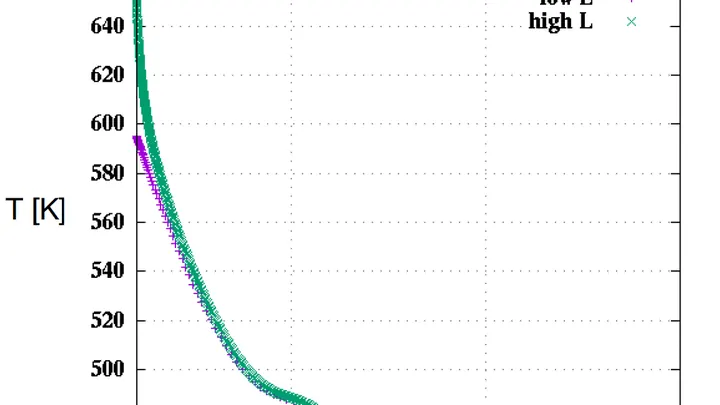
Civilizations in the Universe are separated not just by distance, but by the vast gulf of time. Hunting for their traces is like archaeology: instead of palace ruins, we find clouds of cosmic dust.
A ball on a slope with two pits usually rolls into the nearest one and comes to rest. But if the slope is slightly deformed and 'remembers' recent nudges, the ball can hang around halfway for a long time — in a narrow spot it doesn't want to leave. That's exactly the trick physicists played with light.
By day in Chile's Atacama Desert, the air shimmers with heat like the haze above a hot skillet. Sunlight passing through this shimmer begins to dance and flicker. Astronomers call this airy trembling "seeing" — and it keeps telescopes from getting a sharp view of the stars.
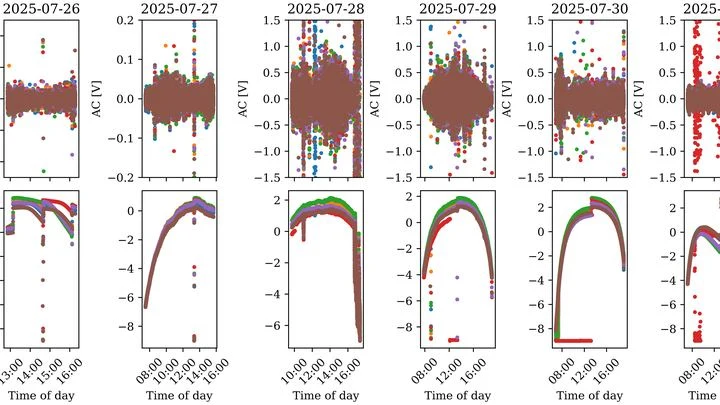
To fight this nuisance, engineers have built a special instrument — a solar seeing monitor.
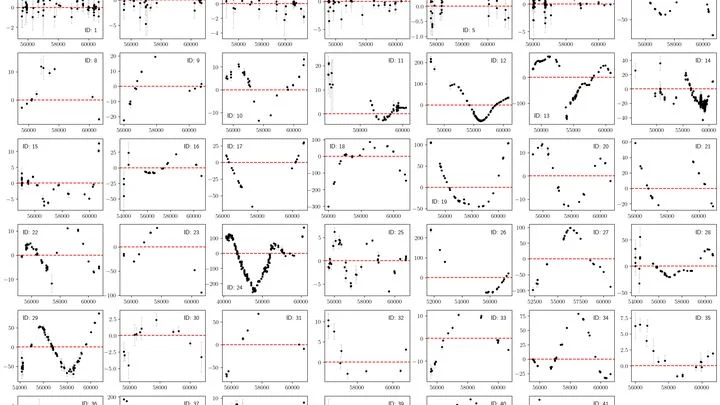
Eclipses in binary stars are like clockwork: a white dwarf (the dense remnant of a star) regularly passes in front of its companion, and the light briefly dims. But for most such pairs, the clock runs fast or slow by seconds over years. Astronomers measured these glitches in 43 systems and found a pattern.
The center of a galaxy is a bustling metropolis where a giant black hole often snatches inattentive stars. But telescopes caught a flare in a quiet suburb, tens of thousands of light-years from the core. This gave away a wandering black hole — an invisible predator, flung out of the center after an ancient galaxy collision.
Astronomers caught the young planet AU Mic b in the act of hiding behind its star. The Spitzer telescope tracked its infrared glow: as the planet slipped behind, the system's total light dimmed slightly. The dip was just 171 parts per million, like a single drop of ink in ten buckets of water.
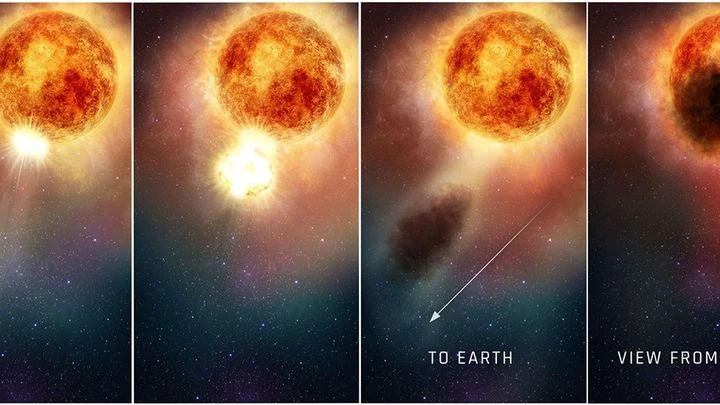
In 2019, Betelgeuse suddenly dimmed, sparking rumors of an imminent explosion. But clouds of cosmic dust turned out to be the culprit. Now, the Gemini North telescope has discerned a minuscule companion star in its dazzling glare, just as calculations had predicted.
When a star wanders too close to a black hole, an object with gravity so intense that not even light can escape, tidal forces shred it like dough caught in a mixer's beaters. This event, known as a tidal disruption event (TDE), unleashes a powerful flare of radiation.