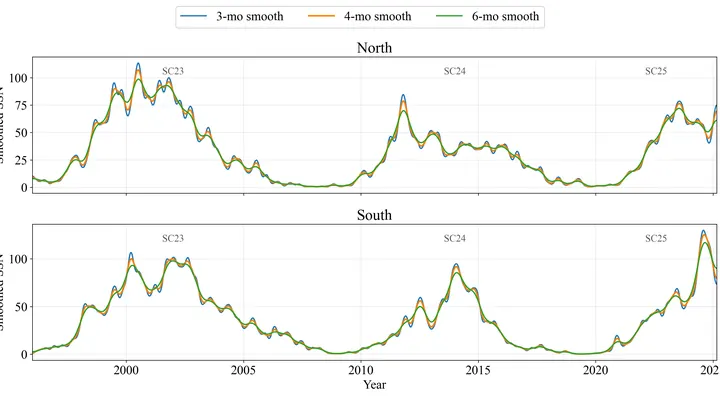
The solar cycle is the roughly 11-year periodic variation in the Sun's activity, marked by changes in the number of sunspots, solar flares, and coronal mass ejections. This cycle is driven by the Sun's magnetic field, which undergoes a complete reversal of polarity every cycle — the north and south magnetic poles swap places. The cycle is not perfectly regular; it can vary in length from about 9 to 14 years, and its amplitude changes over decades and centuries, as seen in the Maunder Minimum in the 17th century when sunspots nearly disappeared.
History
The discovery of the solar cycle is usually attributed to Heinrich Schwabe, who in 1843 announced the periodic variation in sunspot numbers after 17 years of observations. Rudolf Wolf later systematized the counting of sunspots and established the cycle's average length of about 11 years.
How it works
The cycle arises from the interaction between the Sun's differential rotation (the equator rotates faster than the poles) and its convective motions. These stretch and twist the magnetic field lines, amplifying them over time. Eventually, the field becomes so tangled that it erupts through the surface as sunspots and active regions. As the cycle progresses, the magnetic field's polarity reverses, and the process starts anew. The cycle's details are still not fully understood, but it is known to be a self-sustaining dynamo process in the Sun's interior.
In practice
Solar cycle predictions are used to plan satellite operations, power grid management, and space missions, as solar activity affects space weather and can disrupt communications and navigation systems.
Fun fact
The solar cycle influences not only space weather but also Earth's climate: the Maunder Minimum, a period of very low solar activity, coincided with the coldest part of the Little Ice Age.
A perovskite solar cell is like a young athlete: it performs brilliantly at first, but tires with age. Over eight hours, its performance drops noticeably, with no visible cause like cracks or dust. Scientists took one cell and recorded its performance at 0, 90, 280, and 480 minutes of its life.
The solar wind is a continuous stream of charged particles flowing from the Sun. It has two main components: protons (hydrogen nuclei) and alpha particles (helium nuclei, four times heavier).
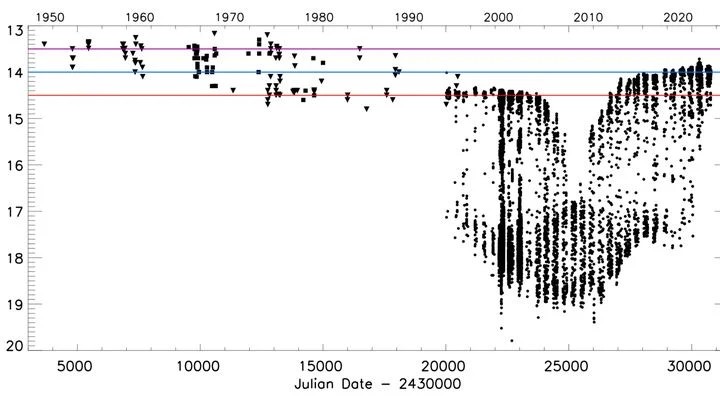
In the KH 15D system, two young stars orbit a common center, and between them and us lies a huge dust disk, like a curtain that sometimes hides the stars and sometimes reveals them. For seventy-five years, astronomers have watched this "theater of shadows": sometimes the light nearly went out, sometimes it flared up with renewed vigor.
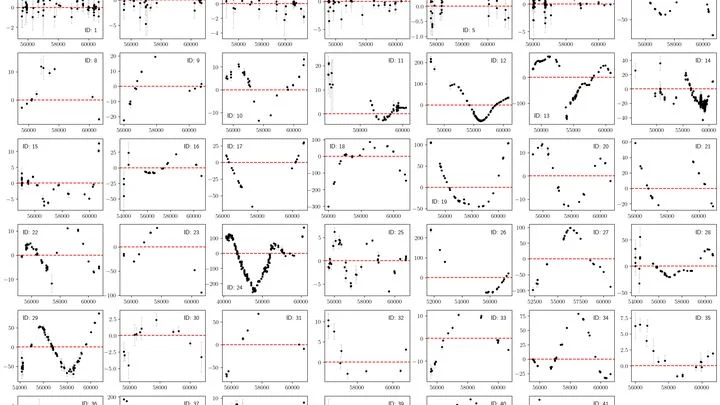
Two hundred and eighty-nine days: that's how long one rotation of the white dwarf white dwarf WD 1532+129 takes. This is not just a record: on its surface, near the magnetic poles, scars of iron and other metals appear — silent testimony to planets it has devoured.
The Sun is constantly struck by blows — magnetic reconnection in the plasma releases energy, making the corona flare up. After each such blow, magnetohydrodynamic waves linger in the plasma loops, like the fading ring of a bell.
The giant cloud of icy chunks on the outskirts of the Solar System, the Oort cloud, resembles a transparent bubble stretched to a light-year across. Usually, these chunks hang quietly in their distant corners, but sometimes something disturbs them.
Most often, it's the tidal influence of our Galaxy.
A planet glides across a star's disk, and for a moment becomes a flashlight. It blocks a tiny patch of surface, revealing details that otherwise escape our view. That's exactly how astronomers peered into the dark spots on V1298 Tauri, a young twin of our Sun. They were aided by the James Webb Space Telescope JWST and three giant planets in orbit.
The Sun doesn't burn steadily: it erupts in series. Like a campfire that dies down and then suddenly throws out showers of sparks, these "fiery seasons" last from six months to a year and a half, and during them the star shows an unusually high number of sunspots.
A streetlamp flickers as someone walks past. That's roughly how our nearest star, Proxima Centauri, behaves: it flares in response to the motion of its planets.
Astronomers observed the star with a highly sensitive instrument, the ESPRESSO spectrograph. It captures light and splits it into colors, much like a prism.
A giant cauldron that barely smolders most of the time, but occasionally spits out showers of sparks. That is roughly how the supermassive black hole at the center of our galaxy — Sagittarius A*—behaves. It weighs four million times as much as the Sun and lies 26,000 light-years away.
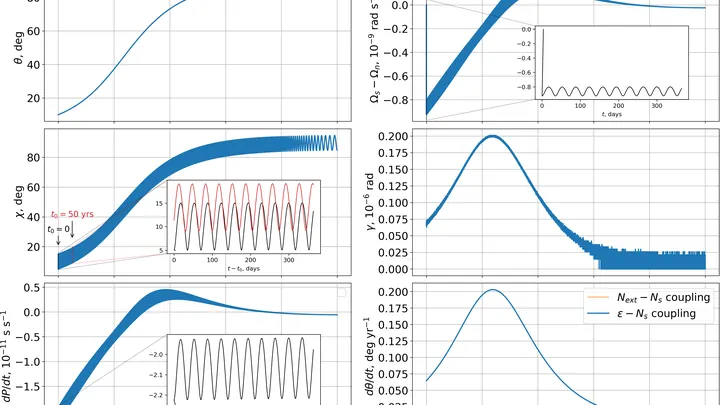
A spinning top that wobbles as it rotates: that's roughly how astronomers picture the neutron star in the binary system Hercules X-1. It completes one full turn on its axis every second, but its axis slowly traces a cone with a period of 35 days.
A sunspot, a dark island on the scorching surface, breathes. Every three minutes, a wave spreads from it, runs along an invisible magnetic arch, and makes the plasma above a neighboring spot flare with a radio signal. Radio telescopes caught seven such flares in a row on February 14, 2024.
For 800,000 years, ice ages have occurred every 100,000 years. The rhythm matches the elongation of Earth's orbit. But the orbit changes the flow of solar heat so subtly — as if the conductor barely moved the baton, yet the orchestra thundered. It remained a mystery how this weak signal controls the ice sheets.
At the center of the Milky Way lies the supermassive black hole Sagittarius A*. It is four million times more massive than the Sun, but by cosmic standards it behaves quietly: it only occasionally flares up when it swallows a clump of gas.
A lighthouse blinks every few seconds, but then begins to slowly brighten and dim over the course of a year. That is exactly what about a third of red giants do — huge stars in the late stages of life. Their normal pulsations take days or weeks, but on top of that, long secondary periods are visible: months and years.
Every 1151 years, seven planets of the Solar System, from Mercury to Neptune, find themselves at almost the same points in their orbits. Their positions scatter by less than a degree, as if the celestial mechanism is wound to the same tune. This rhythm was discovered by comparing planetary positions over 2600 years using precise tables of celestial motion.
The Sun pulses in a slow rhythm, and that rhythm can be heard in the rains over Brazil. Sunspots on the solar disk thicken and thin roughly every eleven years, and along with them, pressure in the Pacific Ocean shifts, sea surface temperatures change, and then rainfall amounts in the northeast of the country follow suit.
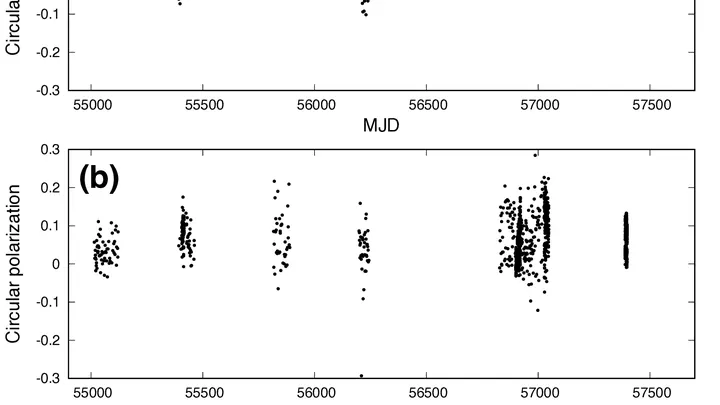
Light from the Sun is usually unpolarized: its waves oscillate in all directions, like a crowd where everyone waves their arms as they please. But on May 3, 2023, astronomers in Locarno, Switzerland, noticed that during a flare, the light from helium became organized — the waves aligned in one direction, like soldiers on parade.
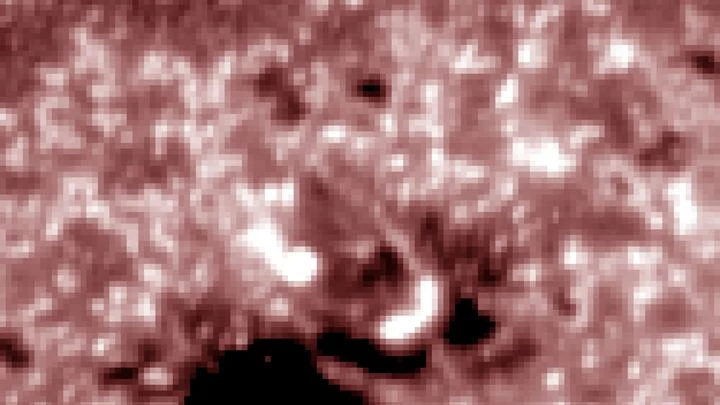
The Sun sometimes produces flares — bright explosions that hurl streams of charged particles into space. On April 22, 2021, one such flare occurred in an active region where a dark sunspot was crossed by a bright "bridge" of hotter gas.
The Sun is not a perfectly steady lightbulb. Its brightness quivers slightly: it dims a bit, then brightens. For Earth's climate, even slow variations stretched over thousands and millions of years matter. They could have left their mark in the geological record of the last 540 million years.
Astronomer [scientist:A. M.
Scientists search for planets around distant stars by detecting a slight wobble in the star's motion: the planet tugs on the star, making its light shift slightly toward the blue and then toward the red. But stars have their own ripples — dark spots and bright faculae on their surfaces. These also shift the light, making it hard to tell them apart from a planet.
31 Aquilae is an aging star that has puffed up into a subgiant. It once resembled the Sun, but has since cooled and grown larger. It rotates very slowly — one full turn takes many days.
A spinning top that whirls so fast it completes 220 rotations in a single second: that's exactly what China's FAST radio telescope has caught. This is the pulsar PSR J1810-0623, a neutron star the size of a city but with more mass than the Sun.
Astronomers caught a signal from a cosmic lighthouse — a radio pulsar with a period of 36 minutes. Unlike ordinary pulsars (neutron stars that spin hundreds of times per second), this one barely turned. It transmitted pulses for only eight days and vanished, visible only in the radio range.
A solar flare is like a short circuit in a giant neon sign. Inside the Sun, magnetic fields twist into loops, like rubber bands, and when they reconnect, energy bursts into space. Part of it goes into hard X-rays, produced by particles accelerated to nearly the speed of light.
Cosmic rays are charged particles that reach us from distant stellar explosions. But before hitting a detector, they must pass through the bubble of the solar wind. The Sun breathes: it inflates this bubble, then contracts it.
Eclipses in binary stars are like clockwork: a white dwarf (the dense remnant of a star) regularly passes in front of its companion, and the light briefly dims. But for most such pairs, the clock runs fast or slow by seconds over years. Astronomers measured these glitches in 43 systems and found a pattern.
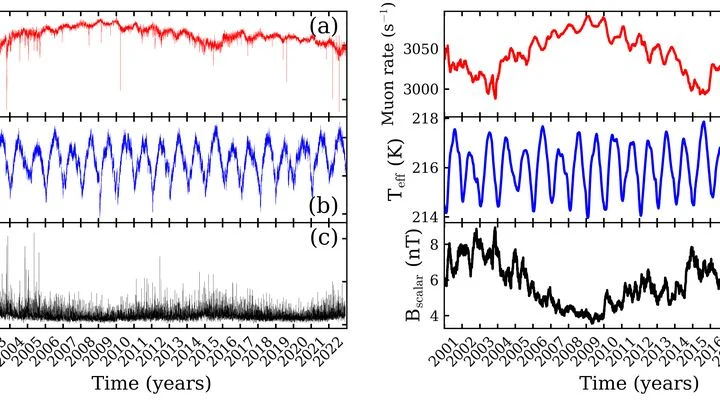
Every second, invisible particles from space, cosmic rays, strike Earth's atmosphere. Colliding with air molecules, they produce showers of secondary particles, among which muons are especially abundant. A muon is a heavy cousin of the electron that lives only a couple of microseconds but still manages to reach the ground.
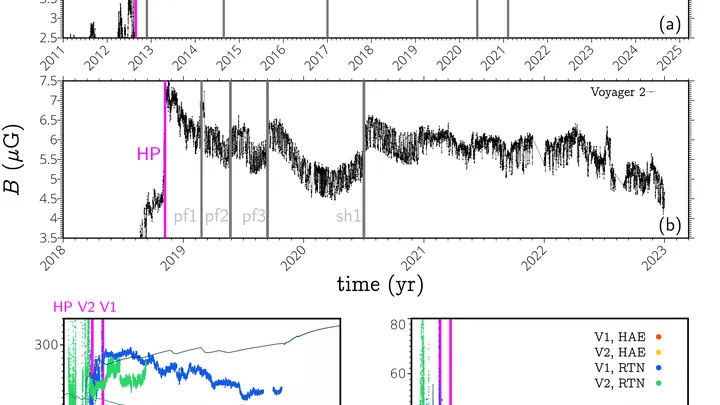
Two aging spacecraft, launched back in 1977, are flying through interstellar space — the region where the Sun's influence fades. The Sun doesn't just shine; it continuously blows a stream of charged particles that forms a giant bubble around our system — the heliosphere.
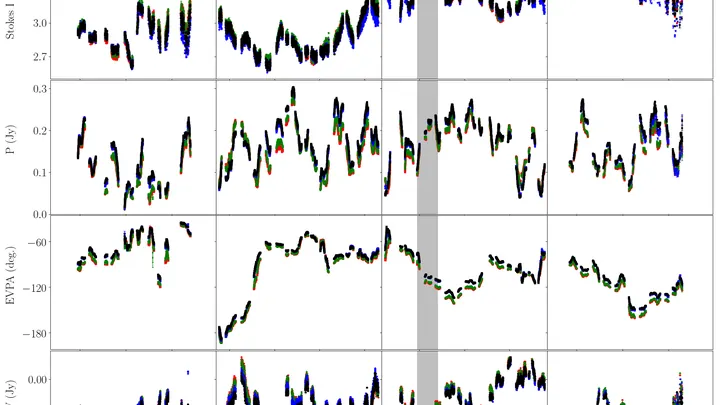
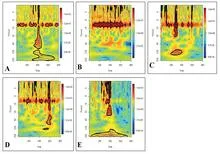
The Sun is not a calm sphere but a boiling cauldron that follows its own rhythms. Roughly every 11 years, its activity peaks: more dark spots appear on its surface, and streams of charged particles fly into space. But hidden within this grand cycle is a shorter one — about 1.7 years.
The young star RY Tau is like a finicky spinning top. Around it whirls a flat disk of gas and dust — the leftovers of the cloud from which the star was born. The star pulls some of the disk's matter toward itself like a vacuum cleaner, and flings some back out in a narrow wind cone like a fountain.
In a dense gas cloud where a star heavier than the Sun is forming, there is a tiny source of radio waves. It works like a laser: methanol molecules amplify the radiation, and we see a bright spot. But this spot behaves strangely: its brightness jumps up and down within a matter of hours.
The neutron star 1E 161348-5055 in the supernova remnant RCW 103 pulses with a period of 6.67 hours. That's very slow for such a compact object, and astronomers long puzzled over what was going on.
For thirteen straight years, the Swift space observatory recorded the X-ray "breathing" of the pulsar GX 301-2. Every few minutes, the BAT instrument measured how much hard radiation came from this pair — a neutron star and its massive companion.
A magnetic compass in a test tube sounds like a magic trick, but it's pure physics. In a solution of fumarate (a salt of malic acid), carbon-13 nuclei behave like tiny spinning tops.
In a silicon crystal, the stuff of microchips, there sometimes sits a foreign atom, like magnesium. It behaves like a tiny magnet with several 'pointer positions.' If you illuminate such a crystal with a short flash of light, the atom momentarily gets excited, then returns to its ground state.
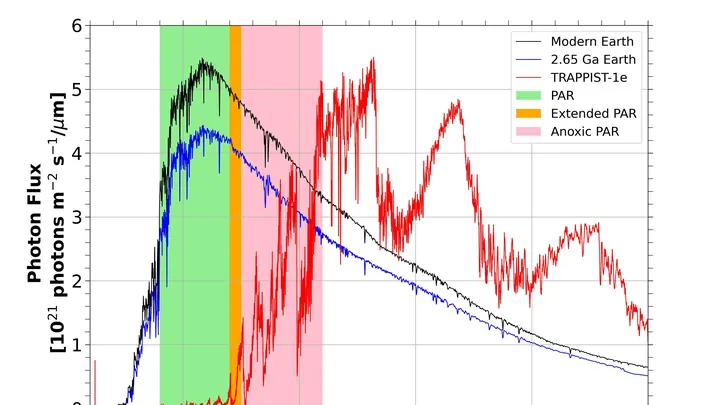
On the exoplanet TRAPPIST-1, oxygenic photosynthesis, the process by which light energy is converted into chemical energy with oxygen as a byproduct, is losing the race for survival. This M-dwarf star emits mostly in the infrared, not in the visible range like the Sun.
Place two pendulums side by side and give one a gentle push; the other will soon pick up the rhythm. This behavior isn't limited to clocks on a shared shelf; it also applies to the plasma inside the Sun. In the star's convection zone, two huge ring-shaped flows circulate: one closer to the surface, the other deeper. Each oscillates with its own period—12.05 and 9.52 years.
Every clear night, a telescope on the island of La Palma looked at the sky and recorded how much the air dimmed starlight. This was routine work for astronomers measuring stellar positions. But in these records, like in an old diary, traces of a different story remained: the arrivals of dust from the Sahara.
A rock chronicle where each layer is a page, and spectral analysis reads the rhythm of the lines. In the Realmonte salt mine in Sicily, geologists measured the thickness of 120 three-part cycles: a millimeter-scale clay parting, a thin anhydrite or polyhalite layer, and then a decimeter-scale halite bed.