Light Catches Chip Tampering express
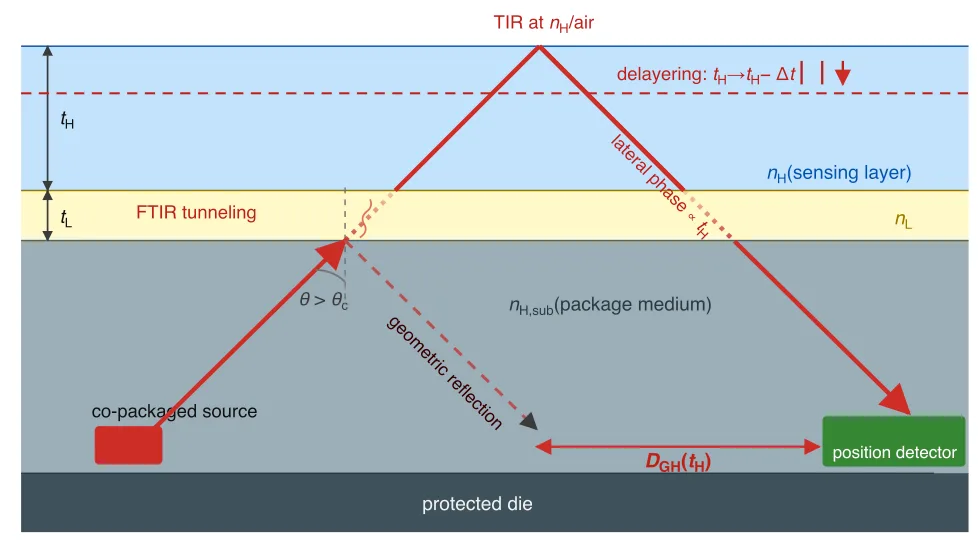
A microchip is like a layered cake: protective layers on top, secrets inside. An attacker can peel off layers one by one to get to the secrets. A new sensor monitors this with a light beam.
The beam hits the chip surface at an angle. Part of the light reflects, but not immediately: it slightly 'dives' into the top layer, like a pebble skipping across water. If the layer becomes thinner, the beam emerges elsewhere — shifting by a few nanometers. The sensor measures this shift.
This shift is nearly impossible to fake. It changes consistently under any disturbance — whether temperature fluctuations or laser jitter. Even if someone drills a pinpoint hole, the beam honestly reports: something was poked here.
Original abstract
as written by the authors arXiv:2608.12243v1
We propose a co-packaged photonic tamper sensor that detects progressive delayering and localized drilling through changes in the Goos-Hanchen (GH) shift of a reflected optical beam. Frustrated total internal reflection (FTIR) couples the beam into a high-index sensing layer, where its transverse-wavevector components acquire a thickness-dependent propagation phase. Numerical simulations show an approximately linear response for sensing-layer thicknesses below 250 nm and a delayering sensitivity of 5.3 nm of beam displacement per nanometer of material removed, nearly three times that of a conventional total internal reflection (TIR) structure. The off-resonant response remains stable under representative refractive-index, wavelength, and incidence-angle variations. Localized drilling also produces a monotonic GH-shift change that increases with drill depth and width. These results establish GH-shift readout as a rapid, spatially encoded, and difficult-to-emulate approach for semiconductor-package tamper detection.
The beam shift the sensor detects is thousands of times thinner than a human hair.