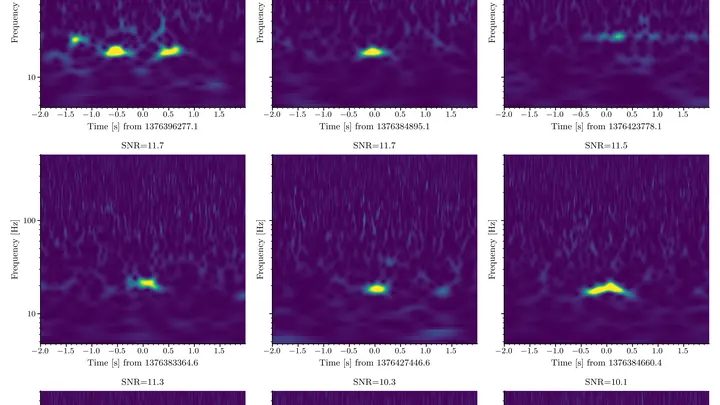
A glitch is a transient noise artifact in a detector that can mimic a real signal. In the context of gravitational wave detection, glitches are short-lived bursts of noise caused by environmental disturbances (e.g., seismic vibrations, electromagnetic interference) or internal instrumental effects (e.g., laser fluctuations, mirror control issues). They are a major challenge because they can be mistaken for genuine gravitational wave signals, especially if they occur at the same time as a real event.
History
The term 'glitch' has been used in electronics and computing since the mid-20th century, but its specific application to gravitational wave detectors became prominent with the operation of LIGO and Virgo in the 2000s and 2010s, as the need to clean data from these noise artifacts grew.
How it works
Glitches arise from various sources, such as a sudden mechanical jolt to the detector, a spike in the data acquisition system, or a thermal event. They appear as localized, non-stationary disturbances in the data stream, often with characteristic shapes that differ from the expected chirp-like signature of a gravitational wave. To distinguish glitches from real signals, researchers use statistical methods, machine learning algorithms, and coincidence checks across multiple detectors—a real gravitational wave should be seen in all detectors simultaneously, while a glitch is typically local to one instrument.
In practice
Glitch identification and removal are essential in gravitational wave astronomy, where they are filtered out using algorithms like the Gravity Spy project, which uses citizen science and deep learning to classify glitches.
Fun fact
Some glitches in LIGO are caused by birds pecking at the detector's vacuum system, creating vibrations that mimic a signal.
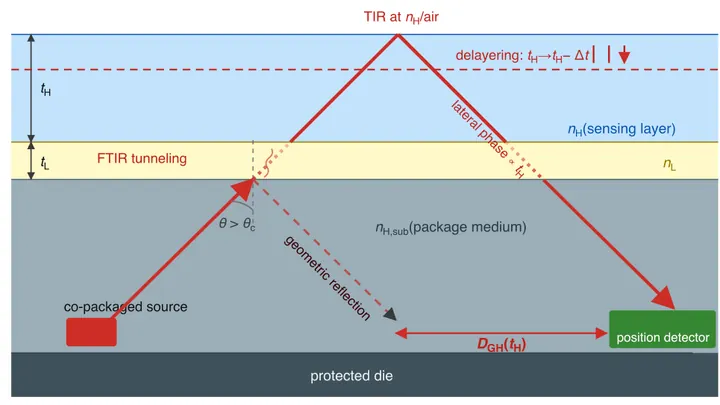
A microchip is like a layered cake: protective layers on top, secrets inside. An attacker can peel off layers one by one to get to the secrets. A new sensor monitors this with a light beam.
The beam hits the chip surface at an angle. Part of the light reflects, but not immediately: it slightly 'dives' into the top layer, like a pebble skipping across water.
When a star many times heavier than the Sun dies, it collapses and explodes as a supernova. This is not just a flash of light — the entire process, from core collapse to the ejection of the outer layers, makes space itself tremble. These ripples are called gravitational waves.
A noisy café. You're trying to make out two quiet conversations: one from the table by the window (black hole mergers), the other a barely audible whisper from the far corner (echoes of the universe's birth). But the hiss of the espresso machine and street noise (detector jitter) drown everything out. New work teaches a computer to separate these sounds.
You're listening to the faint whisper of stars, and nearby someone keeps moving a chair. In gravitational wave telescopes, that role is played by scattered light: it reflects off trembling surfaces and creates false signals.
A huge bowl of water. Drop a stone into it — ripples spread across the surface. The fabric of spacetime works much the same way: when two massive stars merge, they create ripples — gravitational waves. These waves travel to Earth and are picked up by giant detectors like LIGO and Virgo.
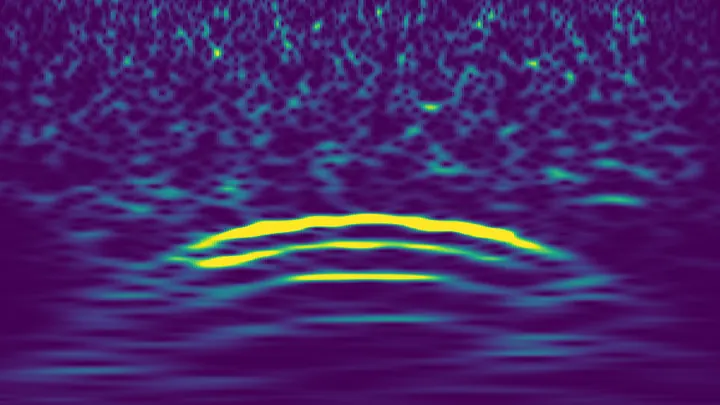
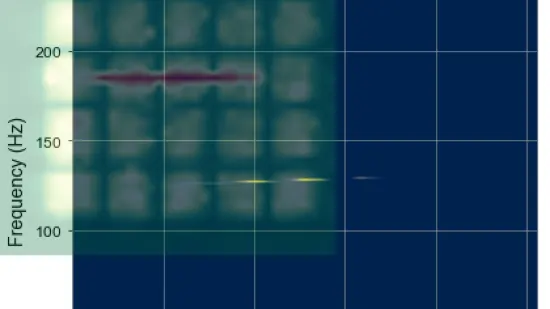
In 2019, the LIGO facility recorded a gravitational waves, a ripple in the fabric of spacetime, whose time-frequency map resembled a strange comb. Each such signal from a black hole merger leaves a unique pattern, like a fingerprint.
Gravitational-wave detectors are like sensitive microphones, listening for the whispers of distant cataclysms. But every now and then, a sharp crack bursts in — a brief noise spike known as a glitch.
The LIGO and Virgo detectors catch gravitational waves from mergers of black holes and neutron stars. But among the cosmic signals, their sensitive arms are constantly crossed by shadows — short-lived noise artifacts, glitches, that stage a true shadow theater.
A gravitational wave observatory is like a set of microphones scattered across the Earth. When a signal arrives from space (say, from a black hole merger or a supernova explosion) each microphone hears something slightly different.
In 2015, detectors caught a gravitational wave for the first time — a ripple in space that traveled from merging black holes. Since then, such signals have become a new window into the universe for astrophysics. But gravitational waves can do more: they carry the imprint of the very theory of gravity.
A translator records a multi-hour conversation. If they try to hold the entire dialogue in their head, they're bound to garble details by the end. That's roughly how gravitational observatories work: they listen to the 'conversation' of massive bodies spiraling together.
Gravitational telescopes listen to the cosmic 'music' — gravitational waves from distant cataclysms. But their recordings are full of 'scratches' — short terrestrial glitches. Previously, assessment was done over the entire track at once, and faint clicks were lost.
Astronomers listen to the cosmos like an old radio: they twist the knob not to find a particular station, but to catch any unusual noise. This approach breaks the mold: instead of hunting for gravitational waves using memorized patterns, they catch everything — without bias.
The universe sometimes resembles a pot of boiling water. With enough heat, liquid turns to vapor: that's a phase transition. Something similar could have happened in the early universe: a field filling space suddenly changed its state, like water becoming gas.
Spacetime is not a passive void but a dynamic membrane capable of elastic deformation. When neutron stars (ultra-dense objects the size of a city, where matter is compressed to nuclear density or black holes) regions with gravity so strong that even light cannot escape their bounds collide, the membrane shudders, generating…
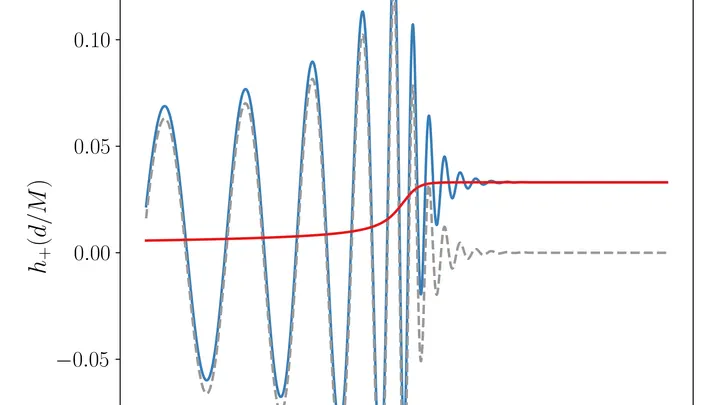
A black hole collision isn't just a burst of gravitational waves; it also leaves a lasting trace: an eternal curvature of spacetime — gravitational memory. Like a boat on water leaves a lingering wake, the cosmos 'remembers' the catastrophe.
The trembling of space sounds like an orchestra. Gravitational waves caught by the LIGO and Virgo detectors tell of black hole collisions. Sometimes the music carries off-key notes — tiny deviations from Einstein's score. They might whisper of new physics or simply of dust on the bows.
Gravitational wave detectors are microphones listening to the trembling of space. But their own noise drowns out weak signals. To hear more, physicists add special "squeezed" light to the instrument: it reduces quantum noise, like noise cancellation in headphones.
A figure skater glides across the ice, gradually approaching the center of the rink. A slight twist of the torso, and the smooth spiral breaks, the trajectory becomes unpredictable. Something similar happens when a small black hole with its own rotation (spin) falls toward a giant black hole.
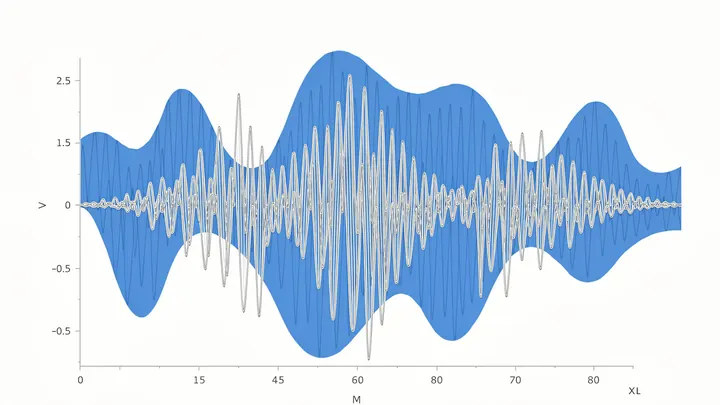
In the headphones used to listen to a distant orchestra, there is an occasional crackle. The crackle can be so loud that it drowns out the music or even blends in with it.
A pebble drops into a pond, and neat circles spread across the water. But the pond's bottom is strewn with invisible glass shards: each one slightly delays the wave, scatters it here, or alters its pace. That's roughly how gravitational waves, the trembling of space itself, pass through distant galaxies and dark clumps of matter.
The Taiji detector, planned for launch into space, will pick up the trembling of space caused by collisions of enormous black holes. But its data is frequently marred by random bursts, like static crackling in a radio receiver.
In 2015, two giant facilities in the United States caught the shiver of space — a gravitational wave from the collision of black holes. Since then, such signals have been caught regularly, but the detectors themselves are enormous: their arms stretch for kilometers.
An atomic gravimeter works like a very precise scale for gravity: it tosses up a cloud of atoms and watches how fast they fall. But these instruments have a hidden flaw — the shape of the signal they produce is slightly skewed. This skew, like a ruler with a chipped edge, subtly shifts every measurement.
Detectors of gravitational waves usually compare the signal with ready-made templates, as if searching for a familiar melody in the noise. This allows them to track only known scenarios, such as black hole mergers.
Right after its birth, the Universe wasn't just expanding: it was inflating at an unimaginable pace. This stage, called inflation, was proposed by Alan Guth. New models compare the process to inflating a balloon with quick, jerky pumps.
An old aviation instrument sometimes sticks: the needle catches on the scale and doesn't move, even though the plane is already changing altitude. Engineers found a simple solution: add a slight vibration. The shaking doesn't hinder; on the contrary, it helps the needle break free and show the truth.