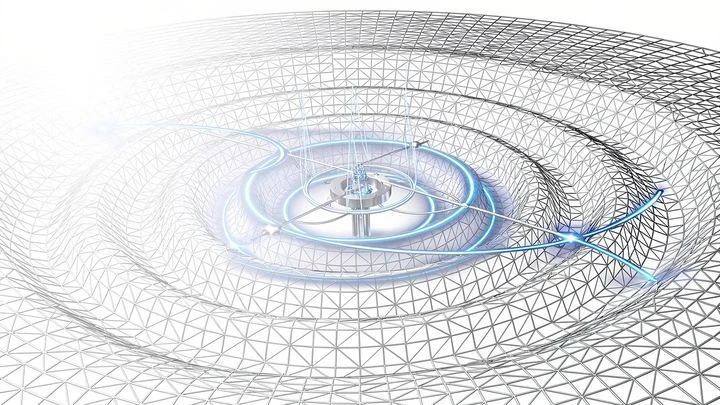
A lightbeam is a directed stream of photons traveling through space. In everyday contexts, it's what comes out of a flashlight or laser. In astrophysics, light beams are crucial because they carry information about distant objects and can be manipulated by gravity. When a light beam passes near a massive object like a galaxy or black hole, its path bends—a phenomenon called gravitational lensing.
History
The bending of light by gravity was predicted by Albert Einstein's general relativity in 1915 and first confirmed by Arthur Eddington during the 1919 solar eclipse. The concept of gravitational lensing was further developed by Einstein and others in the 1930s.
How it works
Light travels in straight lines through flat spacetime, but massive objects curve spacetime around them. A light beam follows the curved geometry, so its path appears bent to an outside observer. This bending can focus or distort the beam, creating multiple images, arcs, or Einstein rings of background sources. The effect is stronger with more massive objects and closer passage.
The Sun itself acts as a gravitational lens, focusinglight from distant stars at a focal point about 550 astronomical units away—a region proposed for a future space telescope.
The blue glow in water around a nuclear reactor is light born when a charged particle outruns light in that medium. The effect was discovered by Pavel Cherenkov in 1934, with the theory provided by Igor Tamm and Ilya Frank.
Light escaping a massive body loses steam. Its frequency dips slightly, and its color shifts toward red. Physicists call this gravitational redshift. In classical theory, it's all clear, but the moment you bring quanta into the picture, trouble starts.
Previously, this shift was modeled as a kind of mode mixer — a device that entangles different states of light.
Eight bright spots on the radio sky. They are all the same quasar HS 0810+2554, whose light passed through a gravitational lens — a massive foreground galaxy.
The Universe speaks two fundamental languages — gravity and light. Under normal conditions, they do not mix: gravitational waves glide through matter without a trace, while photons dance in mirror labyrinths.
The fabric of space bends under weight, like a stretched trampoline. Gravitational waves — ripples spreading from cosmic cataclysms, such as merging black holes. If such a ripple encounters a massive galaxy or invisible dark matter, they act like a magnifying glass: bending and amplifying the signal.
When light swings past a massive body like a black hole, its path warps — an effect predicted by Einstein. New research has taken into account that near such objects, clouds of hadrons often swirl — the very particles we know from protons and neutrons in atomic nuclei.
A pebble drops into a pond, and neat circles spread across the water. But the pond's bottom is strewn with invisible glass shards: each one slightly delays the wave, scatters it here, or alters its pace. That's roughly how gravitational waves, the trembling of space itself, pass through distant galaxies and dark clumps of matter.
When a massive star dies, a supernova explosion occurs, so powerful that a single flash outshines an entire galaxy. In this fire, billions of axions are born — invisible particles that leave almost no trace. Every second, trillions of these tiny things fly right through each of us, completely unnoticed.
A laser beam usually travels straight, like a jet of water from a hose. But what if you twist that jet like the thread of a corkscrew? You get a light spring — a beam that, as it moves, also spins around its own axis. At every point in space, its brightness traces a spiral, and if you place a flat screen in its path, you'll see a rotating spot of light.
A sheet of graphene is a lattice of carbon atoms arranged like a honeycomb. Electrons in it zip around so fast they seem to have no mass, just like light. When a powerful laser pulse hits such a sheet, the electrons get a kick and start accelerating. Their path can be compared to a road with occasional barriers — the forbidden zones.
If you briefly flash light near a black hole, it will respond with a long echo, like a bell that keeps ringing after being struck. The light gets trapped near the hole, bouncing repeatedly off an invisible boundary: the photon sphere, where rays circle around like sound in a metal.
A heavy ion beam in an accelerator is like a crowd of people shoving each other with elbows: the more people, the wider the crowd. Charged particles repel each other, and at currents above a few microamps the beam spreads and loses its shape.
Dark matter is an invisible ocean that, as shown by observations by Vera Rubin, keeps stars in galaxies from flying apart. Physicists suspect that if dark matter consists of ultralight particles, in the cosmic cold it turns into a frictionless fluid — a so-called condensate.
Scientists have described a new type of invisible star that behaves like a breathing lens. Such a star is made of ultralight boson particles (not yet discovered). Its gravity causes spacetime curvature — this is the lens, which rhythmically expands and contracts, as if breathing.
An electron gliding over invisible hills and valleys created by a spin texture: that is the picture behind a new chapter in condensed matter physics. In quantum materials where the direction of localized spins varies smoothly (a spin texture), an electron is no longer just a particle flying through the lattice.