A Two-Hour Flare express
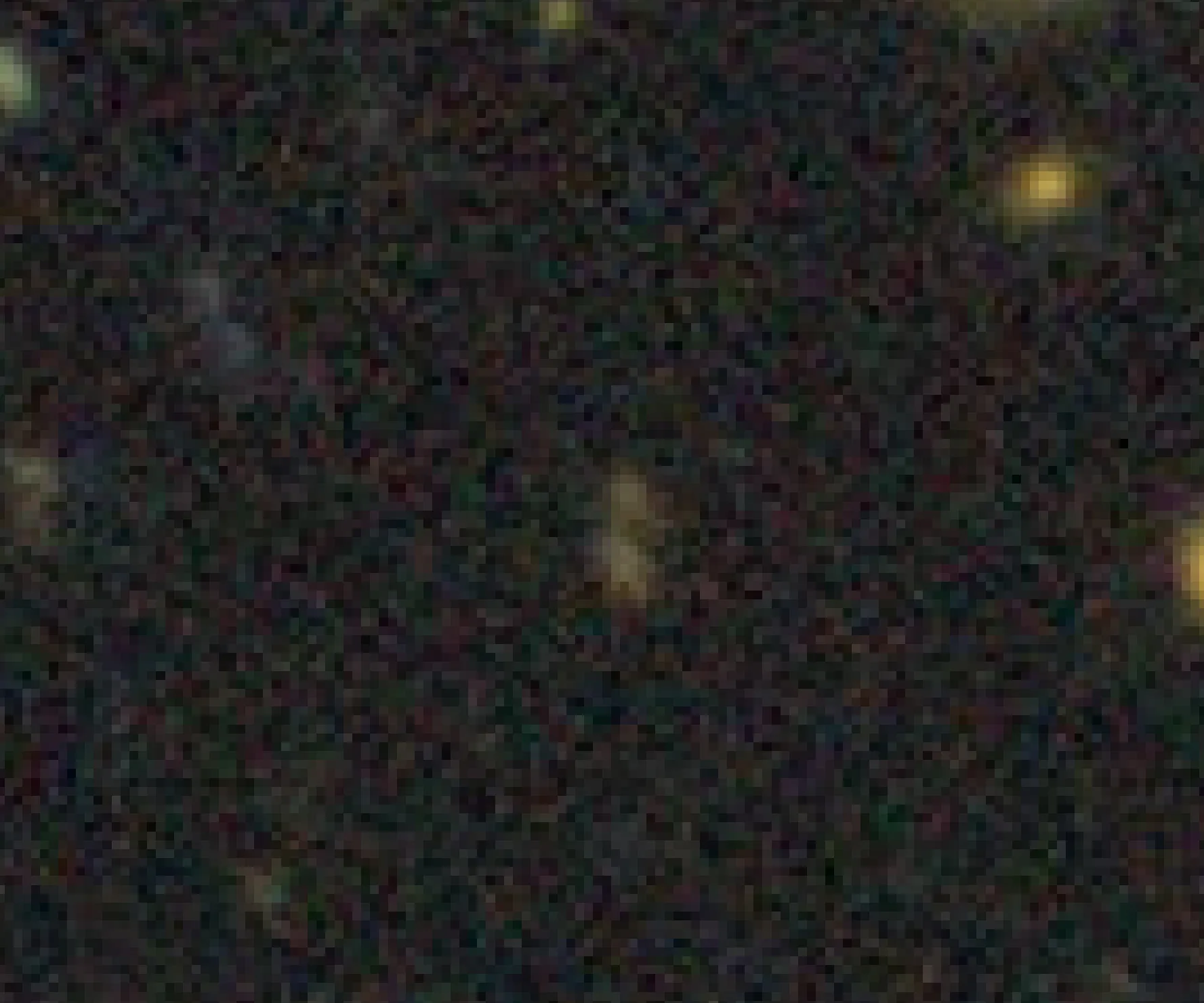
In the early hours of March 4, 2020, the TESS telescope, normally on the hunt for planets around other stars, spotted something odd in a far-off galaxy. The light from an object called AT 2020afjz flared and faded in just a couple of hours, quicker than it takes a cup of coffee to cool. This is the first optical flare of such short duration ever caught from beginning to end.
The flare originated from a galaxy about 7 billion light-years away. Its brightness climbed slowly, over roughly an hour, then plummeted. It's as if someone switched on a flashlight, left it for a couple of hours, and then switched it off. The team compared the event to gamma-ray bursts — cataclysmic explosions that occur when neutron stars merge or massive stars collapse. But gamma-ray bursts usually emit gamma radiation, and none was seen here.
It's possible the gamma rays simply missed our detectors: the satellite that catches them was behind Earth at the time. Or the burst might not have been aimed our way, like a flashlight beam pointing sideways. Such events are called 'orphan' gamma-ray bursts: the explosion is there, but we don't see the gamma rays.
This discovery shows that TESS can pick up short flares from other galaxies. There may be far more such events in the universe than we ever imagined. Each one is like a brief signal from the distant past, helping us understand how stars die.
Original abstract
as written by the authors arXiv:2608.17242v1
We report the discovery of AT 2020afjz (TSS2020a): the first hour-scale extragalactic transient discovered in optical wavelengths whose complete evolution -- from explosion onset to decay -- is temporally resolved, and the first such transient discovered by TESS. AT 2020afjz was identified as a $$>10\sigma$$ detection in the pilot HiLaTS program run within the TESSELLATE Sky Survey, which blindly searches for transient phenomena in TESS data with the TESSELLATE pipeline. Through cross-matching with legacy imaging, we associate it with DES J042144.37$$-$$383311.3, a member of an interacting galaxy pair at $$z_{\rm phot}=0.67^{+0.07}_{-0.10}$$. While AT 2020afjz is similar in duration and brightness to GRB afterglows, it exhibits a slow rise time of $$\sim1$$ hr and lasts for only 2.4 hr above the half-max brightness; modeling the TESS light curve with VegasAfterglow finds that it is best described as either an on-axis "dirty-fireball" or off-axis orphan afterglow. Each of these rare classifications hinge upon a non-detection at gamma-ray energies, but as Fermi-GBM was Earth-occulted at the time of explosion, AT 2020afjz's gamma-quiet nature cannot be definitively confirmed. Regardless, AT 2020afjz demonstrates TESS's power to discover fast extragalactic transients, and heralds a new population awaiting discovery with TESSELLATE.
TESS launched in 2018 to find planets around other stars, but its data have also proven invaluable for studying distant explosions.
In Carl Sagan's novel 'Contact,' the protagonists detect a mysterious radio signal from space — AT 2020afjz was also an unexpected signal, but in light.