The Transiting Exoplanet Survey Satellite (TESS) is a NASA space telescope launched in 2018 to survey the entire sky for exoplanets. It uses the transit method: continuously monitoring the brightness of hundreds of thousands of stars, looking for periodic dips caused by planets passing in front of their host stars. TESS has discovered thousands of exoplanet candidates, including super-puff planets, hot Jupiters, and rocky worlds in habitable zones, providing targets for follow-up observations by other instruments.
History
TESS was proposed in 2006 by a team led by George Ricker at MIT, selected by NASA in 2013, and launched on April 18, 2018. It succeeded the Kepler mission, which had focused on a single patch of sky.
How it works
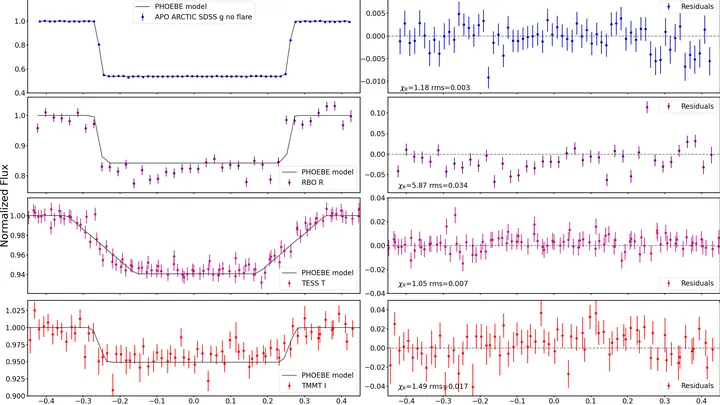
TESS is equipped with four wide-field cameras that capture images of a given sky sector for about 27 days. It divides the sky into 26 sectors, covering nearly the whole celestial sphere over two years. The satellite's highly elliptical orbit (with a 13.7-day period) is in a 2:1 resonance with the Moon, keeping it stable and allowing continuous observations. Photometric data are processed to detect transit signals—small, periodic dimming events—which are then vetted to rule out false positives like eclipsing binaries or stellar variability.
In practice
TESS's discoveries are used to prioritize targets for the James Webb Space Telescope, enabling atmospheric characterization of exoplanets and the search for biosignatures.
Fun fact
TESS's orbit is so stable that it requires no fuel for station-keeping, and its cameras can detect a transit that dims a star by just 0.01%—equivalent to seeing a firefly pass in front of a lighthouse.
In the basement of the laboratory, an 8 tesla magnet hums. Inside it, like a bell in a bell tower, hangs a hollow copper cylinder tuned to a single note. If an axion, a dark matter particle, flies by, the cylinder responds with a faint ring. The trouble is that ordinary copper muffles this ring: at high frequencies, current flows only through a thin skin of the metal, and losses grow.
The family album of this stellar pair has been filling up for 45 years, but the pictures were blurry and the captions contradictory. Now astronomers have pulled out the old photographs, taken new sharp shots, and put everyone back in their proper places. Gamma Cephei is a bright star visible to the naked eye, and it has an invisible companion that orbits it every 70 years.
The electron beam of a microscope usually flies through emptiness, like a courier on an empty highway. Any air molecule is a bump that makes it bounce and lose direction. So before, to examine a sample, you had to freeze it, dry it, or coat it with metal—and still you could only look in a vacuum.
A star blinks every 38 seconds. This is no random twinkle: inside the white dwarf WD 0158−160, steady oscillations run like the beats of an invisible metronome. From the rhythm of those beats and the star's precise distance, astronomers have computed its mass and temperature — without ever looking at its spectrum.
On a sunny street, there's a house with a big family: a giant father who always sits by the window and a small child running around the yard. That's the TOI-4468 system: a gas giant hot Jupiter hugs the star, while a bit farther out circles a sub-Neptune — a planet smaller than Neptune but larger than Earth.
A telescope stares at a star for many nights in a row. Somewhere in the stream of light hides a tiny dip in brightness — an Earth-sized planet briefly blocking part of the star. Such a dip lasts a few hours and repeats once a year or less. Catching it is like hearing a single quiet click in a noisy hall.
In the early hours of March 4, 2020, the TESS telescope, normally on the hunt for planets around other stars, spotted something odd in a far-off galaxy. The light from an object called AT 2020afjz flared and faded in just a couple of hours, quicker than it takes a cup of coffee to cool.
The night sky seems unchanging, but galaxies constantly exchange matter. The Milky Way, like a great river, absorbs smaller streams — dwarf galaxies. Along with their stars, planets may also come to us.
Blood vessel cells were seeded onto a transparent film just 700 nanometers thick — a hundred times thinner than a human hair. Flat electrodes are hidden beneath the film. They send a weak alternating current and listen as the resistance changes.
Photographing an exoplanet orbiting another star is like trying to spot a firefly in front of a spotlight. Earth's atmosphere is constantly churning, which makes stars appear as dancing speckles through a telescope.
Tabby's Star, a beacon in the cosmic sea, has baffled astronomers since 2015. Its light flickered not in the rhythm of planets, but as if scattered by a storm — deep dips, sharp spikes. But amid this chaos, a smooth, nearly perfect dip was found. The eye of the storm.
The light of a distant star carries within it the silent hum of the atmospheres of planets orbiting it. For a long time, capturing it was like trying to make out a whisper over a roaring waterfall. But with the advent of the 39-meter Extremely Large Telescope (ELT) and the ANDES spectrograph with a resolution of 100,000, this task is no longer hopeless.
A solar sail doesn't move on water but in space, and it's pushed not by wind but by the pressure of sunlight. Such a spacecraft can fly for years without spending a drop of fuel. Steering it is like sailing a yacht across an ocean where the currents are planetary gravity and the gusts of wind are shifting sunlight.
When a distant planet passes in front of its star, it briefly blocks part of the light. Astronomers call this a transit and judge the planet's size by the depth of the dip. But light has a property: a massive body acts like a lens. Even a giant planet can slightly bend the star's rays, and the dip becomes a bit shallower than you might expect.
A spotlight blazes straight into your eyes, and a few steps away a tiny firefly flickers. That's roughly what it's like hunting for an Earth-like planet around a neighboring star: the planet is a hundred million to ten billion times fainter than its star, and in the sky they almost merge into a single point.
Decades of radio astronomy have listened to space, hoping to catch narrowband radio transmissions — the technogenic 'voice' of distant exoplanets. But our own technological evolution reveals a paradox: loud analog signals, like 1960s TV broadcasts, are just a brief squawk of a newborn civilization.
In the Galactic bulge, where the light of billions of stars merges into a continuous glow, four cold giants passed unnoticed. You can't see them through a telescope — too far, too dim.
The gravitational dances of celestial bodies long remained silent to astronomers. We learned to catch the shadows of planets against stars with the transit method — a breakthrough that delivered thousands of worlds thanks to William Borucki and his Kepler telescope.
The light of a distant star is no perfect beacon. Passing through the gravitational field of another star, it bends, splits, and magnifies, creating a fleeting Einstein ring in the sky. This is how gravitational microlensing manifests, predicted by Fritz Zwicky back in the 1930s.
In deep space, 95 parsecs from Earth, nature is assembling a planetary clock. The model HD 114082 is a prototype, only 15 million years old. Two massive pendulums — exoplanets b and c — are already swinging with periods of 225 and 314 days, but the whole mechanism is still covered in the construction dust of a debris disk.
Using James Webb, astronomers 'fished out' a third giant planet from the murky dust disk of the star β Pictoris. Two others were already known, but this one was hiding in the bright light, like a fish in muddy water.
A planet glides across a star's disk, and for a moment becomes a flashlight. It blocks a tiny patch of surface, revealing details that otherwise escape our view. That's exactly how astronomers peered into the dark spots on V1298 Tauri, a young twin of our Sun. They were aided by the James Webb Space Telescope JWST and three giant planets in orbit.
A star's light curve is not chaotic noise, but a text written by pulsations, spots, and the steady glow of a thermonuclear furnace. Any planet slipping across the disk leaves a typo in this text: a tiny dip in brightness lasting hours.
When a planet slips behind the edge of its star, the star backlights the planet's atmosphere, just as a setting sun illuminates clouds on the horizon. This brief moment, lasting only minutes, carries the imprint of the gases through which the starlight has passed.
For decades, the search for extraterrestrial intelligence has waited for quiet, coherent signals from space — a kind of 'whistle' in the radio silence. However, our own technosphere has created a continuous radio background — the hum of a vast metropolis, emitted by all communications, radars, and broadcasting stations.
When the light of a distant planet is split into colors, it suddenly jumps at the boundary between red and invisible infrared, as if someone flipped a switch. This is how the vegetation red edge manifests itself: chlorophyll is transparent to near-infrared radiation, and the leaf, to avoid overheating, reflects it away.
Searching for extraterrestrial signals is like trying to hear a whisper at a roaring stadium. The Green Bank Telescope listened to 70,000 stars, but 100 million bursts turned out to be earthly noise — from phones, satellites, microwave ovens.
Light from a distant star seeps through a planet's gaseous envelope, and astronomers try to guess what that envelope is made of. That's how we study the atmospheres of worlds we can never touch. When a planet passes in front of its sun's disk, its gaseous veil briefly intercepts some of the rays.
At the edge of the solar system, far beyond Neptune, hundreds of icy chunks circle the Sun. Some of them move as if an invisible hand had aligned their orbits like compass needles. Ten years ago, this led astronomers to suspect that a massive planet, about ten times heavier than Earth, is hiding there.
An X-ray beam is a stream of tiny packets of energy, photons. Ordinary detectors count them but don't distinguish shades: two photons with close energies look the same to them. The new device works like a sensitive thermometer: it catches each photon and measures how much it warms a thin film. From the warming, you can tell exactly how much energy the photon brought.
The smell of fresh bread unmistakably signals a nearby bakery. But to know if baking is happening right now, it's better to catch not the aroma itself but its intensification — the continuous stream of hot air from the oven. This everyday analogy helps grasp a revolution in the search for extraterrestrial life on exoplanets — planets beyond our solar system.
The TESS telescope photographed the sky for a full year, but its standard pipeline skipped over dim stars. The T16 project took the same images and cleaned them from scratch — resulting in 83,717,159 light curves, like EKGs for every star. Planets passing in front of their star briefly dim it, and these dips in the EKGs are what we look for.
At the very heart of the Milky Way, something is continuously glowing in gamma rays. This light is special: its energy is exactly 511 thousand electronvolts. Such energy is produced when an electron meets its antimatter counterpart, a positron, and they annihilate, leaving behind a flash of light.
By day in Chile's Atacama Desert, the air shimmers with heat like the haze above a hot skillet. Sunlight passing through this shimmer begins to dance and flicker. Astronomers call this airy trembling "seeing" — and it keeps telescopes from getting a sharp view of the stars.
To fight this nuisance, engineers have built a special instrument — a solar seeing monitor.
A massive star's explosion is bright but brief. The flash itself lasts weeks, but the dust it heats around it glows in infrared for years. It's like a camera flash illuminating a room, then hot dust particles lingering in the air — only on a cosmic scale.
Imagine you and your friends are in a dark room. You agree that after a common flash, each of you will turn on a flashlight ten seconds later, but with a correction for the light delay — since the light from the flash reaches each of you with a slight lag.
At night, a distant streetlamp seems motionless, but if you walk closer and look carefully, you might notice it swaying slightly in the wind. That's roughly how astronomers hunt for planets around other stars: they measure how a star shifts ever so slightly under the gravitational tug of its invisible companions.
Every 15 hours, in a constellation 57 light-years away, a miniature solar eclipse takes place. A tiny white dwarf — a star the size of Earth but heavier than the Sun — ducks behind the disk of a red dwarf. For astronomers, this is not just a pretty coincidence but a way to peek into the pair's past.
The light from a distant star is never steady. It shimmers like heat over hot asphalt. When astronomers pointed JWST at the star TOI 700, they saw this shimmer especially clearly: every 16 minutes, the brightness changed by a tiny fraction, just 46 parts per million.For comparison: if you placed a light bulb a kilometer away, this change would be…