Gamma-ray bursts (GRBs) are divided into two classes: long (lasting over 2 seconds) — arising from the core collapse of a rapidly rotating massive star into a black hole, and short (under 2 seconds) — accompanying neutron star mergers. In both cases, the central engine is an accreting black hole that launches an ultra-relativistic jet, piercing the star or the ejected material shell. An observer sees a gamma-ray burst if the beam is directed toward Earth.
History
Discovered on July 2, 1967, by the American Vela 4a satellite, which recorded a double flash of gamma rays. Initially thought to be signs of extraterrestrial civilizations. In 1997, the Italian-Dutch satellite BeppoSAX first measured the afterglow coordinates of GRB 970508, establishing its extragalactic nature. In 2017, the joint detection of GW170817 and GRB 170817A definitively confirmed the link between short bursts and kilonovae.
How it works
The central engine is a compact object (black hole or rapidly rotating neutron star — magnetar) surrounded by an accretion disk. Energy is extracted through neutrino cooling or the Blandford–Znajek electromagnetic mechanism, forming a collimated jet with a Lorentz factor >100. Internal shock waves within the jet produce the prompt gamma-ray emission, while the afterglow arises as the jet decelerates against the interstellar medium, according to the Bland–McKee model.
In practice
Gamma-ray bursts help study the birth of black holes, and their radiation allows us to date the most distant galaxies and probe interstellar matter.
Fun fact
The most distant known burst, GRB 090423, occurred 630 million years after the Big Bang — meaning its light traveled 13 billion years to reach us.
Two snapshots of the same lighthouse. One is taken from a boat sailing straight into the beam, the other from the shore, where the beam only grazes the edge of the sky. From these two frames, you can reconstruct how the lighthouse light is distributed across angles without ever getting close to it. That is roughly what astronomers did with two gamma-ray bursts they consider twins.
A beacon at the edge of the galaxy blinks without a schedule: sometimes silent for years, sometimes emitting hundreds of flares in a single day. Such a beacon needs a watchman who never sleeps and never gets distracted.
A particle with an energy of $$10^{18}$$ eV hitting Earth's atmosphere is like a tennis ball traveling at 200 km/h slamming into a wall. Astrophysicists have debated for decades where such projectiles come from. Gamma-ray bursts, brief and powerful explosions of gamma radiation, have long been suspected as accelerators.
A particle with an energy of $$10^{18}$$ eV hitting Earth's atmosphere is like a tennis ball traveling at 200 km/h slamming into a wall. Astrophysicists have debated for decades where such projectiles come from. Gamma-ray bursts, brief and powerful explosions of gamma radiation, have long been suspected as accelerators.
At the center of the Milky Way, where the supermassive black hole Sagittarius A* churns gas clouds like a millstone, astronomers have caught an irregular pulse. Gamma-ray emission, the most energetic light in the universe, arrives not as a smooth wave but with a break, as if the Galaxy's heart beats with arrhythmia.
At the center of the Milky Way, where the supermassive black hole Sagittarius A* churns gas clouds like a millstone, astronomers have caught an irregular pulse. Gamma-ray emission, the most energetic light in the universe, arrives not as a smooth wave but with a break, as if the Galaxy's heart beats with arrhythmia.
Galaxy Mrk 590 behaves like a radio receiver that sometimes picks up a signal and sometimes fades into static. Its supermassive black hole has been brightening and dimming for decades, and astronomers caught every such 'switch-on.' In 2017, the receiver came alive again, but the VLA radio telescope heard not the signal they expected.
At the center of a galaxy, where a supermassive black hole spins a disk of scorching gas around itself, giant stars sometimes form. They are unlike ordinary stars: the disk continuously feeds them with matter, and a star can grow to hundreds of solar masses, staying bright as long as the gas flow lasts.
Picture a lighthouse on the shore at night. Its lamp is off almost all the time, but once every few days, for a split second, it blazes so brightly that the light is visible beyond the horizon.
Gamma rays are the most energetic light in the Universe. But one part of them, the medium-energy range, long remained invisible: instruments couldn't catch them, leaving a gaping hole in the sky. Scientists call it the "MeV gap," named after the unit of energy these rays carry.
The new camera works like a three-layer detective.
A translator at a meeting keeps getting distracted by every rustle in the room, then suddenly dives into a long monologue by the speaker. That's exactly how the fast radio burst source FRB 20240114A behaves: in one hour, its pulses fire randomly, but over months they line up into a predictable drift.
Strike a bell, and it rings at its own pitch. A black hole, after being disturbed, also rings — except instead of sound, it's the fabric of space itself that shivers. The frequencies of this ring can tell you a lot about the hole: how fast it spins, what its mass is.
An avalanche in a sandpile starts with a single grain. No one knows exactly where it will slip or how big the slide will be. But if you keep pouring sand, the pile itself reaches a state where avalanches of all sizes, from tiny trickles to massive collapses, follow the same law.
In the early hours of March 4, 2020, the TESS telescope, normally on the hunt for planets around other stars, spotted something odd in a far-off galaxy. The light from an object called AT 2020afjz flared and faded in just a couple of hours, quicker than it takes a cup of coffee to cool.
An avalanche in a sandpile starts with a single grain. No one knows exactly where it will slip or how big the slide will be. But if you keep pouring sand, the pile itself reaches a state where avalanches of all sizes, from tiny trickles to massive collapses, follow the same law.
At the heart of nearly every large galaxy sits a supermassive black hole. Usually it behaves quietly, but sometimes, like a waking volcano, it spits out narrow plasma jets. These jets glow in the radio band, making the galaxy 'radio-loud.' Astronomers have long known this happens, but they couldn't catch the very moment of switching on.
In the southern sky, behind a dense veil of dust, hides a source of gamma rays — the most energetic light in the Universe. It shines so brightly that it can be seen even through this veil, but the object itself remains invisible. Astronomers pointed the ALMA radio telescope at the neighboring gas clouds and saw a pattern that gave the invisible object away.
The night sky looks smooth, but it's actually clumpy — vast communities of galaxies that bend light from distant objects like lenses. When a short, powerful radio burst goes off somewhere in the universe, its path to an Earth telescope can pass near such a clump.
The explosion of a massive star is not just a flash: it's a blow to the surrounding gas. But until now, no one had looked at how the gas itself moves at the sites of such explosions. Now astronomers have gathered data on 33 nearby supernovae and for the first time measured the turbulence of the cold molecular gas around them.
When two heavy balls merge into one, ripples spread across the water's surface for a long time. A black hole behaves similarly: after a merger, it 'rings' for a while, emitting special gravitational oscillations — quasinormal modes. Usually, this ring fades quickly, like an echo dying out in an empty hall.
Somewhere in the depths of space, two supermassive black holes are circling each other. Their dance is not smooth — the orbit is stretched, like a rubber band that alternately tightens and relaxes. Each revolution sends ripples through the fabric of spacetime — gravitational waves.
When a star many times heavier than the Sun dies, it collapses and explodes as a supernova. This is not just a flash of light — the entire process, from core collapse to the ejection of the outer layers, makes space itself tremble. These ripples are called gravitational waves.
Two black holes circle in a cosmic dance, spiraling closer together. In the end, they merge into one, and that moment unleashes a powerful burst of gravitational waves, ripples in spacetime itself. But what remains after the merger?
The universe is like a vast invisible scaffold. We don't see it directly, but we know it's there: galaxies and clusters hold together thanks to it. This scaffold is dark matter. The most popular version says it is "cold," made of heavy, slow-moving particles.
A fast radio burst is a short but powerful flash of radio waves from deep space. As it travels to us, the signal passes through clouds of tenuous gas, and the more gas it encounters, the more the signal is smeared across frequencies. Astronomers call this delay the dispersion measure — essentially, it's a "weighing" of all the matter along the line of sight.
A fast radio burst is a short but powerful flash of radio waves from deep space. As it travels to us, the signal passes through clouds of tenuous gas, and the more gas it encounters, the more the signal is smeared across frequencies. Astronomers call this delay the dispersion measure — essentially, it's a "weighing" of all the matter along the line of sight.
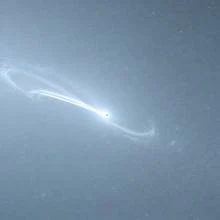
A branch falls into a whirlpool. It gets spun and broken, but sometimes a powerful fountain of water bursts from the center. Similarly, a black hole tears apart a passing star, and occasionally a blinding plasma jet, a jet, shoots into space.
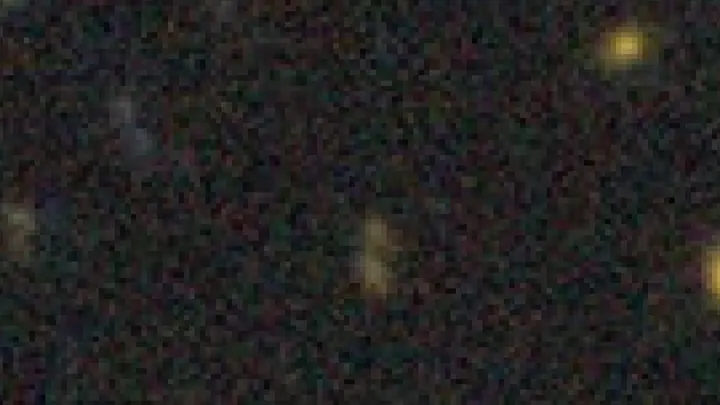
The hunter of ancient light, the James Webb Telescope, aimed its mirrors at a tiny patch of sky and caught a strange beacon. The object, with the working name beacon_1420-$$5253_{4770}$$, flashed and faded. At first, it was logged as a candidate for the most distant galaxy, as if we were seeing it just 300 million years after the big bang.
Boiling water in a pot is a good place to start. Bubbles of steam rise, pop, and the surface settles down. Something similar might have happened in the first moments of the universe's life with a special field filling space: bubbles of a new phase inflated and collided, like islands of steam in liquid.
Predicted by Albert Einstein, gravitational waves are like beacons in the dark ocean of space. They flare up when black holes collide, sending ripples through the fabric of the Universe.
A star runs out of fuel and rapidly collapses under its own gravity. According to classical ideas, it collapses into a point of infinite density — a singularity. But what if nature abhors infinities? In models of regular black holes, instead of a singularity, a dense core of unknown matter forms at the center.
At the heart of the giant galaxy Hydra-A, there's a hive of activity. A supermassive black hole shoots out two powerful plasma jets. They punch through the surrounding cloud of hot gas and inflate giant bubbles within it.
In the depths of the Universe, when a massive star collapses into a black hole or a magnetar is born, a gamma-ray burst flares up — for an instant, it outshines all the stars in the observable Universe.
In the quiet of cold molecular clouds, where interstellar gas under gravity condenses into dense clumps, the birth of massive stars is one of the great puzzles of astrophysics.
Gravitational-wave detectors are like sensitive microphones, listening for the whispers of distant cataclysms. But every now and then, a sharp crack bursts in — a brief noise spike known as a glitch.
The James Webb Space Telescope peered into an era when the universe was less than a billion years old and spotted strange objects—'little red dots.' These are black holes with masses of millions of suns, but in very compact, chemically pristine galaxies. Standard scenarios can't grow such heavyweights that early.
The flash lasts a thousandth of a second, but in that instant it releases as much energy as the Sun emits in a day. Such signals, fast radio bursts, have been caught by telescopes since 2007, and their source remains a mystery. A new study offers an elegant answer: it's all about a cosmic amplifier.