A neutron star merger is a rarest cosmic event where two compact objects lock in a dance, losing orbital energy through gravitational waves, and ultimately merge, forming a black hole or a massive neutron star. The process is accompanied by a short gamma-ray burst and a kilonova—the afterglow from radioactive decay of freshly forged nuclei.
History
The first detection of GW170817 on August 17, 2017, jointly by LIGO (USA) and Virgo (Italy) confirmed the nature of short gamma-ray bursts and launched the era of multi-messenger astronomy. The event was localized in the elliptical galaxy NGC 4993, and subsequent observations in optical, X-ray, and radio revealed details of the kilonova. Theoretical foundations were predicted as early as the 1970s (Clark, Early), but only the development of gravitational-wave observatories made direct detection possible.
How it works
The inspiral is described by the gradual loss of energy through gravitational radiation according to general relativity. Tidal forces disrupt the neutron stars, ejecting neutronized material where rapid neutron capture (r-process) builds heavy-element nuclei. The resulting accretion disk, rotating with enormous angular velocity, collimates a relativistic jet, generating a gamma-ray burst. The thermal energy from radioactive decay in the ejected material powers the kilonova.
In practice
Such mergers are cosmic forges of gold, platinum, and uranium, without which many rare metals would not exist on Earth.
Fun fact
The 2017 collision produced an amount of gold exceeding the mass of the entire Earth by 10 times—that's where the shine of your wedding ring comes from.
A particle with an energy of $$10^{18}$$ eV hitting Earth's atmosphere is like a tennis ball traveling at 200 km/h slamming into a wall. Astrophysicists have debated for decades where such projectiles come from. Gamma-ray bursts, brief and powerful explosions of gamma radiation, have long been suspected as accelerators.
At the center of a galaxy, where a supermassive black hole spins a disk of scorching gas around itself, giant stars sometimes form. They are unlike ordinary stars: the disk continuously feeds them with matter, and a star can grow to hundreds of solar masses, staying bright as long as the gas flow lasts.
Imagine two spinning tops set on a table. If they spin in the same direction, their combined rotation is large; if they spin toward each other, the total rotation can be zero even though each top spins rapidly on its own. In a pair of neutron stars approaching merger, their individual rotations, spins, play the role of such tops.
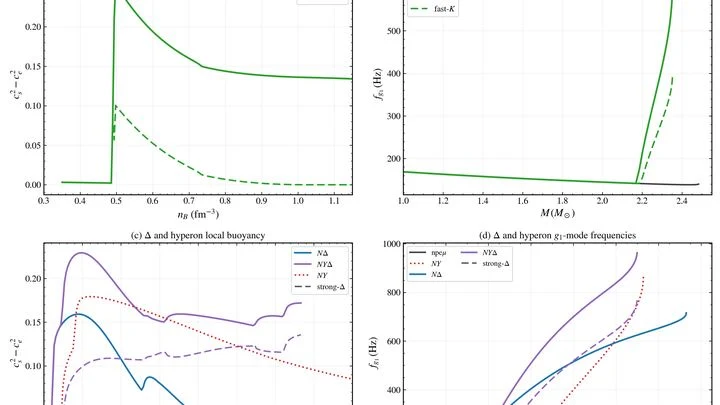
A neutron star is what remains after a massive star explodes. Its matter is compressed so tightly that a teaspoonful would weigh billions of tons. Under such conditions, protons and neutrons can rearrange, and new particles (hyperons, similar to neutrons but containing a 'strange' quark) can appear.
Among the debris of particle collisions, short-lived 'guests' sometimes appear — hyperons. One of them, Σ0, lives for less than one ten-billionth of a second and decays on the fly. Catching it directly is nearly impossible, but its traces can be spotted: it leaves behind another particle, Λ, and an electron-positron pair.
A neutron star is the remnant of an exploded star, compressed so tightly that a teaspoon of its material would weigh as much as a mountain. Inside such an object, protons and neutrons are packed tightly together, and under enormous pressure, hyperons, particles containing a strange quark, can appear.
A neutron star is the remnant of an exploded star, compressed so tightly that a teaspoon of its material would weigh as much as a mountain. Inside such an object, protons and neutrons are packed tightly together, and under enormous pressure, hyperons, particles containing a strange quark, can appear.
A chef tastes tiny morsels from different edges of the plate and tries to reconstruct the recipe of a complex dish. Each morsel offers only a hint of flavor, and the samples are a bit blurred — too much salt here, not enough sugar there. That's roughly how nuclear physicists study the matter inside neutron stars — the densest objects in the universe after black holes.
After a supernova explosion, a dense ball the size of a city remains at the center — a newborn neutron star. It is hot, compressed, and rings like a bell after being struck. These tremors, the star's oscillations, emit gravitational ripples that sensitive detectors on Earth can catch.
A white dwarf is the former core of a star like the Sun, squeezed down to the size of Earth. A teaspoon of its material would weigh several tons. A neutron star is an even denser remnant: a city the size of Manhattan, but with more mass than the Sun.
The merger of two neutron stars is not just a collision. Even before they touch, they deform each other through tidal forces, and this deformation depends on how 'soft' or 'stiff' the matter inside is. Stiff matter resists more; soft matter changes shape more easily.
The merger of two neutron stars is not just a collision. Even before they touch, they deform each other through tidal forces, and this deformation depends on how 'soft' or 'stiff' the matter inside is. Stiff matter resists more; soft matter changes shape more easily.
A neutron star is the ultra-dense remnant of a supernova: the mass of the Sun packed into a sphere the size of a city. For billions of years, it travels through space, gathering around itself invisible matter, dark matter, which emits no light but pulls with gravity.
When two atomic nuclei smash together, a tiny fireball is born. It lives for an instant, but inside, entire epochs pass: compression, heating, expansion. Physicists have learned to eavesdrop on this process, and their "microphone" is the pairs of electrons and positrons that fly out of the ball at different stages.
In the new work, two scenarios were compared.
A cosmic "caliper" will soon measure a neutron star to within a hundred meters. For an object a couple dozen kilometers across, that's like measuring the thickness of a human hair from a kilometer away.
A neutron star is the remnant of an exploded supernova.
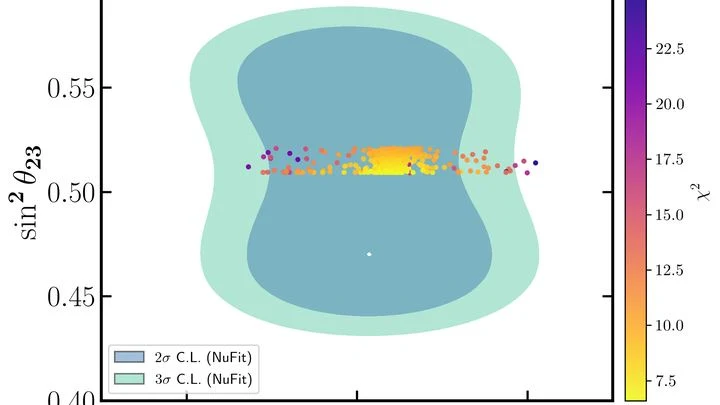
At the heart of a dying star, as its core collapses into a neutron sphere, an invisible storm is born. Trillions of neutrinos, particles that barely interact with matter, race through the scorching plasma. There are so many of them that they begin to influence each other, changing their 'flavors' (electron, muon, tau) like chameleons.
The cosmic detective story began with a quiet flash in the optical band. AT2019wzc slowly brightened and faded like a smoldering ember. But hidden inside was something more energetic — repeating soft X-ray bursts that astronomers call quasi-periodic eruptions.
These eruptions last minutes to hours and repeat every few hours or days.
In a binary star system, one star pulls matter from its companion. Over centuries, this material settles onto the surface of a neutron star — the ultra-dense remnant of a dead star. This process, called accretion, usually proceeds smoothly. Gravity behaves as general relativity predicts, without surprises.
Two black holes circle in a cosmic dance, spiraling closer together. In the end, they merge into one, and that moment unleashes a powerful burst of gravitational waves, ripples in spacetime itself. But what remains after the merger?
A galaxy collision is like a slow dance in which two partners gradually draw closer. Hidden at the center of each is a supermassive black hole — an invisible flywheel with a mass of millions or billions of suns.
A massive star exhausts its fuel, and its core collapses in a fraction of a second. A supernova is born, along with a brief but powerful shower of neutrinos. These particles barely interact with matter, so they fly away freely, carrying information about the catastrophe.
In the galaxy NGC 1052 DF2, stars move at only 8 kilometers per second, as if there were no invisible mass around. For comparison: in our Milky Way, outlying stars accelerate to 200 kilometers per second, held by a massive dark matter halo.
Some 123 parsecs from Earth, in the constellation Corona Australis, drifts the neutron star RX J1856.5-3754. Its diameter is about 12 kilometers, smaller than Moscow's Ring Road, but its surface temperature reaches 460 000 kelvin. The star emits a slow, almost inaudible exhalation.
A supernova explosion blasts off the outer layers of a dying star. What remains is the core — a neutron star, packed into a sphere the size of a city. The existence of such stars was predicted back in 1934 by Fritz Zwicky.
A speed of 7,5 kilometers per second is the threshold beyond which a cosmic collision turns dust grains into a chemical reactor. In the interstellar medium drift tiny cosmic dust grains — the legacy of dying stars.
The collapse of a star's core is like compressing a spring: matter falls inward, and a neutron star is born at the center. But the fall is never perfectly smooth. In the boiling outer layers, random eddies transfer angular momentum to the infalling gas, and a disk swirls around the central object.
This disk is no calm river. It pulses, strengthening and fading.
Three milliseconds before the merger. A gargantuan black hole spinning at breakneck speed drags in a neutron star — a ball the size of a city but with 1.5 times the Sun's mass. Tidal forces stretch the star into a thread as thin as a needle and fling its matter outward.
A neutron star is a boiling cauldron the size of a city but with the mass of one and a half Suns. Deep inside, matter is squeezed so hard that atomic nuclei lose their meaning. Strange forms of matter are born there: a kaon condensate (similar to a superfluid) and neutron stars with hyperons (heavy particles).
In the first moments after the Big Bang, the Universe was a hot soup of particles. Among them floated superheavy neutrinos — thousands of times more massive than their light counterparts that permeate us today. Their masses were almost identical, like triplets rather than random passersby.
Water in a glass looks continuous, but it's made of molecules. Similarly, physicists have long described the matter inside a neutron star as a uniform soup of protons and neutrons. But real neutron stars are not soup. They are a dense crowd of particles where each neutron feels its neighbors.
The authors of the new work abandoned the uniform picture.
A handful of sand in your fist: the grains press against each other, and your hand can't squeeze any further. Ordinary matter behaves similarly. But in a neutron star, compression is billions of times stronger — atoms are crushed, electrons are squeezed into protons, and nearly all space is filled with neutrons.
A billiard ball clicks against another in complete darkness. The sound of the impact and the clatter of balls dropping into pockets: that's all you hear. This is roughly how physicists study the interactions of elementary particles at energies that no terrestrial accelerator can reproduce.
It takes the stellar pair J05+50 nearly two months to complete one orbit around their common center. From Earth, it appears as a faint point in the constellation Hercules — 4625 parsecs away. Photometry of the binary star only captures a steady flicker of brightness, like the pulse of a giant heart.
In June 2024, the CHIME radio telescope recorded over 700 radio bursts per hour from source FRB 20240114A. Such a hyperactive repeater releases in one hour nearly all the magnetic energy of a typical magnetar (a neutron star with an ultra-strong field).
In August 2019, the LIGO and Virgo detectors picked up gravitational waves from the merger of two compact objects in a binary star. One weighed 23 solar masses — a standard black hole. The other came in at 2.5–2.67 M⊙.
A neutron star is the collapsed core of a massive star, squeezed to the size of a city. A teaspoon of its material weighs as much as a mountain. But inside this superdense sphere, a surprise may lurk: under unimaginable pressure, neutrons break apart into quarks, giving the star a new, more compact core.
The theory that handles ordinary atomic nuclei beautifully hits a dead end when we venture into the heart of a neutron star. There, matter density goes off the charts, and old formulas start lying.
A heaping teaspoon, and the scale reads a billion tons. That's roughly what a teaspoon of neutron star matter would weigh if you could scoop it up and put it on a scale. Such objects are born after a supernova explosion: the star's core collapses into a sphere the size of a city, and the density exceeds that of an atomic nucleus.
In 2017, the LIGO and Virgo detectors recorded the spacetime tremor from the collision of two neutron star merger — event GW170817. After the initial burst came an after-ring: a kilohertz oscillation of the newly formed superdense remnant.
In 2017, the LIGO and Virgo detectors recorded the spacetime tremor from the collision of two neutron star merger — event GW170817. After the initial burst came an after-ring: a kilohertz oscillation of the newly formed superdense remnant.