How a Solar Cell Cools Down After a Flash of Light express
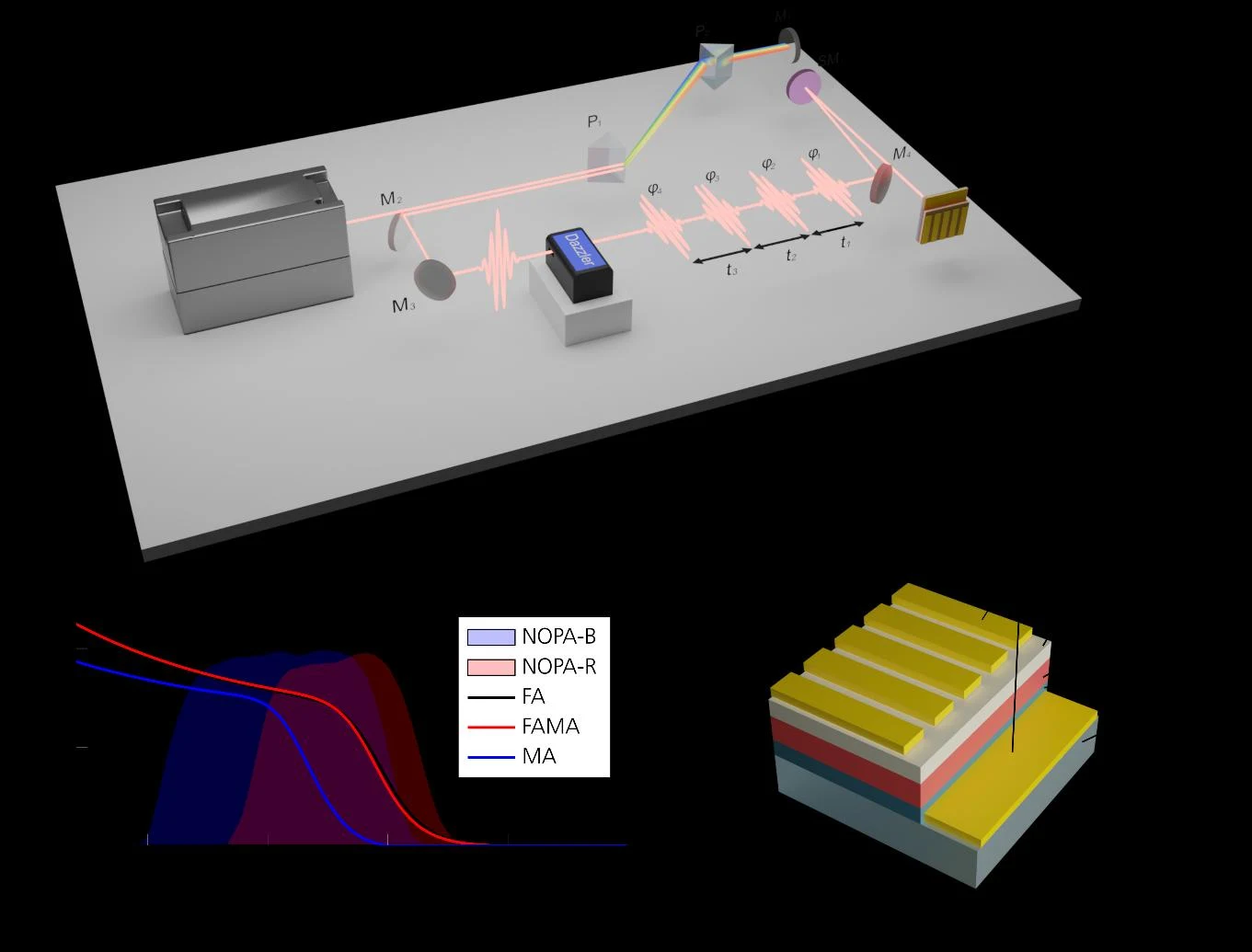
Light hits a solar cell, and inside, charges are born, hot and bothered. Like a person after a jog, they carry extra energy. To deliver current to an external circuit, they need to cool down and reach the edges of the crystal. If cooling drags on, part of the energy is wasted.
The scientists built three identical solar cells but with different perovskite "fillings": one based on methylammonium, one on a mix of methylammonium and formamidinium, and one on pure formamidinium. They illuminated the cells with short pulses and watched how quickly the charges rolled down from high energy steps to lower ones — where they can be harvested into a wire.
It turned out that the speed of this "rolling down" depends strongly on the composition. Charges cool fastest in formamidinium perovskite, slower in the mixed one, and quite leisurely in methylammonium. The difference is not by orders of magnitude, but it is noticeable and important for engineers.
So even a small substitution of one component in the perovskite crystal can change the entire energy pathway. It's like choosing the right lubricant for a mechanism: the parts are the same, but losses are smaller. Now solar cell developers have a tool to tailor perovskite composition for specific applications — for example, for windows that generate power or for lightweight rooftop panels.
Original abstract
as written by the authors arXiv:2608.17577v1
Understanding how photogenerated carriers dissipate excess energy in operating perovskite solar cells is essential for connecting ultrafast photophysics with photovoltaic function and provides design principles for engineering next-generation cell architectures. Here we use photocurrent-detected two-dimensional electronic spectroscopy (PC-2DES) to resolve energy-dependent carrier relaxation in fully encapsulated, functioning metal halide perovskite solar cells. By comparing devices with identical architecture but different absorber compositions - MAPbI3, mixed FAMA, and FAPbI3 - we directly follow the redistribution of photoexcited carriers from initially populated high-energy states toward lower-energy band-edge states. The multidimensional photocurrent response reveals a cascade-like intraband cooling process whose rate depends strongly on absorber composition, with the slowest relaxation in MA-based devices, intermediate behaviour in mixed-cation devices, and fastest relaxation in FA-based devices. A reduced kinetic model incorporating phonon-mediated intraband scattering, supplemented by a phenomenological many-body contribution, captures the main energy-dependent trends. These results establish action-detected multidimensional spectroscopy as a device-level probe of ultrafast energy dissipation and show that subtle changes in perovskite composition can substantially reshape the carrier relaxation pathways that precede charge extraction.
Perovskite is named after Russian mineralogist Lev Perovski, but solar cells use not the natural mineral but its synthetic analog.