Angle-resolved photoemission spectroscopy (ARPES) is a technique used to directly measure the electronic structure of materials. By shining high-energy light (typically ultraviolet or X-ray) on a sample, electrons are ejected via the photoelectric effect. Measuring the kinetic energy and emission angle of these electrons reveals the energy and momentum of the electrons inside the material, providing a detailed map of its band structure. This is crucial for understanding the properties of metals, semiconductors, and exotic quantum materials like high-temperature superconductors.
History
ARPES was developed in the 1970s, building on the photoelectric effect explained by Einstein in 1905. Early experiments used laboratory ultraviolet lamps, but the technique advanced significantly with synchrotron light sources, which provide tunable, high-intensity radiation.
How it works
In ARPES, a photon with known energy strikes the sample, transferring its energy to an electron. The electron escapes if it gains enough energy to overcome the material's work function. By measuring the electron's kinetic energy and angle relative to the surface, one can calculate its binding energy and crystal momentum before emission. The intensity of emitted electrons at each energy and momentum directly reflects the probability of finding an electron in that state, yielding the band dispersion.
In practice
ARPES is used in condensed matter physics to study superconductors, topological insulators, and graphene, helping researchers design new electronic devices and understand quantum phenomena.
Fun fact
ARPES can detect the 'kink' in electron dispersion caused by electron-phonon coupling, a subtle feature that reveals how vibrations of the crystal lattice influence electron behavior.
Light knocks electrons out of a crystal, and they fly toward the detector like arrows toward a target. From their trajectories, physicists reconstruct how electrons behaved inside the material: with what energy and in which direction they moved. But switch on a magnetic field, and the trajectories bend. The arrows start to curve, the target turns into a warped mirror, and the picture blurs.
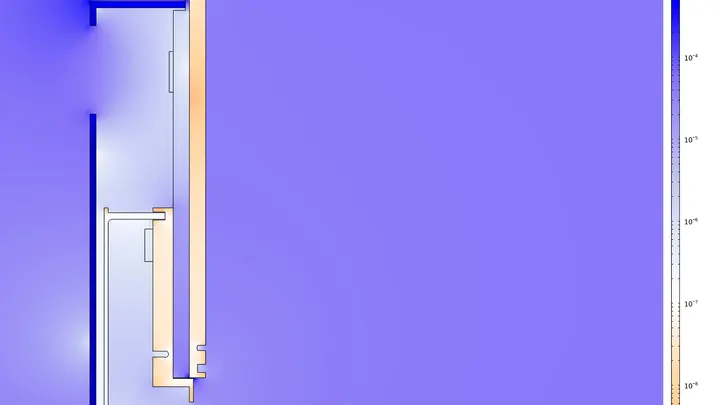
The electron beam of a microscope usually flies through emptiness, like a courier on an empty highway. Any air molecule is a bump that makes it bounce and lose direction. So before, to examine a sample, you had to freeze it, dry it, or coat it with metal—and still you could only look in a vacuum.
You're looking for fireflies in a dark forest. Instead of photographing the whole forest every second and then poring over the images, you carry a small device that spots the flashes on its own and cuts out only a circle around each one. The rest, the blackness, isn't saved. That's exactly how the new sensor for scientific cameras works.
Light hits a solar cell, and inside, charges are born, hot and bothered. Like a person after a jog, they carry extra energy. To deliver current to an external circuit, they need to cool down and reach the edges of the crystal. If cooling drags on, part of the energy is wasted.
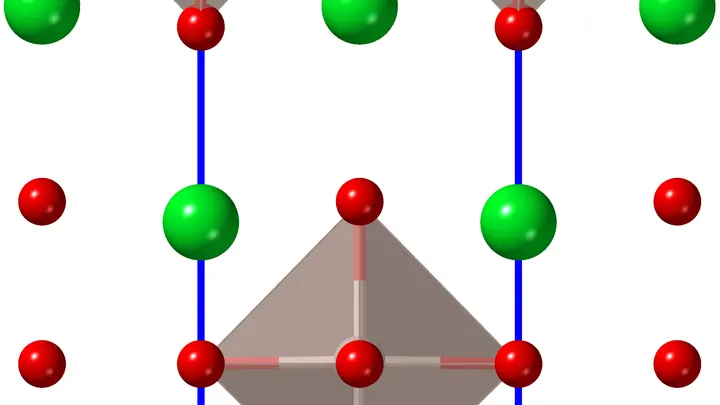
Perovskite is a mineral that scientists have learned to make artificially.
When a ψ(2S) particle decays into a proton and an antiproton, two different mechanisms act simultaneously: the strong interaction, like glue holding quarks together, and the electromagnetic one, like light pushing charges apart. Their contributions add up with a certain phase shift.
Fatty liver disease often goes unnoticed, but over time it can lead to serious problems. To avoid taking a tissue sample, doctors use ultrasound: sound waves pass through the tissue and attenuate differently depending on fat content. This parameter, the attenuation coefficient, shows how "fat" the liver is.
But the method has a flaw.
A flashlight beam cuts through fog. The denser the fog, the more the light scatters and the later it reaches your eye. A similar principle works with fast radio bursts — mysterious, super-powerful pulses from distant galaxies. As their radio waves travel through space, they interact with free electrons — particles stripped from atoms.
Photographing an exoplanet orbiting another star is like trying to spot a firefly in front of a spotlight. Earth's atmosphere is constantly churning, which makes stars appear as dancing speckles through a telescope.
Assembling the puzzle of the Universe, astronomers are used to every new detail fitting perfectly into the already completed picture. But sometimes there are pieces that seem cut from another jigsaw. Twenty thousand active galactic nuclei, and eleven percent of them the neural network confidently rejects as alien.
Imagine a smart antenna panel, a phased array, that steers radio waves traveling at the speed of light. It works like an orchestra: hundreds of tiny emitters, like musical instruments, shift their phase (the moment they 'join' the overall sound) on command via a variable voltage.
Imagine trying to overhear a whisper between two people in a noisy hall. That's roughly the challenge physicists face when they want to understand how electrons pair up inside a superconductor. And if the "hall" is also squeezed by a giant press to pressures of hundreds of thousands of atmospheres, the task seems impossible.
The authors of the new study found an ingenious solution.
An ordinary microscope is powerless when you need to examine a single virus in detail. It's too small. But there's a tool that fires flashes billions of times brighter than sunlight — an X-ray free-electron laser. It's designed to 'photograph' a particle before the beam vaporizes it.
A quantum computer measures a molecule's energy much like an old tape measure that only has markings every meter. If the actual length of a table is 2.37 meters, the tape shows “two and a bit,” and you can't do better. Physicists call this resolution: the step of the grid, finer than which you cannot go.
The authors of the new work turn this flaw into an advantage.
A hundred people are talking at once in a large hall. You try to hear one, but voices blend, some whisper, and you don't even suspect the existence of others. That's roughly how a conventional laser gas analyzer feels when dozens of substances mix in a combustion chamber or a factory pipe.
When matter is heated to millions of degrees, it turns into plasma — a mix of free electrons and ions, like a boiling soup of charged particles. You can't measure the temperature of such a 'soup' with an ordinary thermometer, but you can shine X-rays through it.
An X-ray beam is a stream of tiny packets of energy, photons. Ordinary detectors count them but don't distinguish shades: two photons with close energies look the same to them. The new device works like a sensitive thermometer: it catches each photon and measures how much it warms a thin film. From the warming, you can tell exactly how much energy the photon brought.
An ordinary light sensor answers the question "how much light" but not "where did it come from." To do that, you need lenses, mirrors, or entire arrays. In a new study, researchers propose a sensor that determines the direction of a light beam on its own, without any optics.
A single-atom-thick sheet of tungsten telluride is like thin foil: electrons can't pass through because there's a band gap between their possible states, like a moat you can't jump across. Add two more layers, and the moat disappears; the material becomes a metal, and current flows. Add more layers, and the properties change again, as if someone is flipping modes with a single button.
A flashlight shines into the eye, and the retina responds with electrical impulses, like an echo, but not of sound, of light. This echo can be recorded, and it reveals not only how the eye is working but also how the brain is. After all, the retina is a piece of the brain that has been pushed out to the periphery.
In an atomic nucleus, it's usually crowded: protons and neutrons are packed like commuters on a rush-hour train. But beryllium-11 is different. One neutron keeps its distance from the rest, forming a diffuse cloud — a nuclear halo. This nucleus resembles a planet with a satellite on a highly elongated orbit.
Any cook knows: whether dough sticks to a pan depends on what happens at the interface between two media. For molten metals, that interface long remained invisible — temperatures above 200 °C made it impossible to resolve individual atoms.
A thin film of soap on your hand conforms to the shape of your palm, but clench your fingers and the tension changes unevenly. A monolayer of molybdenum disulfide on a graphite substrate behaves in a similar way.
When light knocks an electron out of an atom, it flies off like a ball thrown into a crowd. Scientists have long wanted to know the exact moment each electron leaves the atom, but direct measurement disturbed the very process. Now physicists have proposed a method that uses a second light pulse to 'photograph' the moment of the electron's birth.
A typical accelerator is like an assembly line where electrons are the workpieces. To get the desired X-ray pulse, the workpiece is fine-tuned after it's already on the line: squeezed, filtered, corrected. In the new work, engineers decided to take a different approach — shaping the workpiece before it even hits the conveyor.
At LCLS-II, electrons are knocked out of a metal by a short laser pulse.
In a piece of manganese oxide just a few atomic layers thick, electrons behave like a crowd on an escalator: each moves by its own rules, but together they create a common flow. Physicists shone soft X-rays on such a film and knocked electrons out.
To align particle spins in one direction, physicists usually cool a substance to near absolute zero and place it in a strong magnetic field. That is expensive and bulky.
A new method resembles tuning many spinning tops with a gentle touch: mediator molecules temporarily bind to target atoms and pass on their order.
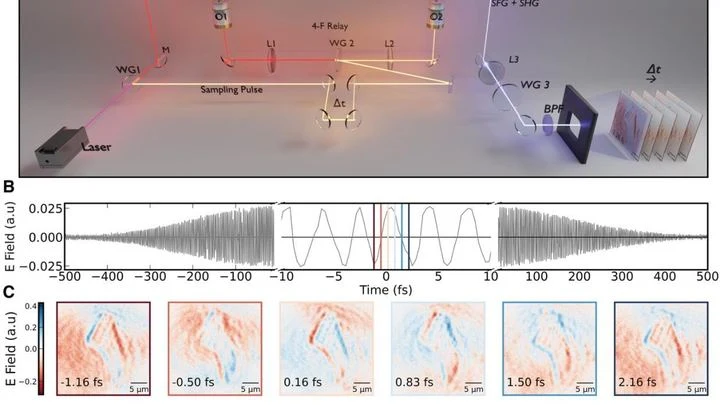
Light is not just a beam but a wave with an electric field that changes at a speed unimaginable to ordinary clocks. Until now, this field could only be measured at a single point, like taking temperature with a single thermometer. Now researchers have created a method that shows the entire field at once, like a thermal imager showing a heat map.
A fingernail-sized piece of ceramic is squeezed in a vise, and its internal structure rearranges like clay under your fingers. Inside, orderly rows of tiny domains line up where they were once randomly oriented. After this 'massage,' the crystal lets light through almost like glass and, at the same time, generates a strong electric charge when bent or pressed.
An X-ray image usually brings to mind a bulky machine in a hospital. But such a picture can be taken by a device the size of a palm, assembled from hobbyist electronics. The authors took a Raspberry Pi mini-computer, a 12.3-megapixel camera, and a screen that glows under X-rays.
A stack of thin plates made of different materials lies on a table. If you heat it from below, heat will rise, but will it spread sideways just as quickly? In layered semiconductors, the answer is no: heat runs faster along the layers than across them. This is like water in a stack of paper: it spreads easily along the sheets but seeps through the stack with difficulty.
An electron beam can be compared to the light from a laser pointer: if it diverges, the spot on the wall quickly spreads out. In the lab, physicists created such a narrow beam that it remained thin over a long distance, like the beam of a good pointer.
An X-ray photon hits the detector like a pebble dropping into still water. The water is a thin film of aluminum and manganese, cooled to near absolute zero. The impact sends a heat wave rippling across the film, and by measuring its height, you can tell how much energy the photon carried.
A thin film of ruthenium oxide Sr₃Ru₂O₇ grown on a foreign crystalline substrate behaves like a tightly stretched rubber sheet: the substrate either compresses it or stretches it.
Imagine a vast field of fireflies, each flashing alone rather than in a swarm: that's what the new automated setup is hunting for. It sweeps a laser across the sample like a flashlight and records the color and brightness of the glow at every spot.
In a thin layer of a crystal, electrons behave differently than in an ordinary piece of metal. They are cramped, collide with each other more often, and feel the shape of the lattice more strongly. Usually, such states are created artificially by stacking layers of different materials. But sometimes nature does it all by itself.
A heart cell in a Petri dish contracts, and at that moment, an electrical wave sweeps across its surface. Previously, to catch that wave, you had to poke the cell with an ultra-fine electrode needle. Now, you just look at it under a microscope.
The method is called electrochromic recording.
Light from an ordinary lamp is chaos: photons scatter in all directions with no order. But if you make many atoms emit light simultaneously and in sync, you get a short, powerful flash, like applause that turns individual claps into a single burst. Such coordinated emission is called superradiance.
Magnetic resonance is like a tuning fork that rings only at its own note. Each molecule has its own frequency, and from that you can tell what the molecule is and what state it's in. But previously, this tuning fork was listened to through a thick wall: the signal was blurred, and you couldn't make out the exact note.
The trace of a short-lived particle is like a signature left in the detector. The particle is born and decays in an instant, but from its trace you can reconstruct its character — whether it's compact like a stone or fluffy like a snowball. That's exactly what this work is about: the authors propose a new way to read such signatures.
They noticed that each particle has an angle that links its mass and lifetime.
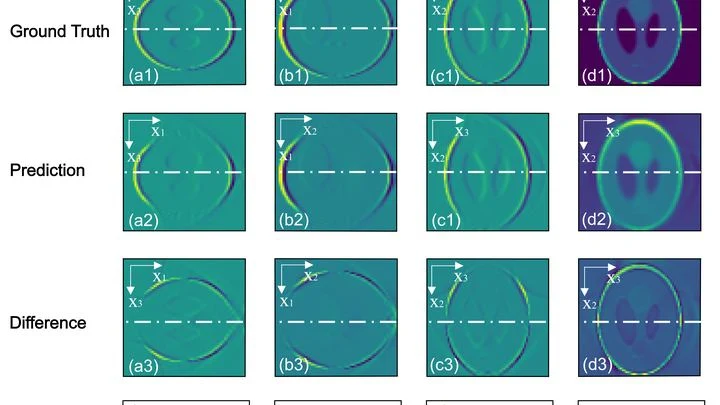
A laser hits tissue, and the tissue responds with a barely audible click — a sound wave. Sensors pick it up, and from that, an image of what's inside is built. That's how photoacoustic imaging works: light reaches deep, and sound carries the picture out.
In the new scheme, there are no sensors. Instead, several thin light beams are sent through the area where the wave has passed.