Lightabsorption is the process by which molecules take in light energy, altering their charge distribution and state. When light hits a molecule, its electric field can interact with the molecule's electrons, causing them to shift into a higher energy state. This is not just a passive 'soaking up' of light; it's a dynamic interaction that changes the molecule's internal charge distribution, often leading to chemical reactions or the emission of light at different wavelengths.
History
The quantitative understanding of lightabsorption began with the Beer-Lambert law in the 18th century, but the quantum mechanical explanation of why specific wavelengths are absorbed was developed in the early 20th century with the advent of quantum theory.
How it works
A photon's energy must match the energy gap between two quantum states of the molecule for absorption to occur. When this resonance condition is met, the photon's energy is transferred to the molecule, exciting an electron to a higher orbital. This excited state is unstable, and the molecule can relax by releasing the energy as heat, light (fluorescence), or by driving a chemical reaction. The specific wavelengths absorbed depend on the molecule's structure, making absorption a powerful fingerprint for identifying substances.
In practice
Lightabsorption is fundamental to spectroscopy, used in everything from medical imaging to astronomy to identify materials and measure their properties. It also underpins photosynthesis, solar panels, and photodynamic therapy for cancer.
Fun fact
The blackest materials, like Vantablack, absorb over 99.96% of visible light, but even they rely on the same basic principle of light absorption as a single molecule.
A sponge slowly watered from a watering can gets soaked all the way through. But if you dump the same bucket of water on it all at once, the middle gets wet while the edges stay almost dry. That's roughly how a material with nonlinear absorption behaves: the more intense the flux, the more it gets stuck at the point of impact.
A surfer glides across the ocean surface until a big wave comes, and then they're flying forward. Similarly, a free electron interacts with light: usually the energy exchange is barely noticeable, but if the surrounding medium begins to oscillate rhythmically, each wave crest pushes the particle harder and harder.
Hydrogen is the most common element. Its atoms are like antennas: they emit and absorb light at very specific frequencies. Einstein predicted that spacetime can ripple: these are gravitational waves.
A swing only gets going if you push it in rhythm. Miss the beat, and your effort is wasted. Light interacts with an atomic nucleus in much the same way: a photon is usually absorbed only when its energy exactly matches the gap between nuclear levels. But what if the photon's energy doesn't fit? The authors of a new study have found a workaround.
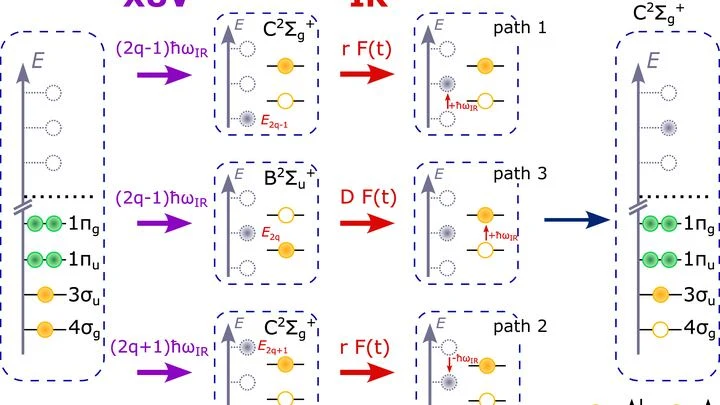
A high-speed camera capable of capturing the motion of electrons is an attosecond interferometer. It sends two laser pulses at a substance with a tiny delay. The first, ultraviolet, acts like a flash, knocking an electron out of the molecule. The second, infrared, like an invisible hand, gently nudges or slows this electron in flight.
A water droplet on a leaf disappears faster under the sun than heat calculations would predict. A few years ago, a hypothesis emerged: light itself, without heating, could knock water molecules off the surface. This was dubbed the photomolecular effect. If it exists, clouds, climate, and even everyday clothes drying could work differently.
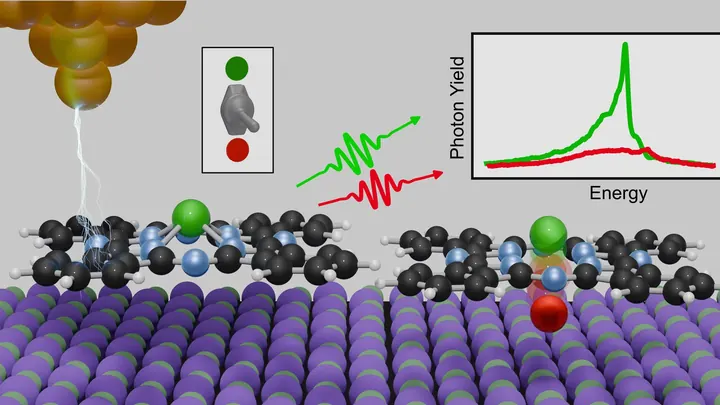
A glowing dot the size of a molecule. Run a current through it, and it flashes like a tiny lightbulb. That's what the experiment with dye molecules on a thin salt film looks like.
When current enters a molecule, one electron hands it energy. The molecule immediately gives that energy back, as light. It's like a swing: give it one push, and it rocks and then stills.
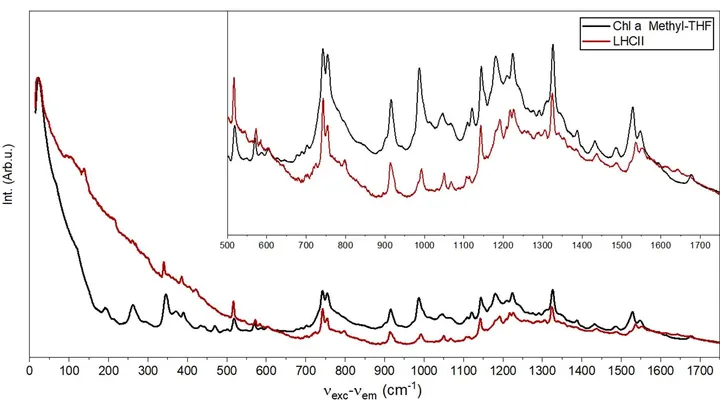
When a sunbeam hits a leaf, a relay race begins inside it. The energy of light passes from one chlorophyll molecule to the next until it reaches the reaction center — the place where the chemistry of life kicks off. This relay runs with astonishing accuracy: nearly every quantum of light finds its way.
An ordinary comb parts hair into even strands. A laser 'comb' does the same to light: it emits not one color but thousands, spaced at exactly equal frequency steps. Such a tool has already helped measure time to billionths of a second and peer inside atoms.
After an injection under the skin, a drug doesn't just spread out like ink in water. Antibody molecules carry an electric charge, and that charge makes them interact with surrounding tissues — much like a magnet attracts or repels iron filings.
A black hole is not just the universe's trash can; it is more like a safe with a secret code. For decades, it was thought that any signal sent toward the event horizon would be partially reflected back: curved spacetime acts like a funhouse mirror, and some energy always escapes.
Two voices in a molecular duet can sound in unison or cancel each other into silence. In physics, such silence is called a dark state: a quantum excitation that does not interact with light and therefore lives unusually long.