Asteroid Hopping: How to Save Fuel express
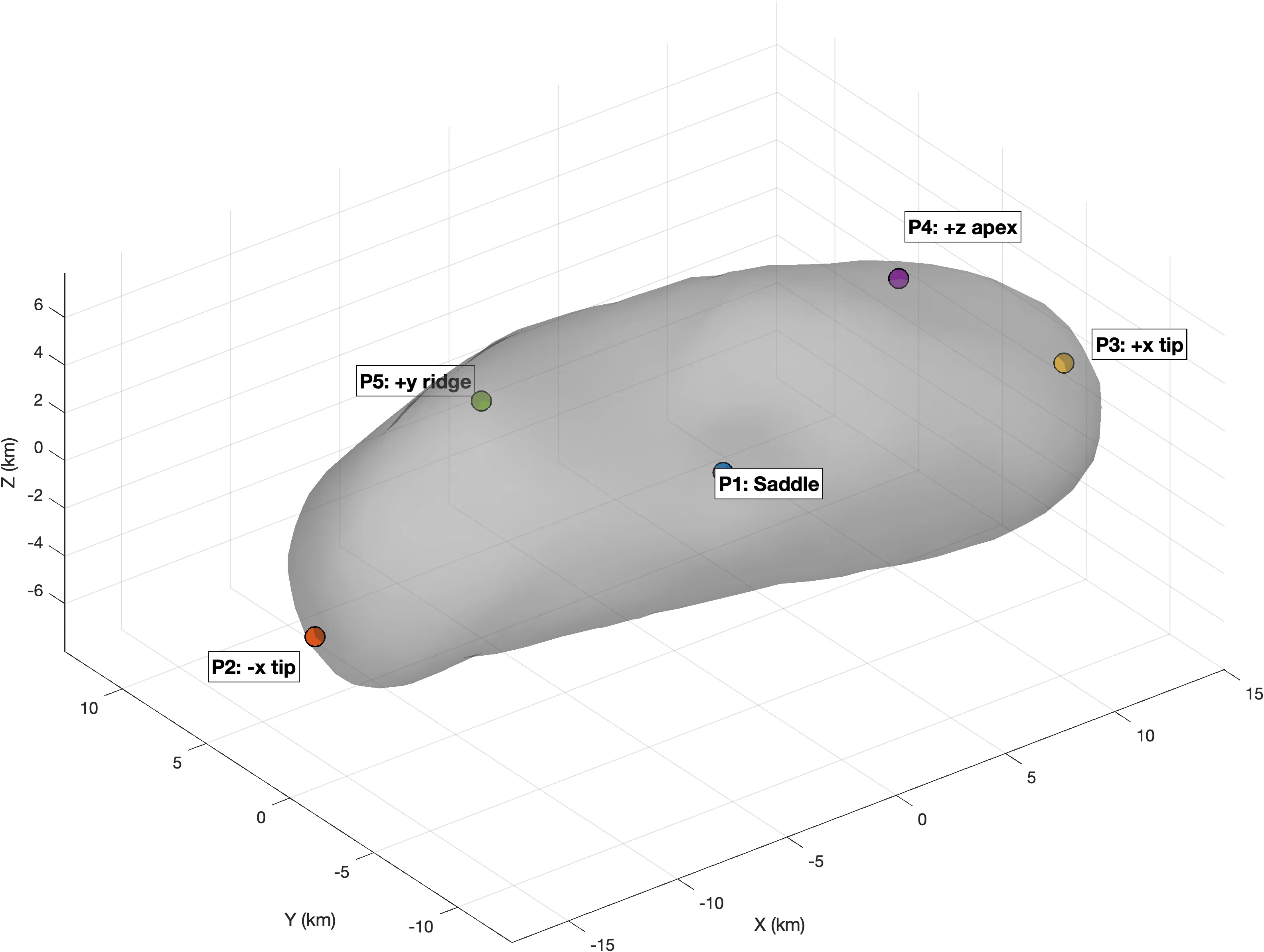
Hopping from rock to rock on the asteroid Eros is not for the faint of heart. Gravity there is so weak that a person could jump hundreds of meters, but that's exactly why any wrong push sends you into space or slams you into sharp cliffs. A spacecraft doesn't just need to fly over: it must calculate every gram of fuel to avoid crashing into the surface and land precisely on target.
Usually, a route is planned as a straight line between two points. But on Eros, that's a bad idea: the straight line almost always passes through the asteroid itself. The rock is uneven, full of bumps and hollows, and the 'straight' path runs into a slope. Because of this, the computer often takes a long time to find a solution and sometimes gives up altogether. The new approach doesn't start with a straight line but with a reasonable guess informed by physics. First, they find a single waypoint through which the trajectory definitely won't hit the rock. Then this 'warm start' is fed to a program that refines the route to perfection.
Next, the route is tested in simulation: the spacecraft performs all 20 transfers between five points on the surface. Each landing is accurate to within a meter, and a full tour of the five points uses a fifth of the fuel tank. If the landing target is shifted slightly, the solution changes smoothly, without sudden jumps: this means the method is reliable and not afraid of small navigation errors.
Such an approach will be useful for future missions to small bodies in the Solar System. Instead of hovering in orbit and burning fuel to stay there, a spacecraft could 'hop' across the surface more cheaply, collecting samples from different locations. And all this — without a single collision with rock.
The asteroid Eros is named after the ancient Greek god of love. Its shape resembles a giant peanut about 33 kilometers long — if you placed such a 'nut' on Earth, it would cover a small city.