Navigation is the science of determining one's position and planning a route to a destination. In the modern world, it relies on a combination of precise timing, sensing technologies, and algorithms that fuse data from multiple sources. From the ancient art of celestial navigation to the GPS in your phone, the core challenge remains the same: knowing where you are and where you're going in a world that is constantly moving and changing. The field extends beyond human travel to include autonomous drones, spacecraft, and even biological organisms that navigate their environments.
History
Navigation has ancient roots, with Polynesian wayfinders using stars and ocean swells, and later the development of the magnetic compass in China. The modern era began with the chronometer in the 18th century for longitude determination, and the 20th century brought radio navigation and then satellite-based systems like GPS, which became fully operational in the 1990s.
How it works
Navigation systems typically use a mix of absolute and relative measurements. Absolute methods, like GPS, determine position by triangulating signals from satellites with known positions, requiring extremely accurate atomic clocks to measure signal travel times. Relative methods, like inertial navigation, use accelerometers and gyroscopes to track movement from a known starting point, but they accumulate errors over time. Modern systems often combine these with sensor data (e.g., cameras, magnetometers) and use filtering algorithms like Kalman filters to produce a best-estimate position. The titles in the corpus highlight diverse navigation strategies: from bacteria making random jumps to comets using multiple engines, and drones coordinating search-and-capture missions.
In practice
Navigation is used in everything from aviation and maritime shipping to autonomous vehicles, robotics, and even in the guidance systems of interplanetary spacecraft, as suggested by the corpus titles about comets and drones.
Fun fact
Some bacteria navigate by alternating between 'runs' (straight swimming) and 'tumbles' (random reorientation), a strategy that is computationally simpler than continuous steering and surprisingly effective for finding nutrients.
Two photographers shoot the same mountain. One takes a hundred shots from the summit and only a couple from the base; the other does the opposite. If you try to align their images, the algorithm might decide that the summit in one photo matches the summit in the other simply because there are many similar points there, not because it's the same spot. Sampling density throws it off.
At the heart of a dying star, as its core collapses into a neutron sphere, an invisible storm is born. Trillions of neutrinos, particles that barely interact with matter, race through the scorching plasma. There are so many of them that they begin to influence each other, changing their 'flavors' (electron, muon, tau) like chameleons.
A web where lions eat zebras and hyenas finish the leftovers is not just a list of dinners. It's a survival map for an entire region. When the climate shifts, animals move, and the map tears. To understand where it will tear and where it will hold, you need to find its unchanging 'skeleton'—the connections that repeat across different places.
A bacterium swims toward food. A chemical signal guides it forward, but with each movement the signal changes. A loop emerges: sensation, action, new sensation. The authors turned this loop into a measurable quantity.
Wireless communication for robots is like a conversation in a noisy workshop, where every word can get lost in the din or arrive too late. In this mess, entropy of the channel, robots fail to yield in time, and coordination breaks down.
Radio signals in a room act just like sound in a concert hall: bouncing off walls and objects, they create a unique pattern — a silent melody for every location. Your phone, like a keen ear, catches this melody amid noise and distortion. It remembers which chord matches the corner of the couch, and which one fits the doorway.
The robot juggler catches and throws balls in precise rhythm with a human, like two пульсара sending pulses in unison. Juggling three balls is a classic cascade, governed by a steady beat, like the uniform rotation of a cosmic lighthouse. Break the rhythm and the pattern crumbles.
A beam of light fades hundreds of times faster underwater than in air — like a flashlight in dense fog. The postman robot uses this to its advantage: it locates sensors scattered on the seafloor by their faint glow and swims right up.
At the heart of the system is a rail with clip-on antennas moving along it, each emitting a radio signal. The smartphone receives these and, knowing the speed of light, calculates the distance to each antenna from the time delay.
In calm water, the route is clear. But in turbulent flows, a robot needs a different strategy. Typical approaches demand an accurate map of currents, but in reality, you can't get one. Nature does it differently: fish feel pressure and vortices right against their bodies.
The modern standard approach to AI training is like a child locked in a library: he remembers millions of books but doesn't know that fire burns and falling hurts.
A person in a boat turns by shifting their body weight. An unmanned vessel uses the same trick: a sliding weight inside the hull does the steering. Its movement is controlled by a neural network, anticipating the chaos of waves and gusts of wind. The propeller pushes the boat forward, while the weight shifts balance — like moving from one foot to the other.
A bee-sized quadcopter autonomously charts its route indoors, like a space probe through an asteroid field. Its camera works as a photometry instrument, capturing reflected light, while the processor decides where to turn at the speed of light.
A solar sail doesn't move on water but in space, and it's pushed not by wind but by the pressure of sunlight. Such a spacecraft can fly for years without spending a drop of fuel. Steering it is like sailing a yacht across an ocean where the currents are planetary gravity and the gusts of wind are shifting sunlight.
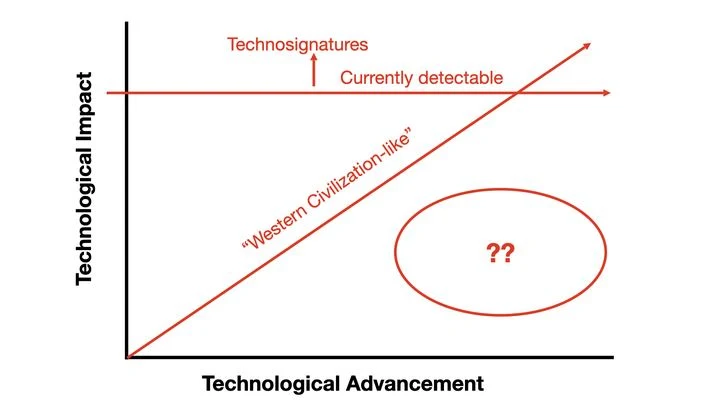
The Drake Equation is an attempt to guess the number of intelligent civilizations in our Galaxy. It’s like counting finished cakes in an unknown bakery: you know the ovens (stars), the baking sheets (planets), and the baking time. But were eggs added to the batter? Western science, relying on a single earthly recipe, considers them a rare ingredient.
In 1958, Philip Anderson showed that strong disorder can stop a wave. Since then, physicists have discovered that between complete stoppage and free travel there are intermediate regimes. A particle can not only stand still or fly, but also jitter in place, pulse, or combine several types of motion at once.
A city is a living system: it consumes resources, produces waste, and its 'circulatory system'—the road network — delivers people and goods to their destinations. But while engineers design transport arteries as rigid geometry of straight lines, nature has spent millions of years perfecting ideal distribution networks.
A drop of water on a table usually sits still. But make the table slightly softer on one edge and stiffer on the other, and the drop will crawl toward the stiffer side. This phenomenon is called durotaxis: the liquid itself chooses where to flow, without pumps or electricity.
This trick works because the surface under the drop is not uniform.
Imagine a mountain range where height represents an organism's fitness. Every point on the slope is a particular set of genes. Evolution climbs upward, but the terrain of this phylogenetic network landscape is cut by ridges and valleys.
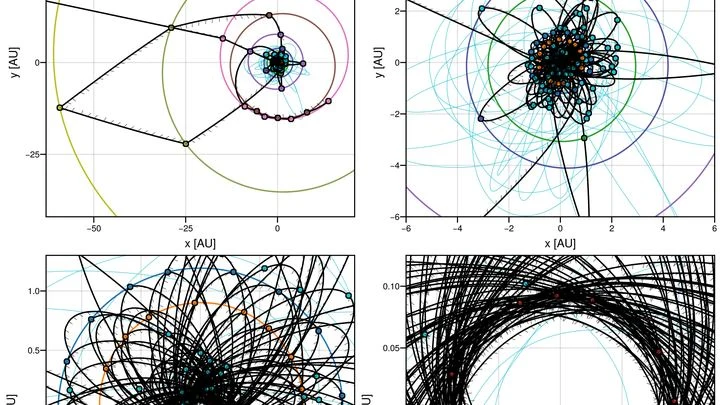
An icy rock is flying through the Solar System on an open trajectory — coming in from interstellar space, swinging around the Sun, and heading back into the dark.
A comet hurtling through space is a mountain of ice and dust that carries itself across the Solar System. If you mount small engines on such a mountain, it becomes a ship with its own fuel: gas from the interior can be vented through nozzles to change course.
Science is like a city where residents pave the streets themselves. Where paths are already worn, new houses go up, while untouched vacant lots go unnoticed — not because building there is impossible, but because no one ever looks.
Water in a narrow gap crawls on its own: that's the capillary effect that pulls sap up a stem. But if it hits a step, the liquid can freeze, like a traveler before a high threshold. Scientists built tiny glass channels and watched when a drop steps over the ledge and when it gets stuck.
A bacterium in a drop of water is looking for food. Around it, there's a chemical gradient: more food molecules on one side, fewer on the other. How should it move to reach the tasty spot fastest? It could steer smoothly, like a cyclist dodging a puddle. Or, like a bacterium, it could periodically stop, tumble, and swim off in a random direction.
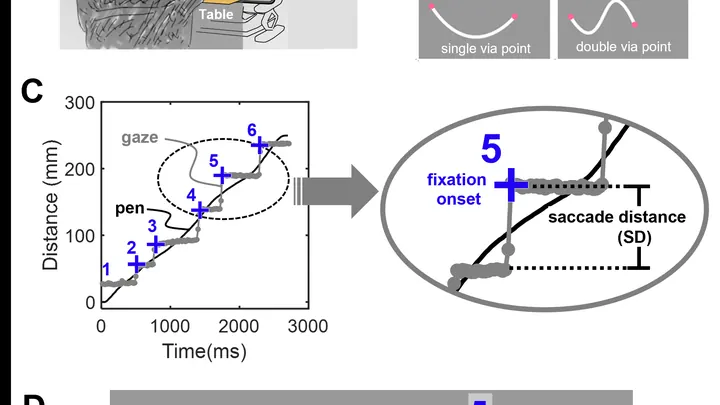
When the hand draws a line, the gaze almost always runs ahead, like a scout peeking around the corner before the column turns. But how far ahead? It turns out that each person has their own distance, and it does not change from attempt to attempt.
In the experiment, professional calligraphers and ordinary people traced a contour on a screen while instruments recorded eye and pen movements.
Toss a handful of pebbles into a stream: some settle on the bottom, others get swept around. That's roughly how waves behave in a disordered medium — light in frosted glass, sound in porous material. Usually, disorder slows things down: the wave gets stuck, spreads out, loses direction. But in a new study, physicists built an acoustic lattice where things work differently.
Paraglider, hang glider, and glider — three different wings, but in the sky they behave the same. Pilots catch invisible warm air currents, rise on them, then glide to the next. Such flight is like a game of hopscotch: a jump upward, then a glide forward, and again a search for a place to jump.
Scientists analyzed thousands of real routes and found a common law.
A bacterium in a drop of water doesn't just swim: it probes the space around it, decides where to turn, and finds its way out of a tangled maze. Artificial microscopic swimmers haven't been able to do that until now: they had to be led by the hand, with signals sent from outside.
According to physicist Hugh Everett, every observation splits the universe into parallel branches. Normally, your memory of the outcome locks you into one branch, like a key keeping a door shut. A new protocol, reality steering, shows you can pick that lock: erase the memory, and the barrier fades, letting you slide into another reality.
Science is a vast kitchen where scientist-cooks seek new recipes. Once, they sifted ingredients by hand; now artificial intelligence, a seasoned chef, lends a hand. AI memorizes millions of flavors and suggests surprising pairings: through information search, the algorithm uncovers hidden patterns.
Plants employ an army of perfect couriers to deliver energy. Each photon of sunlight is absorbed, and its energy is instantly, with almost no loss, transferred to reaction centers where nutrient synthesis occurs.
In a meeting room, an interpreter listens not only to the speaker but to the entire buzz of voices, catching who is looking at whom and who falls silent before an important remark. That's how SEA-ViT reads the ocean: it sees not isolated points from buoys but the whole current field at once, like a single conversation of water.
Picture a globe divided into cells: near the poles they shrink into narrow wedges, while at the equator they stretch into wide bands. If you connect random points on such a globe with lines, the compass arrows will lie: connections will point to where there are more cells, not where the flows actually go.