Spatial resolution is a measure of the ability of an imaging system to distinguish between two points that are very close together. It is the smallest distance at which two distinct objects can be seen as separate rather than as a single blurred blob. This concept is fundamental to any observational science, from astronomy to microscopy, because it sets the limit on the level of detail that can be captured. In astronomy, spatial resolution determines whether we can see the surface of a star, the rings of a planet, or the separation between two nearby stars. In medicine, it determines the clarity of an MRI or CT scan, affecting diagnostic accuracy.
History
The concept of resolutionlimits was first quantified by Lord Rayleigh in the 19th century, building on earlier work by others on diffraction. The development of the electron microscope in the 1930s pushed resolution far beyond the optical limit, and radio interferometry in the mid-20th century revolutionized astronomy.
How it works
Spatial resolution is fundamentally limited by the wavelength of the radiation used and the size of the aperture (the opening through which light or other waves enter). For a perfect lens or mirror, the diffraction limit is given by the Rayleigh criterion: the minimum resolvable angle is proportional to the wavelength divided by the aperture diameter. To achieve higher resolution, one can use shorter wavelengths (like X-rays instead of visible light) or larger apertures. In practice, imperfections in optics and atmospheric turbulence (in ground-based astronomy) further degrade resolution. Techniques like adaptive optics and interferometry combine multiple telescopes to effectively create a larger aperture and improve resolution.
In practice
Spatial resolution is critical in satellite imaging for mapping Earth's surface, in telescopes for observingdistant galaxies, and in medical imaging for detecting small tumors.
Fun fact
The Event Horizon Telescope, which captured the first image of a black hole in 2019, used a network of radio telescopes spread across the globe to achieve the resolution needed to see the black hole's shadow.
A radiologist looks at an abdominal scan and sees not just organs but their spatial relationships: which kidney is larger, where the tumor lies relative to a vessel. It's like reading a map, where it's not enough to know where a city usually stands; you also need to measure the distance between two points on the ground.
One hundred forty parsecs, a distance light traverses in four and a half centuries, separate us from the Taurus molecular cloud. Within its depths hide dark condensations: prestellar cores, where gas and dust slowly contract under their own weight.
A neutron star is the collapsed core of a massive star, squeezed to the size of a city. A teaspoon of its material weighs as much as a mountain. But inside this superdense sphere, a surprise may lurk: under unimaginable pressure, neutrons break apart into quarks, giving the star a new, more compact core.
Imagine photographing a statue in dim light. You face a dilemma: take one bright shot or a series of dim frames from different angles. In the first case, quality is limited by photon noise, the graininess that arises from a lack of photons, while in the second, details overlap, making it harder to reconstruct the 3D structure.
Look at an equilateral triangle — the probability simplex for three assets. Each interior point is a portfolio: non-negative shares summing to one. The triangle's center, the barycenter, corresponds to an equal-weight allocation (1/3, 1/3, 1/3). It seems that by moving toward this point, you lower risk and avoid dangerous edges.
The Sun is not just a source of heat; it's also the largest lens in the solar system. Its gravity bends light rays like glass, focusing them into a bright ring far beyond Pluto's orbit. If light from a distant planet enters this ring, astronomers could reconstruct its portrait — not a point, but a map with surface details.
Two rulers show slightly different lengths for the same table. That's roughly the situation in cosmology with the Hubble constant — the number that tells how fast the universe is expanding.
A flashlight beam aimed through frosted glass turns into a blurry spot with every extra millimeter of thickness. Scintillators, materials that convert X-rays into visible light, behave much the same way. They underpin medical imaging, baggage screening, and detectors at particle accelerators.
When a massive star exhausts its fuel, the core collapse can spawn a supernova and a neutron star, but with enough mass, nothing halts the crush — a black hole is born.
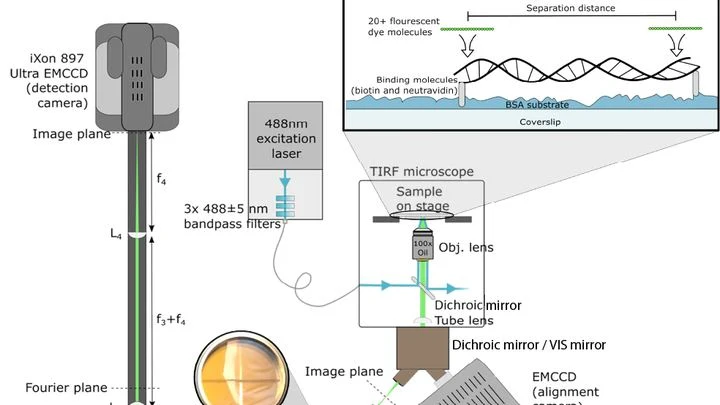
A conventional light microscope hits a fundamental limit: it cannot distinguish two points closer than 200 nanometers — roughly the thickness of a soap bubble divided by a hundred. To see deeper, scientists have made molecules in the sample blink or fade, but these tricks are slow and harmful to living cells.
An X-ray image usually brings to mind a bulky machine in a hospital. But such a picture can be taken by a device the size of a palm, assembled from hobbyist electronics. The authors took a Raspberry Pi mini-computer, a 12.3-megapixel camera, and a screen that glows under X-rays.
An X-ray image of a battery looks like a photo taken through frosted glass: fine details blur into a gray smudge. The culprit is the detector itself, which cannot distinguish features smaller than its pixel size. Engineers proposed getting around this barrier by illuminating the sample not with a uniform beam but with a striped pattern.
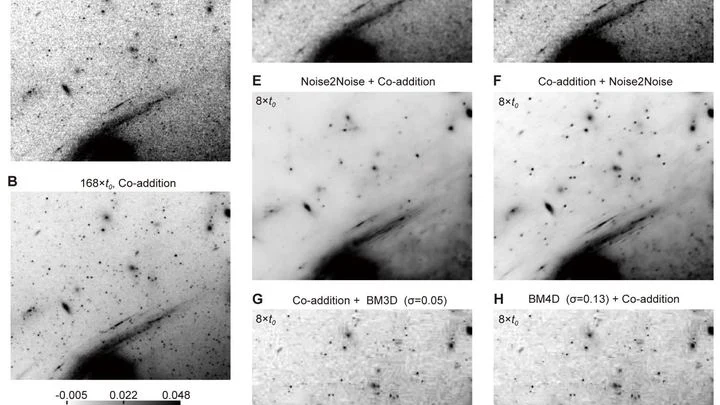
The night sky in a telescope image looks like a photo taken through a fogged-up window: bright stars are visible, but everything faint drowns in a murky haze. That haze is noise — random interference from electronics, heat, and the atmosphere itself.
Light passing through a lens bends slightly. For an optical computer, this is like a warped mirror for an artist: the image is there, but the details blur. An Ising machine using light beams tackles problems like packing luggage or planning a courier's route.
Our body's tissue is like a city: different neighborhoods are home to different cells, each with its own job. To understand how this city is organized, biologists take images showing which genes are active at each spot. But sharp images are expensive, and cheap ones come out blurry, like a photo of a city from high above, where individual buildings are hard to make out.
In the dark, a tiny spark flashes. A gamma ray born inside a patient's body strikes a crystal and knocks out a shower of light. The detector's job is to figure out exactly where that happened. The more precise the answer, the sharper the image on the tomograph screen.
The new detector resembles a honeycomb, but not a flat one — the cells narrow toward the bottom.
In the dark clouds of interstellar gas where stars are born, matter gathers into dense knots — future cradles of stars. Astronomers measure distances between these knots from sky photographs, but a photograph is flat while the cloud is volumetric. Converting from plane to volume is not as simple as it seems.