Displacement is the vector quantity that describes the change in position of an object from its initial point to its final point. Unlike distance, which is a scalar measuring the total path length traveled, displacement only cares about the straight-line separation between start and end, including direction. It is a fundamental concept in kinematics, forming the basis for defining velocity and acceleration, and it plays a central role in mechanics, wave theory, and even electromagnetism where it appears in the displacement current.
History
The concept of displacement as a vector was formalized in the 19th century, building on earlier work by Galileo and Newton on motion. The term 'displacement' in its modern sense became standard with the development of vector analysis by Hamilton and Gibbs in the late 1800s.
How it works
Displacement is calculated as Δr = r_final - r_initial, where r is the position vector. It obeys vector addition, so displacements can be combined by adding their components. In calculus, instantaneous velocity is the time derivative of displacement, and acceleration is the second derivative. In oscillatory systems, displacement from equilibrium is the key variable, as in Hooke's law F = -kx, where x is the displacement.
In practice
Displacement is used everywhere from engineering (measuring structural deformation) to seismology (tracking ground motion during earthquakes) and GPS navigation (calculating position changes). In fluid dynamics, displacement thickness describes how a boundary layer pushes the outer flow outward.
Fun fact
In a closed loop, the total displacement is always zero, regardless of the distance traveled — which is why a hiker who walks 10 kilometers in a circle ends up with zero displacement from the starting point.
Units by system: SI: m · CGS: cm · Planck: l p · natural: 1gev
A crowd at the entrance to a narrow corridor behaves differently than in a spacious hall: some people get pressed against the walls, others are pushed forward. Roughly the same happens when an elongated particle finds itself in a fluid teeming with self-propelled dumbbells. Until now, it was unclear why such a particle moves faster along its long axis than across it, and how the crowd density affects its speed.
Two pieces of sandpaper are pressed tightly together. As you start to slide them, they first catch on the rough spots, then suddenly slip. A fault in the Earth behaves much the same way during an earthquake. But there's a crucial detail: how far do you need to push the edges before the grip gives way? This distance is called the critical slip distance.
Water droplets shoot out of a nozzle one after another, like cyclists on a narrow track. The faster ones catch up with the slower ones and merge into larger drops. This simple mechanism is called ballistic aggregation, and until now it had only been observed on cosmic scales: this is how dust particles stick together to form planets.
A handful of rice grains falls onto a hot skillet, and they start jumping. Each grain pushes its neighbors, and the whole pile stirs without any external hand. That's active matter: a multitude of particles that draw energy on their own and convert it into motion.
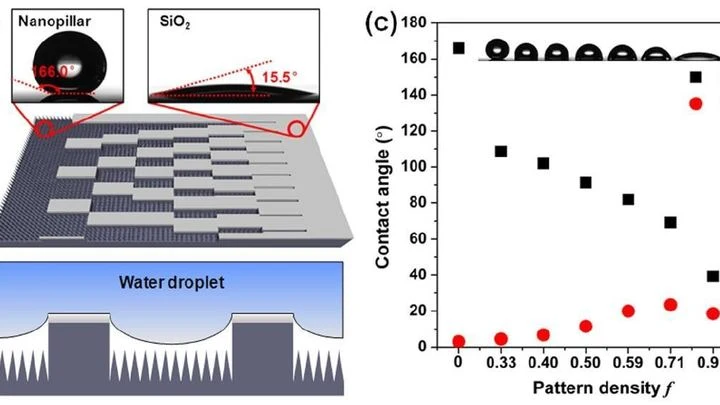
A drop of water on a table usually sits still. But make the table slightly softer on one edge and stiffer on the other, and the drop will crawl toward the stiffer side. This phenomenon is called durotaxis: the liquid itself chooses where to flow, without pumps or electricity.
This trick works because the surface under the drop is not uniform.
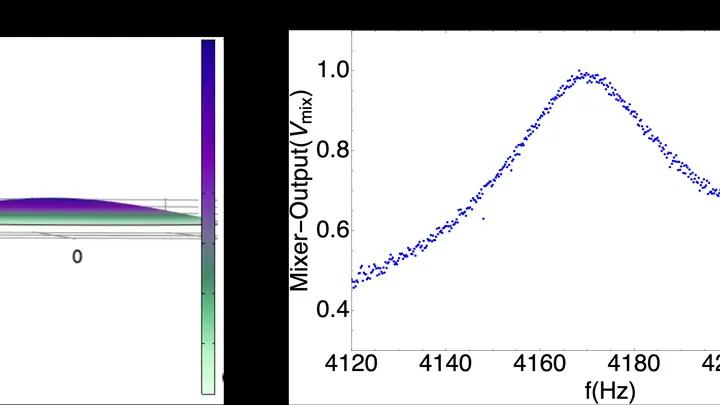
A thin film, clamped between two metal posts, trembles at the slightest nudge. Its movements are picked up by a microwave resonator — a cavity where radio waves bounce around like sound in an empty room. When the membrane shifts, the cavity's response changes.
Diamond is not just a gemstone. This crystal can conduct electricity when free charge carriers, electrons and holes, appear in it. But how fast do they move? In scientific papers, numbers vary by tens of times. One lab reports a mobility of 1000 cm²/(V·s), another 4000.