Bringing Electrons Back to the Stage ✛
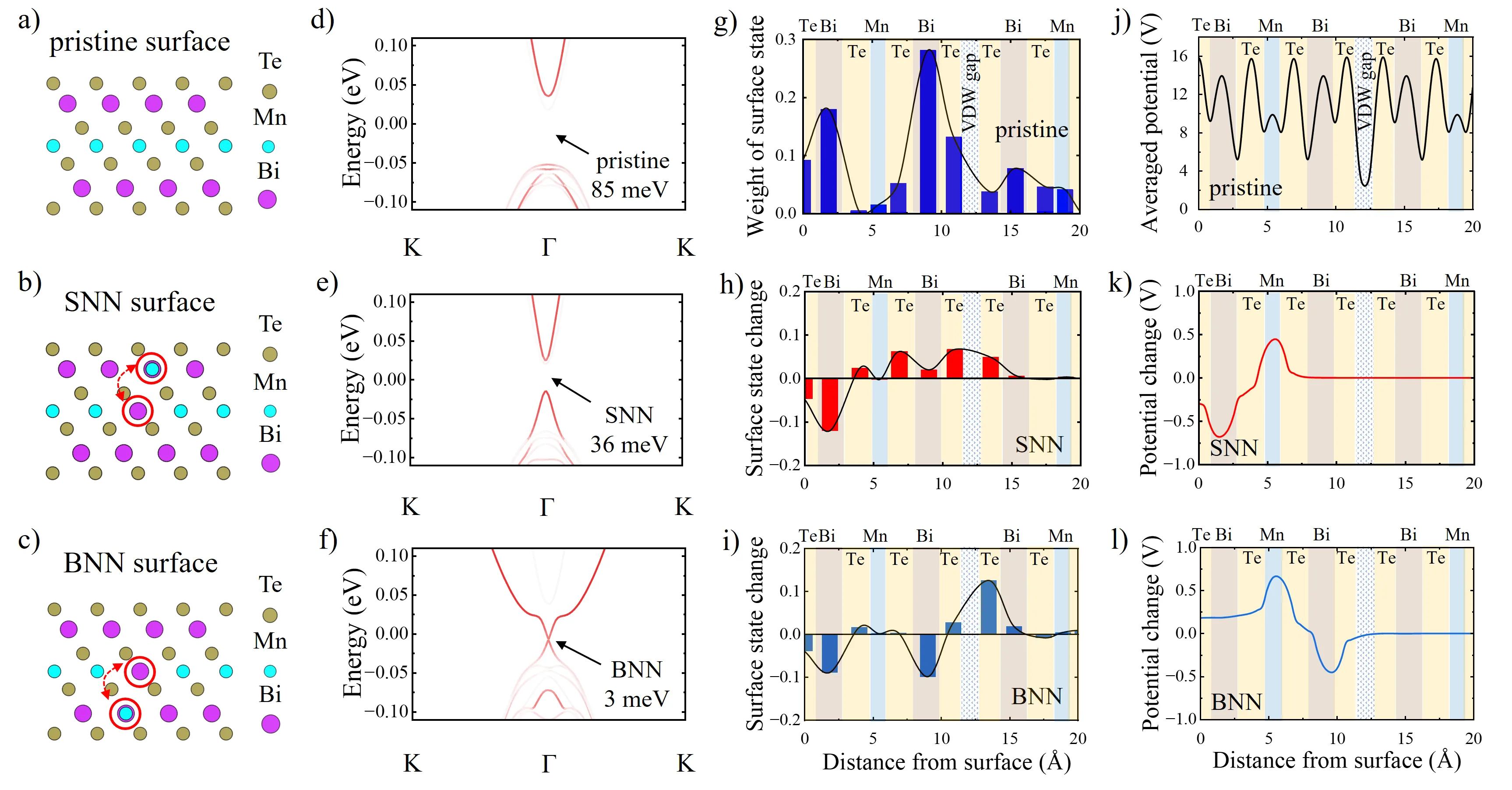
The crystal surface is like a stage where electrons are meant to perform. In MnBi2Te4, special states should run along the surface, making it conducting only on the outside while the interior remains an insulator. Magnetic properties open a gap in these states: an energy interval that electrons cannot occupy. This gap is essential for the quantum anomalous Hall effect, where resistance changes in exact steps.
But in real samples, the gap nearly vanishes. The culprits are defects: manganese and bismuth atoms sometimes swap places in the crystal lattice. Such a swap lowers the electric potential at the surface, and the electronic states, like actors driven off the stage, retreat into the bulk. There, the magnetic influence is weaker, the gap closes, and the effect disappears.
Scientists have found a way to bring electrons back to the stage. Applying an external electric field raises the surface potential, and the states resurface. A field with a potential of 0.1 volts restores the gap to 11–24 millielectronvolts. Another route is to place a polar insulator on top, such as In2Te3, whose internal field acts like an invisible director and also brings the states back up.
The most intriguing part is that the field direction works like a switch. By changing its sign, the material can be toggled from a state with zero Hall conductivity to one with the quantized value e²/h. This means that without a magnetic field, purely by electrical means, one can control quantized transport. The stage comes alive again, and electrons return to the spotlight.
The magnetic gap in clean MnBi2Te4 is predicted to be 90 meV, corresponding to a temperature of about 1000 K, but in real samples, defects cause it to nearly vanish, and the quantum anomalous Hall effect has been observed only at temperatures below 1 K.
The idea of controlling topological states with an electric field echoes the concept of 'topological transistors' from science fiction, where quantum states are switched without current, merely by changing the potential.