Magnetic properties describe how a material responds to an applied magnetic field. These responses arise from the behavior of electrons within atoms, particularly their spin and orbital motion, which create tiny magnetic moments. Depending on how these moments align, materials can be classified as ferromagnetic (strongly attracted, like iron), paramagnetic (weakly attracted), diamagnetic (weakly repelled), or antiferromagnetic (no net magnetization).
History
The modern understanding began with Pierre Curie's work in the 1890s on the temperature dependence of magnetism, and was later refined by Paul Langevin's classical theory and the quantum mechanical explanations by Werner Heisenberg and others in the 1920s.
How it works
In ferromagnetic materials, neighboring atomic moments align in the same direction within small regions called domains. When an external field is applied, domains that are aligned with the field grow, producing a strong net magnetization. In paramagnetic materials, moments are randomly oriented but tend to align slightly with an applied field, while in diamagnetic materials, the field induces opposing moments, creating a weak repulsion.
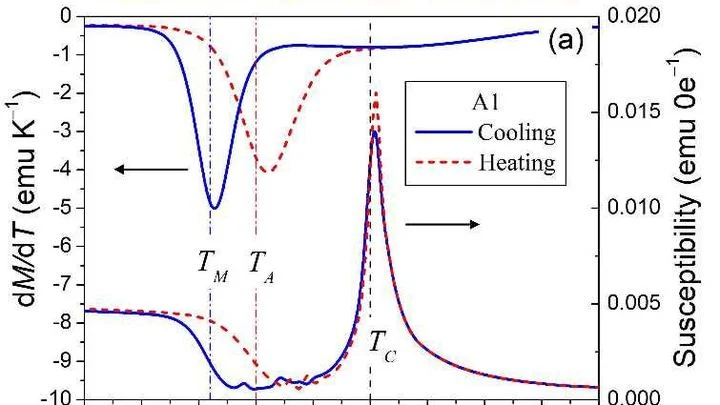
A metal bar suddenly becomes stiff when heated, and at the same time loses or gains magnetic properties. In alloys based on nickel and manganese, such transformations occur not smoothly but abruptly — atoms rearrange into a new order, and the material changes its behavior.
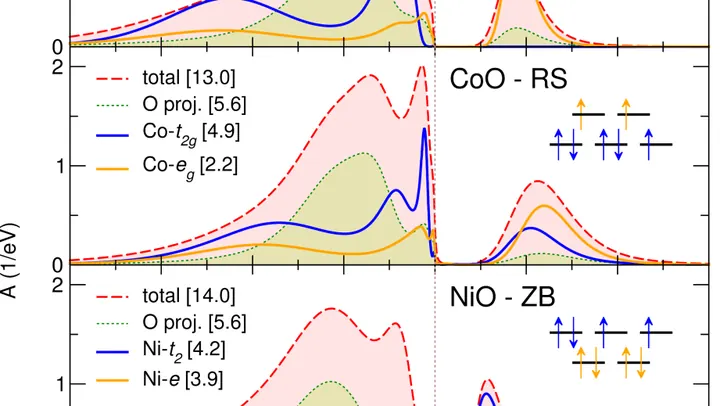
If you change not the composition but only the arrangement of atoms, you can make the same material conduct electricity or absorb light differently. That's exactly what the authors did with nickel and cobalt oxides. In one case, atoms are stacked like balls in a cubic box: each metal atom is surrounded by six oxygen atoms (rock salt structure).
In a solid, atoms vibrate, transmitting sound. Sometimes this wave doesn't run straight but curls into a spiral, like a corkscrew entering a cork. In ordinary crystals, such 'sound vortices' are known, but in magnetic materials they had long eluded detection.
A dust grain in interstellar space is like a tiny compass. Inside it sit inclusions of magnetic minerals that make the grain rotate along invisible magnetic field lines. How obediently the grains align determines how they polarize the light of distant stars and what radiation they emit.
The crystal Ca2RuO4 resembles a stack of thin sheets. Inside each sheet, the electron spins are arranged in strict order, like rows of soldiers on a parade ground. The bonds between the sheets are weak, and their sign can be flipped by slightly pulling the crystal apart.
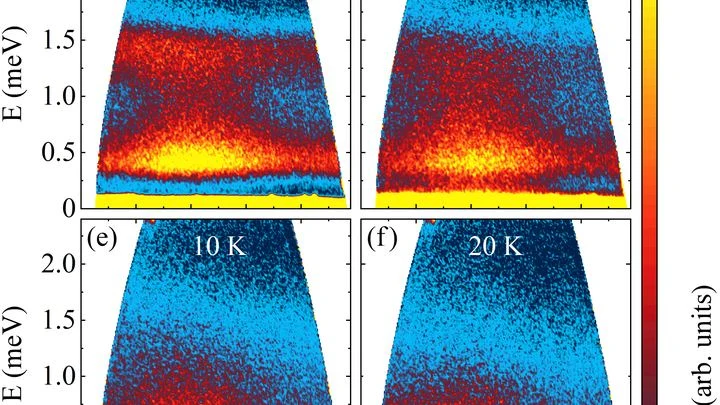
The tiny magnetic arrows inside a crystal of terbium-iridium oxide behave strangely: instead of lying along their preferred axis, they stand across it. This state fully forms when cooled to 1.5 Kelvin — colder than outer space.
Researchers probed the crystal with neutrons and observed how these flipped arrows oscillate and exchange energy.