Magnetic Gap Returns in MnBi2Te4 ✛
Context
This work fits into the broader study of magnetic topological insulators and the quantum anomalous Hall effect, alongside studies of MnBi2Te4 surface states, defects, and interfaces. Neighboring papers examine how disorder, twisted materials, and thin films affect topological properties, but this work uniquely links defects to electrostatic potential and offers a way to control the gap.
Methods
The authors modeled a four-layer MnBi2Te4 film with a single Mn–Bi antisite pair on the top surface and calculated the band structure using density functional theory with spin–orbit coupling. They then constructed a tight-binding Hamiltonian from maximally localized Wannier functions, incorporating external electric fields of three profiles: uniform, point-like, and exponentially decaying. For heterostructures with polar insulators In2Te3 and Al2O3, they performed first-principles calculations with relaxation of interatomic distances. The anomalous Hall conductivity was computed via the Kubo formula on a dense k-point grid with additional refinement near the Γ point.
Results
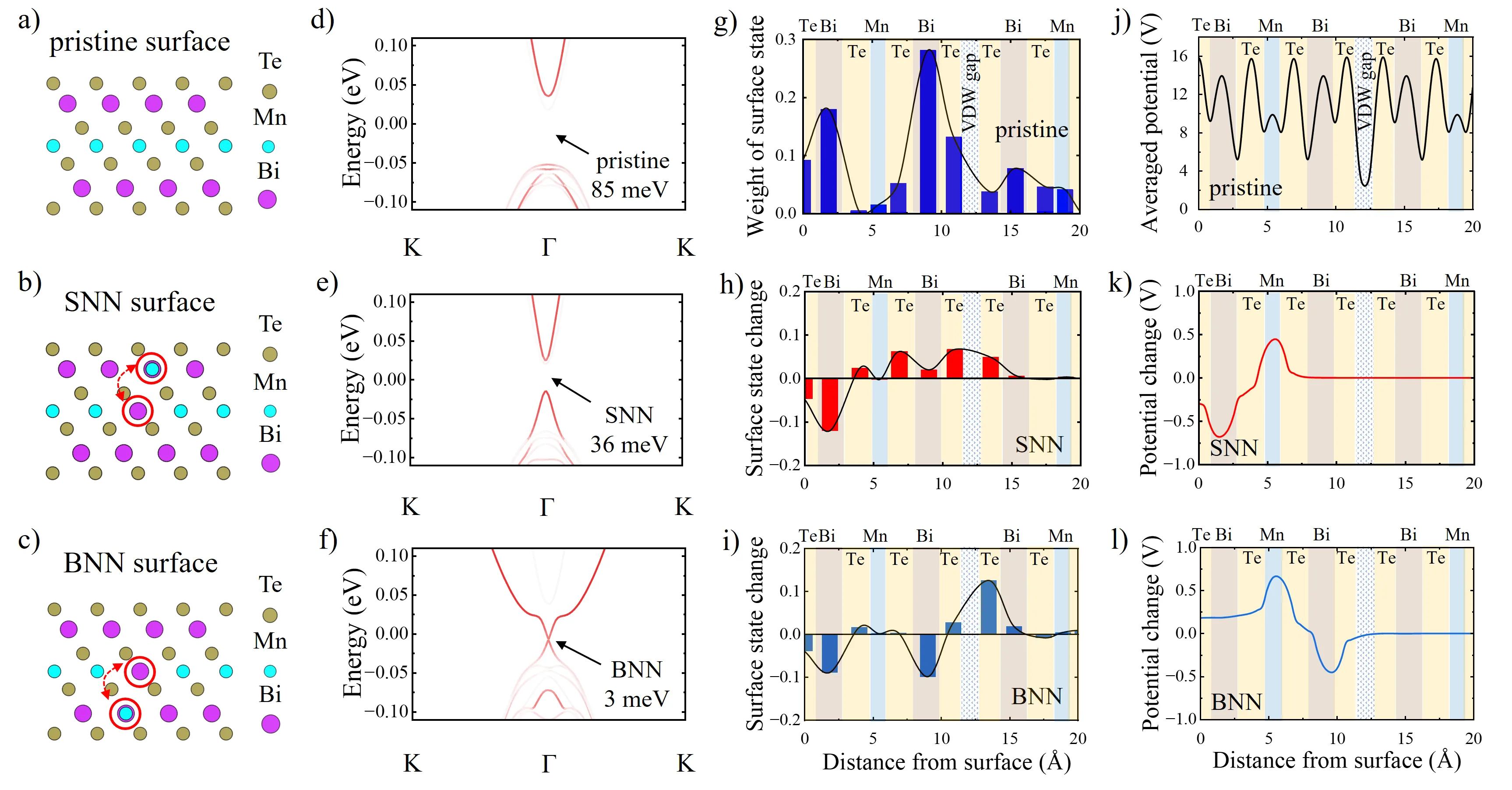
A clean MnBi2Te4 surface has a magnetic gap of 85 meV, but a single BNN defect reduces it to 3 meV. The defect lowers the electrostatic potential of the Bi layer, shifting topological states deeper into the crystal where exchange interaction weakens. Applying an external field with a surface potential of 0.1 V restores the gap to 11–24 meV depending on the field profile. In a heterostructure with polarized In2Te3, the gap reaches 21 meV for downward polarization and 14 meV for upward polarization. Reversing the field sign switches the anomalous Hall conductivity between zero and the quantized value e²/h, that is, between an axion insulator and a Chern insulator.
Implications
Unlike neighboring works that merely note the influence of defects or disorder, this study proposes a concrete mechanism: defects alter the electrostatic potential, not just the magnetic order. This allows the gap to be controlled by an external field, which was not previously considered a primary tool. The work also explains why AlOx capping improves the quantum anomalous Hall effect in experiments, attributing it to the interface field.
Future development
One could look for simpler predictors of how a given substrate or capping layer will affect the surface potential, avoiding costly first-principles calculations each time. It would also be interesting to test how robust the restored gap is against temperature and other defect types, and whether quantization can be achieved at even higher temperatures.
Impact
The results are important for developing devices based on magnetic topological insulators, such as topological field-effect transistors and memory elements, where control of quantized transport is required.
Next steps
Conduct experimental verification of the predictions on real MnBi2Te4 heterostructures with polar insulators and measure the anomalous Hall conductivity for different field directions.
Key open problems
This work directly addresses the challenge of realizing the quantum anomalous Hall effect at practically achievable temperatures in magnetic topological insulators, as well as understanding the role of defects in suppressing topological properties.
The knowledge machine's view
This section is addressed to the author of the paper and their colleagues. Neighbouring works were found by meaning-based search across our archive, not by word overlap. We do not review: we show the field around the work.
What the work does
The study examines a MnBi2Te4 film with Mn–Bi antisite defects, which lower the surface electrostatic potential, driving topological states deeper and closing the magnetic gap. First-principles calculations and a tight-binding model show that an external electric field or contact with a polar insulator restores the gap to tens of meV, and switching the field changes the topology between an axion insulator and a Chern insulator.
Where its strength is
A key strength is identifying the specific mechanism by which defects act through the electrostatic potential and proposing to control the gap with an external field, linking defects to electrical control of topology.
Where it could go next
- It might be interesting to see how disorder and defects affect edge currents in the quantum anomalous Hall regime: a related preprint in the archive discusses how quantum edges navigate obstacles.based on: Indestructible current: how quantum edges bypass obstacles arXiv:2603.03927
- The idea of controlling topology with an electric field resonates with approaches in twisted materials, where electrostatic doping alters topological properties; it may be worth comparing with work on the magic angle and the giant effect.based on: Magic Twist Angle Sparks Giant Effect arXiv:2603.14192
- Since interface fields arise in heterostructures with polar insulators, one could consider an analogy with systems where magnetic order is sensitive to heat and external stimuli, as in work on thermal destruction of magnetic order.based on: Heat Breaks Magnetic Order arXiv:2602.07976
Worth trying
- Test whether gap restoration persists at finite temperature and with defect dynamics taken into account.
- Calculate the anomalous Hall conductivity for realistic field profiles in heterostructures with different polar insulators.
- Assess the possibility of switching topology in a gated device using a tight-binding model.
Why this may matter
The work paves the way for electrical control of quantized transport in magnetic topological insulators, which is important for low-energy spintronics and topological transistors.
Nearby works in our archive
- Anti-capacitance: How to See a Four-Dimensional Quantum Effectsimilarity 0.55
- Magnetic Patterns on a Crystalsimilarity 0.52
- Indestructible current: how quantum edges bypass obstaclessimilarity 0.52
- Magnetic Patterns at the Atomic Levelsimilarity 0.51
- Heat Breaks Magnetic Ordersimilarity 0.51
- Magic Twist Angle Sparks Giant Effectsimilarity 0.51
The archive is sparse around this work: the closest review is only 0.55, against a usual 0.64. It looks like few have drilled nearby.
The magnetic gap in clean MnBi2Te4 is predicted to be 90 meV, corresponding to a temperature of about 1000 K, but in real samples, defects cause it to nearly vanish, and the quantum anomalous Hall effect has been observed only at temperatures below 1 K.
The idea of controlling topological states with an electric field echoes the concept of 'topological transistors' from science fiction, where quantum states are switched without current, merely by changing the potential.
Key numbers
- magnetic gap of clean surface: 85 meV
- gap with BNN defect: 3 meV
- restored gap by external field: up to 24 meV
- gap in heterostructure with In2Te3: 21 meV
- required field at surface: 107–108 V/m