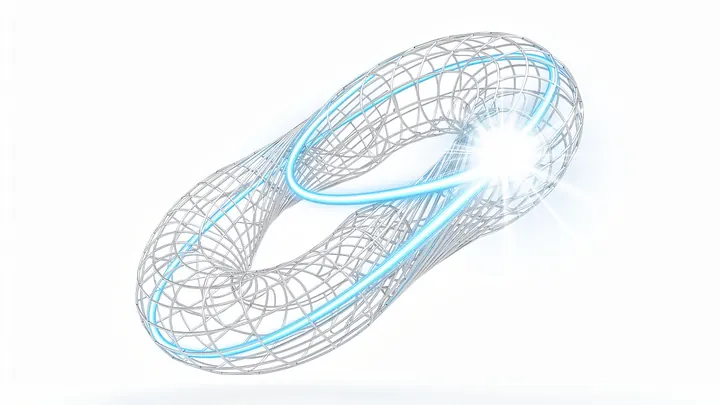
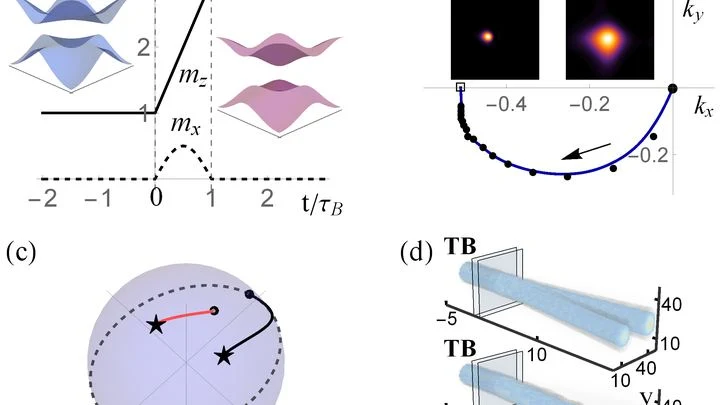
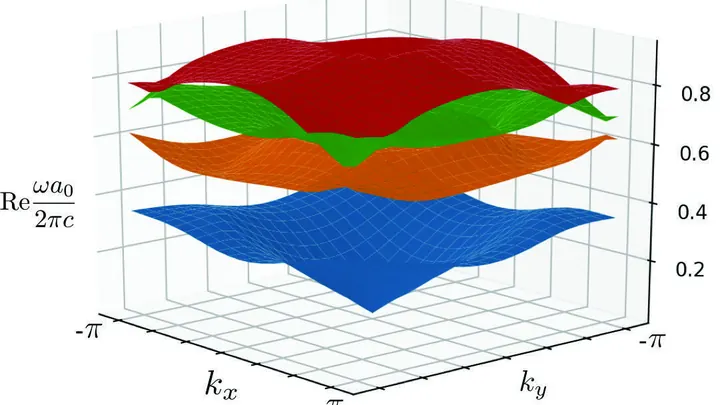
Topological surface states are electronic states that exist only on the boundary of a material, not in its interior. They arise from the material's topological properties — a global classification of its electronic band structure that remains unchanged under smooth deformations. In a topological insulator, the bulk behaves like an insulator (no conducting states), but the surface hosts conducting states that bridge the energy gap. These surface states are protected by time-reversal symmetry, meaning they are robust against scattering from impurities or defects, unlike ordinary surface states.
History
The concept was theoretically predicted in the mid-2000s, with key contributions from Charles Kane, Eugene Mele, and Shoucheng Zhang, and experimentally confirmed in bismuth antimony alloys in 2008.
How it works
In a topological material, the band structure has a nontrivial topological invariant (like a Chern number or Z2 index). At the interface between a topological and a trivial material, the invariant must change, forcing the energy gap to close at the boundary. This creates gapless surface states that are metallic. Because they are protected by symmetry, they cannot be localized by disorder — an electron in such a state will pass through without backscattering, even in the presence of impurities.
In practice
These states are explored for spintronics and fault-tolerant quantum computing, as their spin-momentum locking and robustness could enable dissipationless electronic transport.
Fun fact
The surface states of a topological insulator have a spin that is locked perpendicular to their momentum, meaning electrons with opposite spins travel in opposite directions — a property that could be used to create spin-polarizedcurrents without magnetic fields.
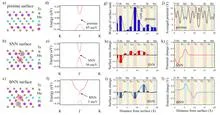
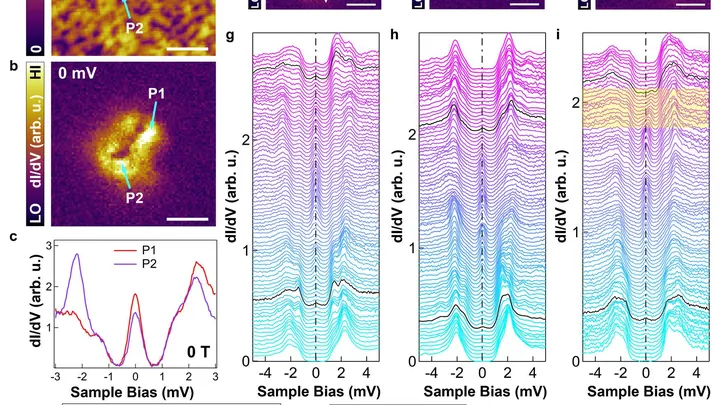
The surface of a crystal is like a stage where quantum effects are meant to perform. In MnBi2Te4, a magnetic topological insulator, special electronic states are expected to run along the surface, and the magnetic order opens an energy gap in them: a forbidden zone that makes transport quantized.
A layered cake of molybdenum disulfide MoS2 sits on the lab bench. It is prepared in the usual way: adhesive tape peels off the top layers to obtain a thin sample. But beneath the tape remains an invisible cavity where the atomic floors are no longer pressed together. It is there that electrons begin to behave differently than in the crystal bulk.
A door lock with two different keys: one turns easily, the other demands noticeable effort. That is how two layers of hexagonal boron nitride behave when twisted relative to each other. This material consists of boron and nitrogen atoms arranged in a hexagonal lattice, and its layers can sit in different registries, like two identical grids shifted by different angles.
An ultrathin film of tellurium, tantalum, and iridium atoms behaves as an insulator in its interior but conducts current along its edges. This property, the quantum spin Hall effect, promises lossless electronics. However, calculations of the electronic structure did not predict such a phase for the 1T-TaIrTe₄ monolayer.
Two dancers on one stage: the triangle and the stripe. In a quantum gas of dysprosium atoms cooled to 62 nanokelvin, these two spatial structures have met for the first time in a single experiment. The gas is held in a trap shaped like a surfboard, and its atoms are among the most magnetic in the periodic table.
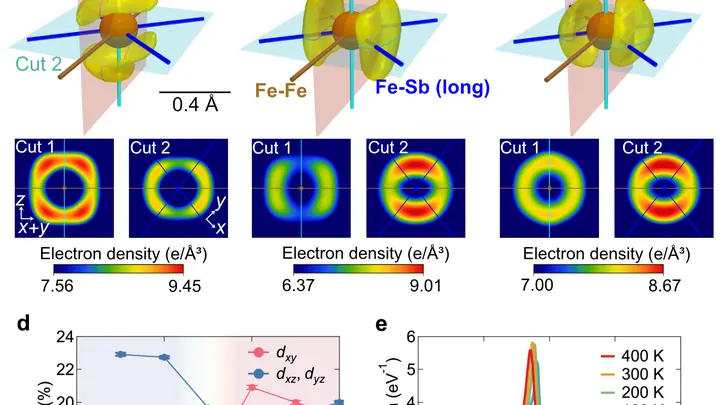
A house with cork walls suddenly gets covered in copper sheets, but only when frost sets in. That's roughly how FeSb₂ behaves when made into a film just a few atomic layers thick. Under normal conditions, it's a narrow-gap insulator: electrons sit tightly in place like spectators in an overcrowded hall.
Two transparent sheets with circles drawn on them. If you stack them exactly, the circles align. But give one sheet a slight twist, and a new pattern emerges: in some places the circles bunch together, in others they spread apart. That's roughly how moiré works — an unexpected pattern born from rotating two periodic structures.
A polar molecule is like a tiny dumbbell with opposite charges at its ends. Normally, such particles quickly stick together or fly apart when they meet — electric forces are too strong. But the authors of the work found a way to turn this aggressiveness into a controlled game.
The ring was assembled from several different segments. In each segment, particles behave in their own way, like musicians playing different notes. The most interesting part begins at the junctions: here particles often get stuck, like an echo trapped in a narrow corridor. This phenomenon is called the skin effect — particles pile up at the boundary, like a crowd at an exit.
But the authors noticed something new.
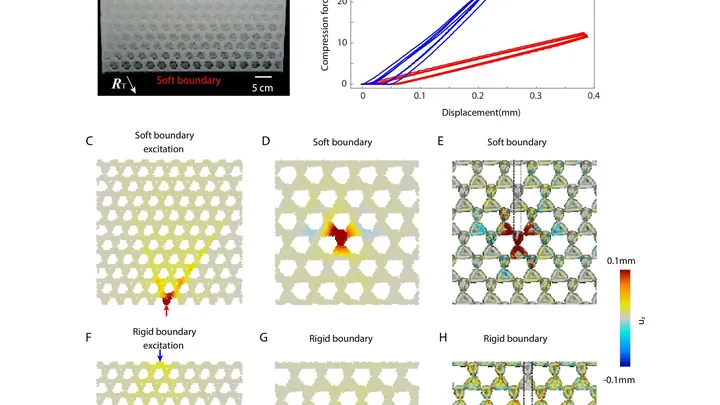
Bending a sheet of paper is easy. But compressing it by pushing from the edge is a different story: the paper will crumple but barely transmit the force further. That's how ordinary elasticity works — deformation depends on where and how you press. The new three-dimensional lattice pushes this contrast to the limit.
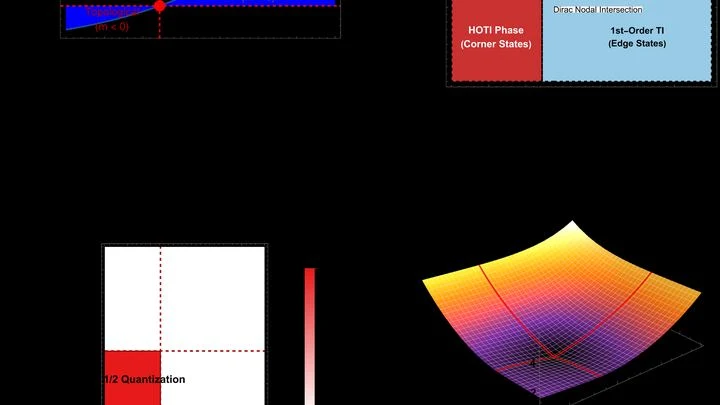
The book is open to the middle. Current runs along the spine, while the pages remain cool. That's roughly how a two-dimensional topological insulator works — a material where electricity flows only along the edges, while the interior stays still.
Boson stars are gravitational atoms. Only instead of electric charge, gravity itself serves as the nucleus, holding a cloud of scalar field in quantized clumps.
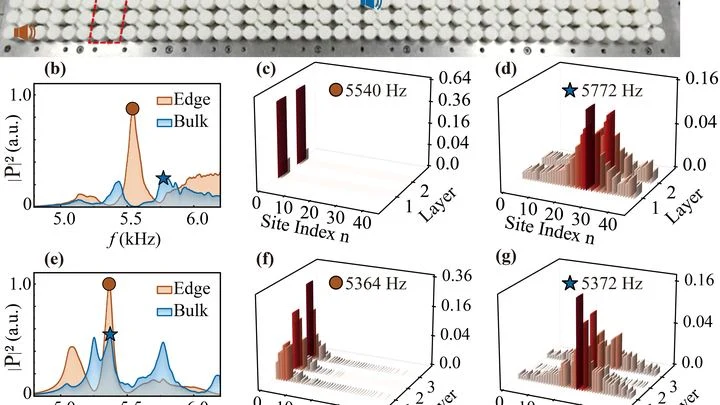
A sheet of rubber is squeezed from two sides. At first glance, it's just deformation. But inside, deep within the material, a hidden order awakens. This is not just wrinkles on the surface. It's the birth of special zones where vibrations become trapped, as if in a cage.
Previously, it was thought that such effects require intricate lattices and periodic structures.
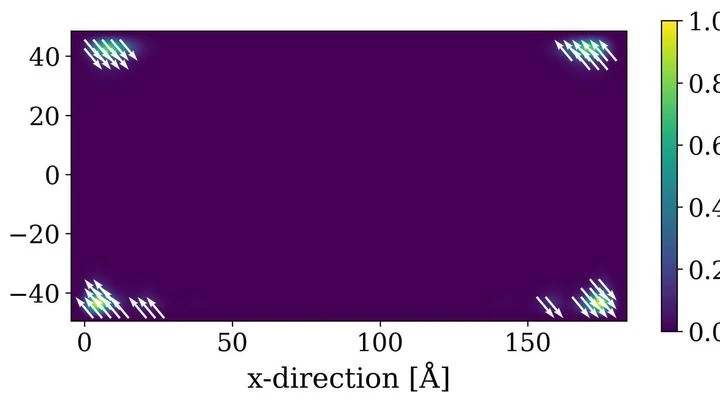
In a pool, water usually spreads in circles from a thrown stone. But if you direct the flow strictly along the rim, it will run only along the edge. Something similar has been noticed in pieces of the superconducting crystal FeTe0.55Se0.45.
You're looking for a quiet room for an important conversation. You step into a space, and hear silence. But upon closer inspection, you find that in one corner the ventilation is simply broken, and in another there's a hole in the floor that absorbs sound.
A long, narrow pan, and a thin pancake sets in uneven stripes. For decades, scientists saw a similar picture when modeling the behavior of electrons in superconductors — materials that conduct electricity without loss. They used elongated "cylinders," and the result was always the same: rigid magnetic "stripes" that were thought to hinder superconductivity.
In the mid-20th century, Roger Penrose described a black hole using the concept of a “trapped surface” – a region where even a light ray directed outward inevitably falls inward. A situation familiar to everyone: water in a sink’s vortex is irretrievably sucked down the drain.
The quantum birth of the Universe is like a game of dice, where the chance of rolling a six is catastrophically small. The formalism of Hawking and Hartle, an elegant recipe for a world born from timelessness, has spent decades predicting that a universe like ours is fantastically improbable.
A stone falls into a pond, and ripples spread across the water. They reflect off the shore, overlap, and die out. All this motion unfolds in space. But what if the pond itself changed its depth or density for an instant — not at one point, but everywhere at once? A temporal boundary is exactly such a jump in properties over time, not space.
Imagine a line of people holding hands but facing in opposite directions: some look north, others south. That's how a p-wave magnet is arranged. Electrons in it align their magnetic moments (spins) not randomly but in a strict wave-like pattern.
Light, discovered by Maxwell, behaves differently in different media. In a new study, researchers simulated a two-dimensional crystal that absorbs light and has magnetic properties. In it, light waves behave like passengers on a one-way escalator: they relentlessly move toward edges and corners, where they accumulate.
A fabric that stretches lengthwise but not crosswise. That's roughly how a semi-Dirac material works: electrons can move freely in one direction but barely budge in the other. Because of this unusual anisotropy, special tracks, one-dimensional channels, emerge at the edges of the two-dimensional crystal. Electrons race along them only along the perimeter, like water in a trough.
A single-atom-thick sheet of tungsten telluride is like thin foil: electrons can't pass through because there's a band gap between their possible states, like a moat you can't jump across. Add two more layers, and the moat disappears; the material becomes a metal, and current flows. Add more layers, and the properties change again, as if someone is flipping modes with a single button.
A struck tuning fork fades: its vibrations leak into the air. But there are systems where the oscillation does not decay, even though there are plenty of free waves around, ready to carry energy away. Physicists call such 'captured' states bound states in the continuum (BIC).
A thin wire of the new material conducts electricity without loss when cooled to three degrees above absolute zero. It's like water flowing through a pipe without any friction against the walls. The material is called PtPb3Bi, and its hallmark is an internal structure resembling a bundle of threads: electrons run freely along a thread but struggle to jump between threads.
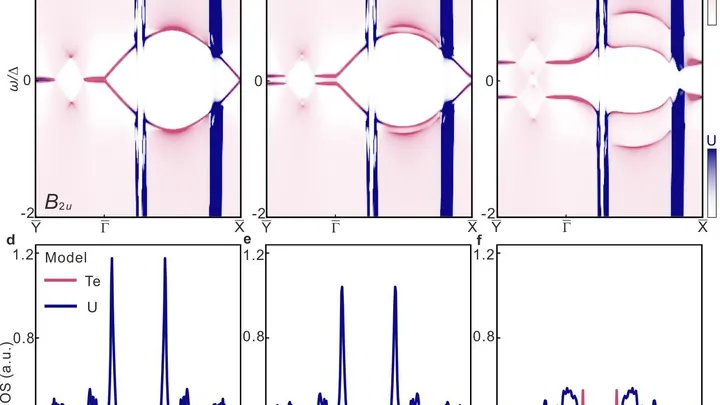
A superconductor is like a city where electric current flows without traffic lights or jams. But the crystal UTe2 has a quirk: its surface follows different rules than its interior. On the tellurium atoms sitting at the surface, electrons found a 'loophole'—states with energies that are forbidden inside the crystal.
Atoms settled along a chain of traps, like a line of coastal forts. Nearby, a quantum sea: a Bose-Einstein condensate (a substance with zero resistance, where particles move as a single wave).
Two-dimensional bismuth on a silicon substrate is a promising material for future electronics. Its edges conduct current without loss, like a highway with no traffic lights. But bismuth itself is delicate: air and moisture quickly degrade its properties.
A chain of red phosphorus atoms is like a train where the cars are atoms and the couplers are chemical bonds. Sometimes the couplers are stronger, sometimes weaker, and that affects how electrons run through the train.
A stack of identical pancakes on a plate is just a stack. But if you arrange them with a certain order, something new suddenly appears: for example, a pattern that was not visible in each pancake individually. Physicists have performed a similar trick with thin layers of materials.
A lizard falling from a branch doesn't just tumble: it catches the air with its body and turns the fall into a glide. Engineers have long borrowed tricks from such feats, but until now there was no common language to compare the gliding of a snake, a lizard, and a man-made wing. The new study introduces such a language: a three-dimensional map of velocities that shows where any motion inevitably ends up.
A thin nanowire of α-Bi₄Br₄ — a compound of bismuth and bromine — conducts current not like an ordinary wire. Inside, electricity moves only along the edges, like water in a trough, not touching the bottom or sides. This behavior is called topological insulation: the interior does not conduct, but electrons glide losslessly along the surface or edges.
Light usually tends to scatter in all directions, like splashes from a thrown stone. But it can be caught in an invisible cage where it swirls in place, losing almost no energy. Physicists have built just such a cage using the magnetic material CrSBr — a layered crystal that can be split into flakes just a few atoms thick.
In 1976, Gerard 't Hooft noticed that the vacuum of a gauge theory is not as simple as it seems: it possesses a topological structure that manifests itself in a nonzero topological susceptibility.
An ordinary insulator conducts no current, neither in its interior nor along its edges. A topological insulator is a different story: it remains insulating inside but conducts electricity without loss along its edges.
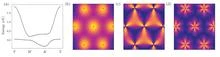
Electronic charge is a tumbleweed that moves camp depending on energy. In tungsten selenide (WSe₂) crystals, this is seen with utmost clarity: at a bias of −1.4 V, near the K point of the Brillouin zone, the maxima of tunneling current sit in the centers of hexagons, where there are no atoms.
In 1979, Su, Schrieffer, and Heeger proposed a model that explained the strange electrical properties of polyacetylene, an organic polymer that conducts electricity almost like a metal. Their chain consisted of carbon atoms connected alternately by single and double bonds.