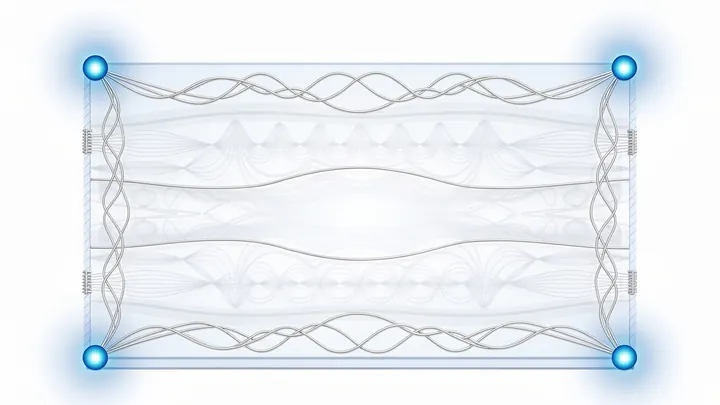
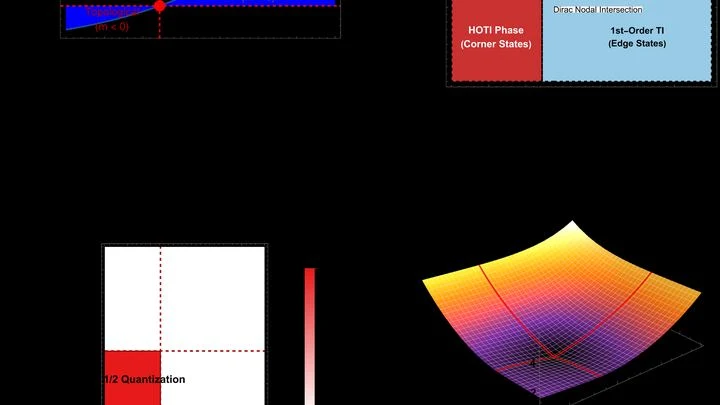
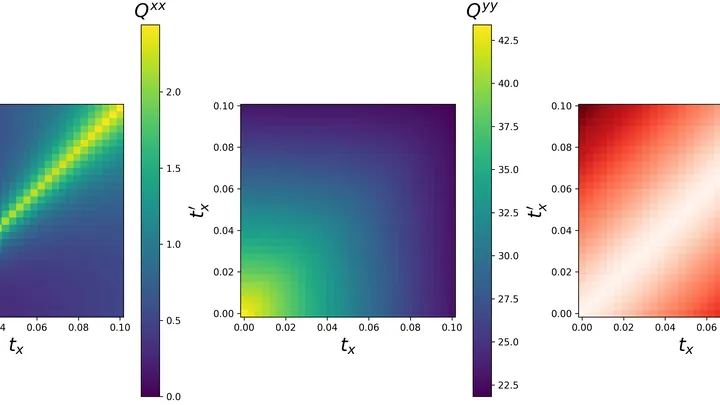
A topological insulator is a material that is a dielectric with a band gap in the bulk but possesses conductingstates on its surface (or edges) protected by topological invariants. The electronic surface states are described by the two-dimensional Dirac equation for massless particles and have a linear dispersion law. The most important property is insensitivity to disorder and impurities as long as time-reversal symmetry (or another protective symmetry) is preserved. Topological protection means that the state cannot be destroyed by small perturbations without closing the bulk band gap.
History
The foundations were laid by work on the quantum Hall effect (1980s), when David Thouless, F. Duncan Haldane, and Michael Kosterlitz used topology to explain the robustness of Hall conductivity. In 2005, Charles Kane and Eugene Mele proposed that graphene, when spin-orbit coupling is considered, could be a two-dimensional topological insulator (quantum spin Hall phase), but the effect in graphene turned out to be negligibly small. In 2006, Bernevig, Hughes, and Zhang predicted the quantum spin Hall effect in HgTe/CdTe quantum wells. Experimentally, a two-dimensional topological insulator was realized by Laurens Molenkamp's group in 2007. Almost simultaneously (2008-2009), three-dimensional topological insulators — tetradymites (Bi₂Se₃, Bi₂Te₃) — with surface Dirac fermions were discovered.
How it works
A topological insulator forms due to band inversion driven by strong spin-orbit coupling. The bulk Hamiltonian can be described in the k·p approximation, and under certain parameters, a condition for a nonzero Z₂ invariant arises. Surface states are solutions of the two-dimensional Dirac equation H = v_F (σ_x p_x + σ_y p_y), where v_F is the Fermi velocity. Owing to spin polarization and chirality (spin direction is rigidly tied to momentum), backscattering is suppressed, and conductivity is quantized. Topological protection is destroyed only by perturbations capable of closing the bulk band gap, such as a strong magnetic field or breaking of time-reversal symmetry.
In practice
Topological insulators could become the basis for ultra-fast and noise-resistant quantum computers, and are also used in thermoelectric converters.
Fun fact
If a layer of superconductor is deposited on a topological insulator, special particles — Majorana fermions, which are their own antiparticles — can emerge at the interface. Their existence was predicted by Italian physicist Ettore Majorana in 1937.
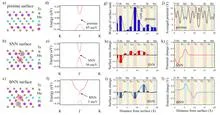
The surface of a crystal is like a stage where quantum effects are meant to perform. In MnBi2Te4, a magnetic topological insulator, special electronic states are expected to run along the surface, and the magnetic order opens an energy gap in them: a forbidden zone that makes transport quantized.
A sheet of paper tears where tension exceeds strength. Epithelium, the cell sheet lining our organs, behaves similarly, but until recently models could not show how tears appear in it. The classical vertex model describes tissue as a network of polygons tightly packed together and forbids cells from detaching.
A weaver sits at her loom, her hands moving in a rhythm that cannot be predicted in advance. The threads converge and diverge, forming a pattern that seems random yet follows strict rules.
An ultrathin film of tellurium, tantalum, and iridium atoms behaves as an insulator in its interior but conducts current along its edges. This property, the quantum spin Hall effect, promises lossless electronics. However, calculations of the electronic structure did not predict such a phase for the 1T-TaIrTe₄ monolayer.
An ultrathin film of tellurium, tantalum, and iridium atoms behaves as an insulator in its interior but conducts current along its edges. This property, the quantum spin Hall effect, promises lossless electronics. However, calculations of the electronic structure did not predict such a phase for the 1T-TaIrTe₄ monolayer.
A fusion reactor is like a super-hot furnace where plasma reaches millions of degrees. The walls are made of tungsten, the most refractory metal there is. But even tungsten needs protection: fast particles from the plasma bombard the surface and knock atoms loose. These ejected atoms enter the plasma and cool it down, like a spoonful of cold milk in hot tea.
The quantum world is often compared to a musical instrument. Electronic bands in a crystal are like strings, each with its own pitch. Usually, if the strings are tuned simply, without tricky interlacing, then the sound produced by their combined motion remains simple.
A highway where opposing flows are separated not just onto different sides, but onto two independent roads: each with its own entrance and exit. Something similar happens to electrons in a new type of topological insulator described by the authors of the study.
The quantum world is often compared to a musical instrument. Electronic bands in a crystal are like strings, each with its own pitch. Usually, if the strings are tuned simply, without tricky interlacing, then the sound produced by their combined motion remains simple.
A highway where opposing flows are separated not just onto different sides, but onto two independent roads: each with its own entrance and exit. Something similar happens to electrons in a new type of topological insulator described by the authors of the study.
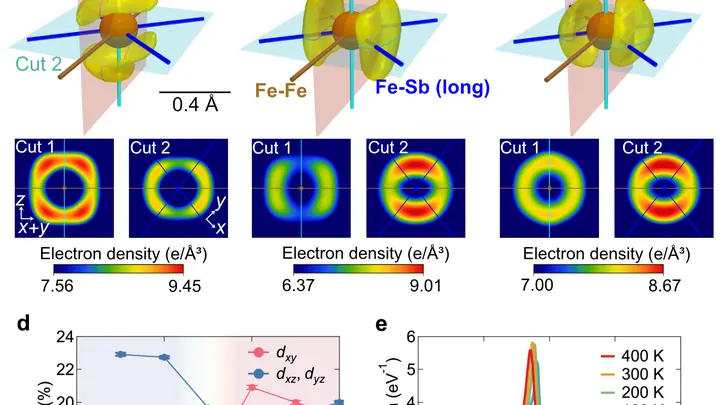
A house with cork walls suddenly gets covered in copper sheets, but only when frost sets in. That's roughly how FeSb₂ behaves when made into a film just a few atomic layers thick. Under normal conditions, it's a narrow-gap insulator: electrons sit tightly in place like spectators in an overcrowded hall.
A house with cork walls suddenly gets covered in copper sheets, but only when frost sets in. That's roughly how FeSb₂ behaves when made into a film just a few atomic layers thick. Under normal conditions, it's a narrow-gap insulator: electrons sit tightly in place like spectators in an overcrowded hall.
In the world of crystals, there is a hidden geometry. When an electron runs through a two-dimensional insulator, its path is twisted by an invisible force — topology. This twist is described by the Chern number, an integer that cannot be changed by smooth deformation.
Take two thin sheets of a semiconductor. One is saturated with free electrons, like a packed café where every table is taken. The other, by contrast, is full of empty spots—'holes' eager to be filled. When these sheets are brought close together, a spark of attraction jumps between them: electrons and holes begin to feel each other across the thin gap.
A superconductor is like a perfect wire — current flows through it with zero loss. The catch is that you have to cool it way down. Physicists have long hunted for materials that superconduct at more practical temperatures. One approach: don't wait for nature to oblige — build your own material, layer by layer, like a Lego set.
Hidden within thin layers of tantalum selenide (TaSe₂) is a property that defies conventional physics. When guest atoms were added between the layers of this material, the structure lost its center of symmetry, and inside, superconductivity with armor emerged.
Hidden within thin layers of tantalum selenide (TaSe₂) is a property that defies conventional physics. When guest atoms were added between the layers of this material, the structure lost its center of symmetry, and inside, superconductivity with armor emerged.
A sheet of paper with magnetic properties: that's roughly what the new material 1T-CrS₂ is like. Its layers are held together by weak forces, like the pages of a notebook, but each layer is a true magnet.
In a crystal, electrons are not distributed randomly. Their waves obey the lattice symmetry, like ripples on water taking the shape of a hoop thrown into it. The new work shows that at high-symmetry points, this ripple must have nodes — places where electron density is strictly zero.
Bending a sheet of paper is easy. But compressing it by pushing from the edge is a different story: the paper will crumple but barely transmit the force further. That's how ordinary elasticity works — deformation depends on where and how you press. The new three-dimensional lattice pushes this contrast to the limit.
A honeycomb made not of wax but of atoms is graphene — a flat crystal just one atom thick. Electrons in it are like runners at an intersection: they speed up here, slow down there, but never get stuck at the edge. Physicists call such a sheet "topologically trivial," meaning its edges are perfectly ordinary, with no special properties.
Now, let's knock out a single atom from the honeycomb.
Two sheets of tungsten diselenide (not carbon, but a compound of tungsten and selenium) are rotated relative to each other by a tiny angle, about 5 degrees. This creates a moiré pattern: an enlarged periodic lattice where electrons behave very differently than in a regular crystal.
The book is open to the middle. Current runs along the spine, while the pages remain cool. That's roughly how a two-dimensional topological insulator works — a material where electricity flows only along the edges, while the interior stays still.
Building a quantum computer capable of solving problems beyond classical machines requires reliable qubits. One of the most elegant ideas is to use Majorana zero modes as qubits: ghostly excitations that remember their entangled paths and aren't thrown off by thermal noise.
Some crystals behave like a switch: nudge the temperature or pressure, and they turn from a conductor into an insulator. This is called a metal–insulator transition (a change in the ability to conduct electricity).
Some materials are internally like a Möbius strip: their electronic states are twisted in a special way. Such topological properties are usually manipulated with a powerful magnetic field, as if trying to flatten the strip with a sledgehammer. A group of researchers has found a more delicate tool.
The thinner the ferroelectric film, the stronger the depolarizing field — a dictate of classical physics. Imagine a pencil balancing on a fingertip: the shorter it is, the harder to keep it upright. Nanoscale polarization likewise strives to vanish.
A sheet of rubber is squeezed from two sides. At first glance, it's just deformation. But inside, deep within the material, a hidden order awakens. This is not just wrinkles on the surface. It's the birth of special zones where vibrations become trapped, as if in a cage.
Previously, it was thought that such effects require intricate lattices and periodic structures.
Imagine a multilayered shell where metal and insulator layers alternate like pages in a book. Such a structure can make an object hidden inside invisible to an observer. Light bends around it as water smoothly flows around a smooth stone: no ripple, no splash — no reflection, no shadow.
A sheet of paper with square grid, one with diamond grid, and one with honeycomb — three different universes for an ant. Change the sheet, and the rules of movement change. That's roughly how electrons experience the crystal lattice: geometry dictates whether they become little magnets, superconductors, or something else. In ordinary materials, the lattice is as rigid as if engraved.
In a long corridor, a crowd of people tries to keep as far apart as possible. In a spacious hall, they would simply spread out, but here the walls squeeze them so tightly that they have to move single file, coordinating every step. Electrons in graphene layers twisted by a tiny angle behave in a similar way.
A neat stack of atomic layers lies on a substrate. An invisible beam of terahertz light shines down on it, with a magnetic field applied from the side. After reflection, the beam's polarization rotates slightly.
Inflation is the ultra-fast expansion of the universe in its first moments. It was driven by a field resembling a ball rolling down a hill. But there could have been a second, almost imperceptible ball nearby. The authors of this work considered exactly that scenario: a light spectator field (the axion), frozen at the top of its potential.
Light from an ordinary bulb seems utterly chaotic: its waves oscillate out of sync, like a crowd where everyone walks in their own direction. Such light is called incoherent. For a long time, it was believed that elegant topological structures (knots, rings, links) could only be created in coherent laser light, where all waves march in step.
A long, narrow pan, and a thin pancake sets in uneven stripes. For decades, scientists saw a similar picture when modeling the behavior of electrons in superconductors — materials that conduct electricity without loss. They used elongated "cylinders," and the result was always the same: rigid magnetic "stripes" that were thought to hinder superconductivity.
A tellurium crystal resembles a tiny spiral staircase: its atoms are twisted into a helix. When heat runs through such a crystal, it is carried not by electrons but by sound waves — vibrations of the lattice itself. These waves don't just push back and forth; they also rotate around their axis like a spinning top.
Heat a nail in a fire, and it will lengthen — everyone knows that. But heat only the tip and leave the other end cold, and the nail doesn't just get longer: it bends, because hot metal expands more than cold metal. It's this very bending, but at the atomic level, that physicists have turned into electricity.
Two thin layers of a semiconductor were twisted relative to each other by 2.29 degrees, like two sheets of transparent paper with printed grids. Where the lines nearly align, a large pattern of dark and bright spots emerges. Electrons in this pattern behave very differently from those in a regular crystal.
A bridge made of two rows of planks bends under the feet of pedestrians, and each step gets a boost from the elastic motion of the deck. A similar principle underlies superconductivity: electrons glide without resistance because the atomic lattice itself adapts to them. In nickel-based materials, this picture has long been elusive.
A crystal is like a row of soldiers on a parade ground: every atom is in its place, and electrons march through it in neat waves. An amorphous material is like a crowd at a train station, where there is no order, just a jostling throng. In such a crowd, an electron usually gets stuck quickly, like a person trying to push through a dense mass of people.