How Leaks Make Light Dance ✛
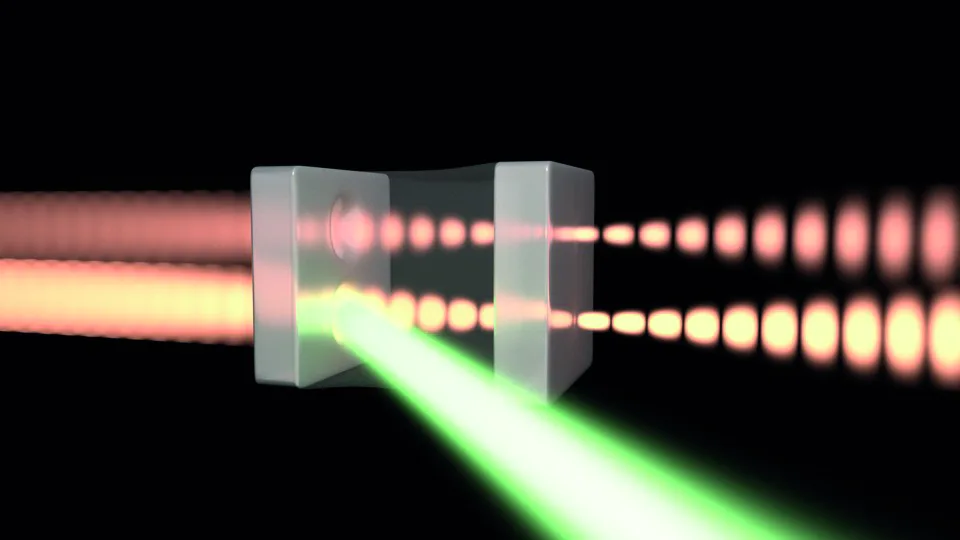
Two connected vessels joined by a tube usually settle at the same water level. But if each vessel has a hole, and the holes are different, the level starts to oscillate on its own. The same happens with light in two dimples of a micromirror: photons flow from one dimple to the other, but they leak at different rates. These losses don't damp the motion; they set its rhythm.
Previously, it was believed that such self-sustaining oscillations require special amplification. Here, however, they were generated by the leaks themselves, which are usually considered the enemy of order. The scientists varied the pump and the cutoff wavelength and built a map showing where light freezes and where it dances. This is fundamental knowledge with no applications yet, but it could prove useful for brain-like computing devices.
The limit cycles in this system oscillate 11 times slower than photons tunnel between the wells. That is like two communicating vessels exchanging water within seconds while their levels oscillate with a period of minutes.
The idea of controlled dissipation as a constructor of order echoes Stanislaw Lem's novel 'Solaris', where the ocean organizes complex structures from chaos on its own. Here, light in a microcavity, losing energy, does not die but spins into a stable dance.