Semiconductorlight interaction refers to the various ways light and semiconductors affect each other, particularly the generation and dynamics of charge carriers (electrons and holes) when photons are absorbed. This interaction is fundamental to many optoelectronic devices, but it also reveals subtle material properties. For instance, light can excite carriers that then recombine, emitting light or heat, and the details of these processes can indicate the presence of defects or impurities without the need for chemical doping.
History
The photoelectric effect in semiconductors was first explained by Albert Einstein in 1905, but the modern understanding of carrier dynamics emerged with the development of semiconductor physics in the mid-20th century, particularly through the work of William Shockley and others at Bell Labs.
How it works
When a photon with energy greater than the semiconductor's band gap strikes the material, it can be absorbed, promoting an electron from the valence band to the conduction band, leaving behind a hole. These photo-generated carriers can move, recombine, or be trapped by defects. The dynamics — such as carrier lifetime, diffusion length, and recombination pathways — are sensitive to the material's quality and can be probed using techniques like time-resolved photoluminescence or transient absorption spectroscopy. These measurements reveal how light interacts with the semiconductor's electronic structure, including the role of dark states (non-emissiveexcited states) and charge-transfer states.
In practice
This interaction is exploited in solar cells, photodetectors, and LEDs, and it is also used in non-destructive testing of semiconductor wafers to identify defects that could impair device performance.
Fun fact
In some semiconductors, light can be 'slowed down' to speeds of just a few meters per second by creating special quantum states, a phenomenon used in optical delay lines and quantum memory.
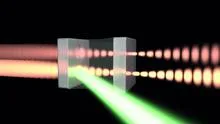
Two connected vessels joined by a tube usually settle at the same water level. Here, the vessels start rocking on their own because each has a leak, and the leaks are different. Light in two dimples of a micromirror behaves the same way: photons flow from one well to the other, but they are lost at different rates. These losses do not damp the motion; they set its rhythm.
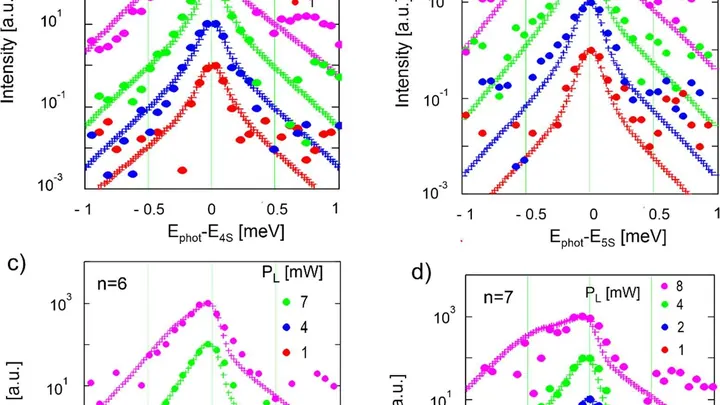
A copper oxide crystal looks like a dark red pebble. But when a short laser pulse hits it, pairs are born inside: an electron and a 'hole'—a place where an electron is missing. Such a pair is called an exciton and behaves almost like a hydrogen atom: the particles circle each other, bound by electric attraction.
At nine in the morning, the DarkSide-50 detector, 1400 meters beneath Gran Sasso, records a weak ionization pulse. By eleven at night, the frequency of such events drops noticeably. This is not an electronics glitch or a seasonal background variation.
In a boron nitride crystal, the perfect atomic lattice is sometimes disrupted: an atom is missing here, or replaced by a foreign one there. Under a powerful microscope, these tiny imperfections appear as traps for electrons: they capture particles and start to emit light, and they also respond to magnetic fields.
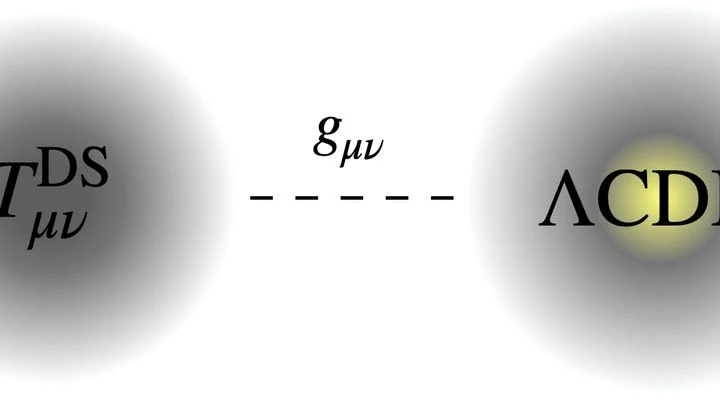
A pond with ripples spreading from a fallen stone. So it is on cosmic scales: a sudden burst of energy in the dark sector, an invisible substance that emits no light, creates ripples in the fabric of space. These ripples alter the path of light particles traveling to us from the very birth of the cosmos.
The authors of the new study built a mathematical framework to describe these distortions.
An ordinary light sensor answers the question "how much light" but not "where did it come from." To do that, you need lenses, mirrors, or entire arrays. In a new study, researchers propose a sensor that determines the direction of a light beam on its own, without any optics.
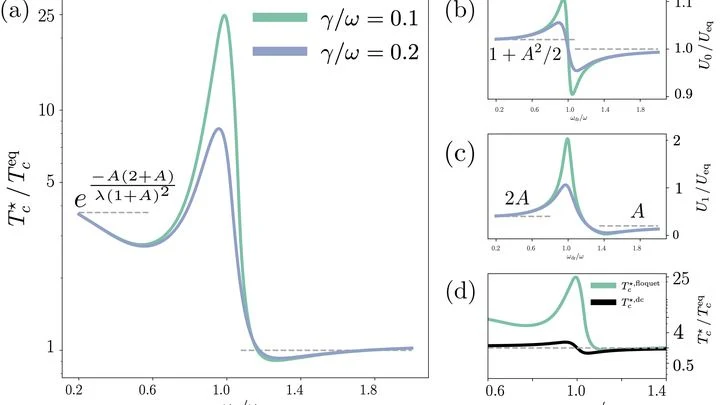
In a dark room, an infrared laser flashes, and a speck of black K3C60 powder conducts electricity without resistance for a split second. The light strikes at 10 terahertz — a thousand times faster than a microwave oven. The effect is a hundred times stronger than at other frequencies. Why this particular frequency?
Two pendulums on a stable table swing independently. If you place them on a shaky surface, vibrations synchronize their motion. The same principle worked on a silicon chip with photons.
Scientists created two sources of light that emit pairs of particles.
A semiconductor diode normally conducts current in only one direction, like a spring-loaded door: it opens easily one way but pushes back the other. But if you dope the crystal heavily, the door starts behaving strangely: under reverse bias, the current doesn't just flow: it shoots up.
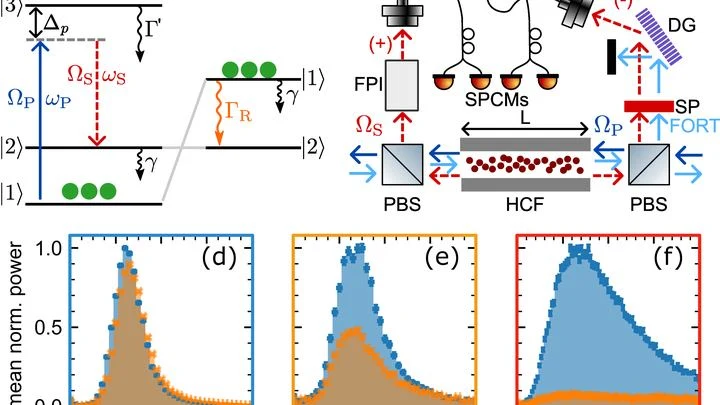
A swarm of fireflies in a night forest flashes randomly: each beetle blinks on its own, and the light scatters equally in all directions. Now imagine the fireflies agreeing to blink so that their combined light goes only north — even though they stay put and none of them turns. That's roughly what physicists did with atoms inside a thin glass tube.
The tip of a scanning tunneling microscope approaches a crystal surface so closely that an electric current jumps between them. Electrons from the needle are injected into a layered semiconductor and land in an atomic vacancy — a spot where one atom is missing from the lattice. This void acts as a tiny trap for charge.
A regular laser is like a choir where everyone sings their own part — the sound is loud, but with inevitable roughness. In the new quantum laser, the singers hear each other and harmonize their voices.
An ordinary superconductor works only in nature's freezer — at temperatures below minus one hundred degrees. The carbon-ball material K₃C₆₀ is no exception: without cold, it resists current like a crowd in a narrow corridor. But physicists noticed something strange: if you shine a laser on it, it starts conducting without loss even in warmth.
A silicon wafer is like cookie dough. Heat it in an oven, and tiny raisins appear inside — defects in the crystal lattice that can emit single photons. These "raisins" are called color centers, and they are needed for quantum computers and secure communication.
A laser pointer shines a neat spot: all its light waves march in step, like soldiers on parade. Such light is called coherent. But nature and technology also feature another kind of light—'messy' light, where waves are out of sync, like a crowd at a market. It's called partially coherent.
Ordinary light is a stream of independent particles: photons fly through each other without noticing their neighbors. But in superconducting circuits cooled to near absolute zero, the situation changes. There, photons travel along narrow metal tracks, and if tiny elements called Josephson junctions are embedded in these tracks, light begins to 'feel' itself.
Inside a large particle accelerator, an invisible shower of gamma rays reigns, like leaving a glass thread under an X-ray machine switched on for years. Ordinary electronics there quickly fail, yet data from the detector still needs to get out. The solution is optical fiber: a thin glass core that carries light.
In a dark room, you might notice a faint blue glow around some radiation sources. This is Cherenkov light: it appears when a charged particle travels through a medium faster than light can propagate in it. The result is a light shock wave, similar to the sonic boom from a supersonic jet, but made of photons.
Dark matter is an invisible substance, five times more abundant in the universe than ordinary matter. Its particles barely touch atoms, but occasionally they can nudge an electron, like a string brushed by the wind.
Two beams of light, red and blue, enter a tiny ring made of silicon nitride. The ring is smaller than the thickness of a human hair. At the input, both beams are equally bright. But inside the ring, one of them suddenly starts to outshine the other, like two equally matched people in a debate where one unexpectedly gains the upper hand.
Particles of dark matter can behave like molasses: in one model they don't interfere with each other; in another, they gently jostle, creating viscosity. This determines how quickly giant black holes at the centers of galaxies fall into each other and merge.